3/8/20

Lauder for Men - Vintage 1980s Gold Cap Formula (Estée Lauder)


Here's one that I've enjoyed for a while, and yet I've neglected to mention it. Released in 1985, Lauder for Men was the American answer to Europe's vaunted Jules (1980) and Kouros (1981). It's perhaps a day late and dollar short to review such a monumental fragrance in 2020, decades after its time, and that far behind society's collective familiarity with it. However, the 1990s and 2000s saw a significant reformulation, and I thought it might be nice to reconsider the "vintage" gold cap formula that signifies the true gold standard of the brand.

Lauder for Men is what every aromatic fougère should be: a rich lavender and citrus accord, buttressed with a tonka note so complex it could be its own perfume. It reminds me of Moustache and Monsieur Rochas Concentrée, two fougères with expansive, natural-smelling coumarin notes that imbue their compositions with soft, grassy, hay-like aromas. Midcentury masculines relied on a careful balance between naturals and synthetics, with lab chemicals extending the silky freshness of citrus past the five minute mark, while also allowing lavender's opalescence into a dusky, oakmoss-extended base. In Lauder's scent a rather expensive burst of animalic honey and Meyer lemon is conjoined with lavender, petitgrain, anise, and juniper, which travel together through a vibrant, mellow, and truly beautiful coumarin. As if the tonka effect weren't enough, Lauder layered a luxurious bouquet of florals across this gorgeous wreath, with noticeable hints of jasmine and carnation wafting through.

As the aromatics settle, they coalesce into a mossy tobacco accord, which smells quite tailored and understated. This doesn't scream "TOBACCO!!!" like Havana does. It quietly radiates, an austere unisex tobacco leaf peeled from the cap of a pricy cigar. For me, Lauder for men conjures images of 18th century aristocrats lounging in a field, their powdered wigs reflecting warm spring sunshine. This is a languid, poised, and very rich composition, and it smells refined and natural, like what a fougère would have been in the 1700s. Perhaps Houbigant could learn a thing or two.

3/1/20

Stetson (Coty)


I reviewed Stetson back in 2013, but it was an awful review. I recently bought a bottle, and decided it was time to do it right. So let's get into this.

Stetson is an oddity. It's a cheap oriental marketed to men, but it smells like an old-fashioned feminine. Its top notes of malted lavender and citrus rapidly burn into waxy, candle-smoked jasmine and powdery woods. Simple pyramid, meritorious execution, efficient, plain, economical packaging. I've noticed that cheap masculines are often packed with notes, but Stetson harkens from a brief moment in perfumery history when companies were pushing budget formulas with compact pyramids, possibly because they realized it was better to render a few notes well, rather than many notes badly. The execs behind frags like Chaps, English Leather, and Stetson embraced this philosophy in the early 1980s, and it paid off.

But the 1980s are long over. How does Stetson work in 2020? Nobody will ever accuse it of being a great fragrance, but the jasmine note at its core is interesting. I love a good floral, and jasmine soliflores are among my favorites. The aldehydic jasmine in Chrome Legend is what shuttled it firmly into the "love" camp for me. Tea Rose Jasmin was another good one, now sadly gone. And that overripe, fruity, ethereal jasmine in Ocean Rain is truly incredible. So an old-school oriental with such an intense white floral note is endearing. Universal themes of cool morning dew (the fruited lavender) and afternoon warmth (leathery woods) create a successful sense of contrast in what would otherwise be flat gas station fare.

A fun thing to do when wearing a thirty-eight year-old fragrance is to envision the world in which it was released. Were young guys wearing Stetson to attract the local Phoebe Cates? Ms. Cates was our national treasure at the time. Disco was dead, The Cars and Tom Petty were on the radio, and Burt Reynolds was in his Charles Bronson Lite phase. But Stetson doesn't really smell like the eighties. It smells like the forties. It's a rip on Chantilly (Houbigant, 1941), and by proxy on Shalimar. So even in 1981, Stetson was an anachronism. Its quality made it a good value, and its marketing erased the potential for stigma. People were clever back then.

I wear Stetson more often than I thought I would. I figured I'd buy it and wear it once a year. I've used it about fifteen times in the past three months. It smells good. It wears beautifully. Its floral note carries solidly through the day, never losing clarity or balance. It's subtle enough to escape coming across as "perfumey." It's good stuff.

I recommend Stetson to any guy who wants a well-made oriental that won't break the bank. There are better orientals out there, but not for the money, and if you enjoy jasmine, few fragrances exploit the note as well as this one. Two thumbs up.


2/22/20

Dakar (Al-Rehab)


It's been a while, so I'm revisiting my Drakkar Noir clones. I ran out of the real stuff a year ago, and never restocked it for reasons that elude me. Yesterday I wore Taxi for the first time in over a year. I'm not sure if it macerated in the bottle, or I just never noticed its strength before, but it's a beast! I got fifteen hours and ridiculous tenacity out of it, and still smell it on the inside of my jacket. It's a lot better than I ever gave it credit for; Drakkar is a smooth, smoky fougere with near-perfect balance and adequate projection, but Taxi is smoother, at least compared to Drakkar's current formula. It's great stuff.

People have been asking me to review Al-Rehab's version of Drakkar Noir for years, and I never got around to it. Called "Dakar" (no relation to the capital of Senegal), their clone is a pale shade of green, and comes in roll-on and EDP spray. I bought the 50ml spray for ten bucks off Amazon, but that isn't the greatest deal. Parfums Belcam sells 75ml of their clone for eight dollars, and it smells surprisingly close to the original. And when I want something similar and at the same price-point as Drakkar Noir, I reach for Francesco Smalto's excellent version. Given how successful these are, I had high hopes for Dakar.

And Dakar did not disappoint! It's an interesting variant of the theme: all drydown. From top to bottom, it smells of an aged (and intensified) Drakkar Noir, conveying its wood-smoky characteristics with near perfect accuracy. The only noticeable changeup is a distinct cumin note, which adds exoticism to the otherwise familiar milieu. Its weakest phase is the top notes, very brief, unfocused, flat, and cheap. Nonetheless, this doesn't detract from the wearing experience. Dakar smells directly on point after two minutes on skin or fabric, and really blooms in its drydown. Vintage, full-throated Drakkar Noir is alive in this fragrance.

If you're into collecting Drakkar clones like I am, I highly recommend giving Dakar a try. After going through a few different versions, I've come to believe that Drakkar Noir is a remarkably easy formula to imitate. I suppose it's a straightforward case of GC analysis, with the understanding that roughly 10% of the main course is dihydromyrcenol. Dakar has a fairly complex ingredients list, with oakmoss included pretty high up the ranks. So yeah, this scent is about 98% identical to vintage Drakkar Noir from the 1980s, and maybe the 90s. It's strong, fresh, and smells like it belongs in a John Hughes or Joe Dante movie.

With that said, if you're someone who just wants a handful of Reagan-era classics, and you don't obsess over fougeres, just get Drakkar Noir. It's like $40 on Amazon, and you can get the 7 oz bottle, which should last you a hundred years. In any case, if you do opt for Dakar, just know that you're getting a powerhouse fern from a bygone era. This is going to raise eyebrows if you wear one spray too many, and even if you don't, you sure as shit won't smell "au courant." To me, that's a major plus!


2/8/20

Old Spice Cologne (Shulton, 1970 - 1973 Vintage)


In the world of "non-luxury perfumes," few have a reputation as gargantuan as 1970s Old Spice. Last year I was fortunate enough to find a bottle of early seventies Old Spice cologne for a great price, and bought it. I wanted a vintage cologne for the bottle more than the scent. As much as I appreciate vintage, I hate the Procter & Gamble bottles (cheap, crappy plastic) more than I love the vintage scent.

I don't even hate the fact that P&G uses plastic. The change in container material isn't a big deal. What pisses me off is the piss poor logo they print on the new stuff. That dumb "patch" with its microscopic ship is an eyesore. I can't understand what the design department at P&G is thinking with that thing. I've ranted about this before, and won't go on about it here, but just wanted to briefly touch on it again. The vintage Shulton milk glass bottles are pretty much the same size, shape, and color as their successors, but are superior in sporting beautiful scarlet script and the iconic grey-blue graphic of the Grand Turk, and at a size I can actually see.

The scent's reputation precedes it, although this is not obvious to casual observers. You have to be a fraghead to understand the extent of cultural murmurings about seventies Old Spice. The decade is known for a plethora of loud and super musky (super "fly") compositions, and the idea is that Old Spice entered a more full-bodied era in the Nixon years, likely following the zeitgeist. The problem in 2020 is that the fragrance is now nearly fifty years old. Orientals are known for having good staying power, and a good formula can likely survive twenty or thirty years with minimal changes. But pushing a half century is, put simply, pushing it.

The fragrance has survived, but only barely. It's wearable, and it still smells good, but its dynamism is nonexistent, and its balance long gone. Instead of the fizzy pop of orange skin, orange flower, ambergris, aldehydes, clove, cinnamon, and nutmeg familiar to me in my now long-gone 1980s vintage (which was only twenty-five years old when last I wore it), the seventies juice emits a super-smooth burst of aldehydes, which last a mere ten seconds or so, followed by an intense bourbon vanilla, very deep and musky, almost as if I've dribbled vanilla extract on my arm, which quickly dries to a powdery skin musk, made extra dusky by hints of cinnamon and clove.

Where the vintage excels is in its depth. Procter & Gamble managed to make their reformulation shimmery and pert, especially in freezing cold winter conditions, but it rarely gives an impression of durability. Shulton's formula achieves an odd trick; once applied, the wearer is treated to something that seems to radiate five or six inches from skin, without actually smelling like much up close. Although it pretends to disappear ten minutes after application, I often get a whiff of powdery vanilla five or six hours after application, and in a way that seems to drift through the air. This kinetic effect is remarkable for being both softly tenacious and engaging. It's essentially a rich vanilla base that doesn't smell cheap because it doesn't smell like a cologne.

How the chemists for Shulton developed this kind of oriental base is beyond me. I suspect there's real vanilla extract in there. But the powder, talc-like and quintessentially barbershop in nature, lends this simple note an abstract quality that I haven't encountered in recent fragrances. When I wear it, I feel like I'm emitting a vanilla essence from my sweat. The vague dusting of spice lends it animalism, but its sweet song is crystal clear, unembellished by chemical harmonies, a direct example of masculinity as melody. I wish the spices had held up more, and can't detect the ambergris that I know Shulton used, but I like it. It's really good stuff.

I also bought a bottle of 1970s vintage aftershave, but I got rid of the juice. It was probably fine, and I was probably just imagining danger, but something about using fifty year-old aftershave didn't appeal to me, and there was a touch of rancidity in the oils that sealed its fate. I refilled the bottle with current aftershave, and that works fine. The aftershave bottle dates between 1973 and 1980. I imagine it's from the late seventies, judging by the condition of the bottle.

If you enjoy Old Spice as much as I do, getting a vintage bottle is still a viable option, especially if you just want the bottle. But if looks don't bother you, the new stuff is still very good and worthy of use. Just don't make me look at that shitty packaging. I would give my left leg to take control of the package design department at P&G so I could dial the clock back to a more comfortable and less cost-efficient date! But with that said, I'd probably struggle to keep my job.


2/1/20

Why I Went Back to Vintage Old Spice (And Gave Up On Wearing Everything Else)


When I started my fragrance journey back in 2008, I was in possession of 1980s vintage Old Spice aftershave and cologne, made by Shulton, but had not yet acquired an appreciation for them, and sold both bottles on eBay for about twenty-five dollars. I've regretted it ever since.

Recently I repurchased vintage Old Spice, this time from the 1970s, and I haven't looked back. In the intervening years, I've explored every nook and cranny of the fragrance world, and it's been quite an interesting trip. My collection is roughly one hundred bottles (maybe closer to eighty-five "proper" fragrances), and most of them are fragrances I truly enjoy, or else I would never have kept them. One thing has bothered me though: it gets complicated when you own this many EDTs. All sorts of factors are considered. Is it too cold outside for this fragrance? Too hot? Is it the wrong occasion to wear this? Is this too loud? Is this too feminine? Am I sending the wrong message if I wear this to a cookout? At times the scale of choice, the sheer immensity of variety begins to feel like a hindrance rather than an advantage, and I've been keenly aware of how often that feeling occurs, and how pervasive it has become.

I've been a member of Badger & Blade for ten years, and the wetshaver community has many overlaps with the mainstream "fragcomm." Wetshavers are into colognes and aftershaves and eau de toilettes, but naturally the primary focus is shaving. A good shave requires all sorts of extraneous skin care, and the average diligent wetshaver, even a minimalist like me, has at least a half dozen products that work in tandem to keep shorn skin healthy and glowing. Witch hazel, balms, talcs, various kinds of alcohols and alcohol-based aftershaves, all are useful tools in the pursuit of the perfect shave. But even in this community, variety has taken over. Obama's second term saw the rise of "small batch" aftershave companies, an industry not unlike that of craft beer. Suddenly there are tons of inexpensive glass bottles with home-printed labels carrying liquids called "4:20," and "Red Hot Jeeper-Creeper," and all sorts of zany names, and when I dipped back into B&B a few months ago, I hardly recognized the landscape.

The fragrance industry as a whole has exploded to a size where Big Bang analogies are apt. I’ve watched Youtubers with collections that suggest a mall kiosk swallowed their homes. Some of these guys have around $100K worth of fragrance, all carefully organized on custom shelves, all averaging $250 a bottle. If thieves broke in with grocery carts and loaded up, they'd take a loss big enough to equal the cost of the newest Corvette. Even my collection, modest as it is, has a few valuable oldies that I could probably make a grand on. I can't even imagine what it must be like to have the entire Tom Ford range stacked under the entire Creed range, under the entire Guerlain range, and on, and on. How does a guy with that kind of collection get a chance to stop and actually enjoy any of it?

I began noticing something about myself. I would watch a Charles Bronson movie, or a Steve McQueen movie, or any pre-1980s movie, with the sort of testosterone-laden, ultra-masculine star that Hollywood is no longer allowed to cultivate, and I'd find myself thinking, "That guy wasn't obsessed with cologne. That guy was an Old Spice guy." Sure, Bronson danced around in those Mandom commercials from Japan, but in real life he probably used whatever drugstore cheapie was available, and didn't give it a second thought. He was more interested in spending his millions on cars and women.

These men depicted characters that were simple and direct. They perform heroic feats that defy imagination. They bed gorgeous women without a glimmer of self doubt. They aren't real life. But they were templates of the ideal that men once admired. Today they're victims of cancel culture, the toxic zeitgeist of perceived misogyny, symbols of the "patriarchy," and probably considered bigots and racists by humorless, self-hating upper middle-class white people. Bronson, McQueen, Lee Van Cleef, all are lucky they're dead. Last year on WNPR (a public radio network), a black woman said she considers the movie Gone With The Wind a Confederate monument. Clark Gable wouldn't stand a chance with her. But Clark Gable was probably an Old Spice guy. I can't imagine that he would bother with anything stronger, anything more expensive, or anything less American than the Shulton classic.

Then last June I got a promotion at work. The new position has me working in closer quarters with two women who are very olfactorily aware of their surroundings, and I realized that sheer necessity would switch my macro frag world down to something micro. I needed something I really liked, something easy to wear, something cheap enough to bring and leave in the car, and most importantly, something that wouldn't piss anyone off. My position is a sort of "middle management" role, which means people are looking to me for some leadership. It didn't take long to figure out what I needed. The only oriental I ever really liked was Old Spice, and the only drugstore frag that doesn't smell "cheap" is vintage Old Spice. So I hopped on eBay and found what I needed, an aftershave that dates between 1973 and 1980, and a cologne that predates 1973. I wasn't buying vintage for their contents, however.

As much as I appreciate the vanilla smoothness of vintage Old Spice, I think the current formula is actually quite good. Procter & Gamble did an excellent job maintaining the overall quality and identity of the scent, despite the odds. They royally fucked up the packaging though. It has gotten to the point with those godforsaken plastic bottles, with their godawful "patch" logos, where I couldn't abide them anymore. That P&G thought it necessary to switch to plastic is one thing, but to strip the plastic of the beloved Grand Turk is another level of stupid. So back to the Wheaton-style milk glass, with their beautiful script font, and those glorious ships. If I'm wearing something every day, I want to like the bottle I'm reaching for.

Am I done with fragrance? No. I still enjoy fragrance, I still value variety, and I still see exploring the fragrance world as something worthy of pursuit. I'm not through with fragrance, but I'm through with a "rotation." I'm working on developing a very small wardrobe for regular use. But for the time being, I'm enjoying simplicity. I don't want to be an overly perfumed Millennial jerk anymore. I don't want to smell like a fourteen year-old girl, or spend four hundred dollars just to piss off a woman fifteen feet away. I want to smell like a man. I want to smell like a man from the past. And I want to smell discreet. In this day and age, discretion is key to my survival, and also the key to my success. With Old Spice, discretion is handled very, very well. Thank goodness for small favors.


1/18/20

L'Homme Ideal Cologne (Guerlain)


Nothing says "buy me" like a panicked man fleeing a hundred bridezillas.

I can't remember the last time I had such mixed feelings about a fragrance.

I recall reading Perfumes: The Guide for the first time in 2009, and thinking that its authors' credibility was shot because they found Guerlain, at least generally speaking, to be pretty amazing, and Creed to be mostly crap. In my years of exploring fragrance, I've yet to fully get on board the Guerlain hype train.

My problem with the brand is that it issues great fragrances made of subpar materials. Their Vetiver smells good, but its top notes are chemical enough to draw comparisons to bug spray. Shalimar is nice, but boring. It smells like high quality citrus blended with mediocre vanilla and an even more mediocre musk. Mitsouko is impressive mostly in how it handles oakmoss. I can't say I was ever blown away by the supposed "peach" that I've yet to find in its abstract (and ancient) composition. Habit Rouge is a decent powdery dandy fragrance, but isn't worth fifty dollars when Pinaud Clubman achieves the same effect for seven. I've only put my nose on two or three in the Aqua Allegoria line, but those I've smelled were good, competently made, and instantly forgettable. What's the deal with them? And why so many?

The L'Homme Ideal line has people abuzz about how "fresh" its frags are. Lately there's complaints about Guerlain's discontinuation of L'Homme Ideal Cologne. Majority sentiment declares it an excellent summer fragrance, with an unusual and memorable accord of grapefruit and "almond" that will be sorely missed a couple of years from now when bottle supplies dry up.

I'll preface my opinion by stating that one should be wary of buying into company-issued note pyramids. While Guerlain might say there's "almond" in this fragrance, I smell none at all. Of course, the fact that almond is in the pyramid is enough to make dozens of reviewers on both basenotes and fragrantica remark on how good the almond note is. Why Guerlain felt the need to relabel the massive vetiver in this fragrance is beyond me.

Vetiver can possess a dry, nutty quality, and it can lend a composition an austere earthiness when used well. That element is very much at the heart of this "cologne" (really an EDT). It is preceded by a burst of synthetic pink pepper and citrus, mostly grapefruit, and while it smells overtly fake, it nonetheless smells very, very good.

The citrus and pepper accord smells so good that I'm tempted to say it's the best use of these notes I've encountered in years, except there's a niggling feeling about the grapefruit I just can't shake. And then - a lightbulb flickers - I've smelled this note elsewhere: this is the same grapefruit found in Bleu de Chanel, only at a much higher volume. Thierry Wasser's orchestration of intense citrus in these modern Guerlains is here made possible by tying it to terpenic notes that whisper through the fruity fizz and tug its longevity into the unreal after hours of the day -- I get fifteen hours out of this grapefruit note, which is only possible if the perfumer disguised pine and called it grapefruit. This realization made me smell L'Homme Ideal Cologne as a mini Bleu with more grapefruit on top, with perhaps the ghost of Pino Silvestre under its designer sheets, and quite a bit of vetiver in the base. When you think of L'Homme as its own fragrance, it seems generic and affable enough. But when you consider it the offspring of Bleu de Chanel, pangs for Bleu overshadow the experience. If I'm gonna go nightclub playa, I'd rather reach for the Chanel.

That said, it's still a pretty good scent. Yes, the ingredients are disappointing as usual, and yes the composition isn't as original as it could be, especially with citrus playing a central role, but it still works. The blend is smooth, gentle, soft. The balance is pitch-perfect, with the ghost of sulfur following the citrus fizz to remind me of real grapefruit, and the sweetness of pink pepper providing piquant contrast. The vetiver is shaded into the background with detail rarely experienced in mainstream perfumery. The freshness lasts an epic eternity, no small feat. And the overall effect is simple, clean, and inviting, a laundered white T-shirt in a spring morning breeze.

Fragrances like L'Homme Ideal Cologne are made for flirting. In 2020, that's the truth. Once upon a time they were made to denote hygiene, to complement a "type," but these days they're made for dates, for intimate gatherings, for getting closer to someone of interest. Women have been exposed to a multitude of masculine clichés over the decades, and at this point their collective opinion is firm. Clean smells are the winners.

So while guys like Luca Turin bemoan the "fresh" culture, guys who want to get laid wear stuff like this because it works. But is a fragrance that is guaranteed to attract women merely a functional tool for the proletariat? Are the reasons for preferring stuff like Lapidus Pour Homme and Giorgio for Men automatically contrarian? Is it bad that this fragrance bores me? Is it even worse that it seemed to find favor with a beautiful woman that I met in passing the other day?

Guerlain really aggravates me.


1/1/20

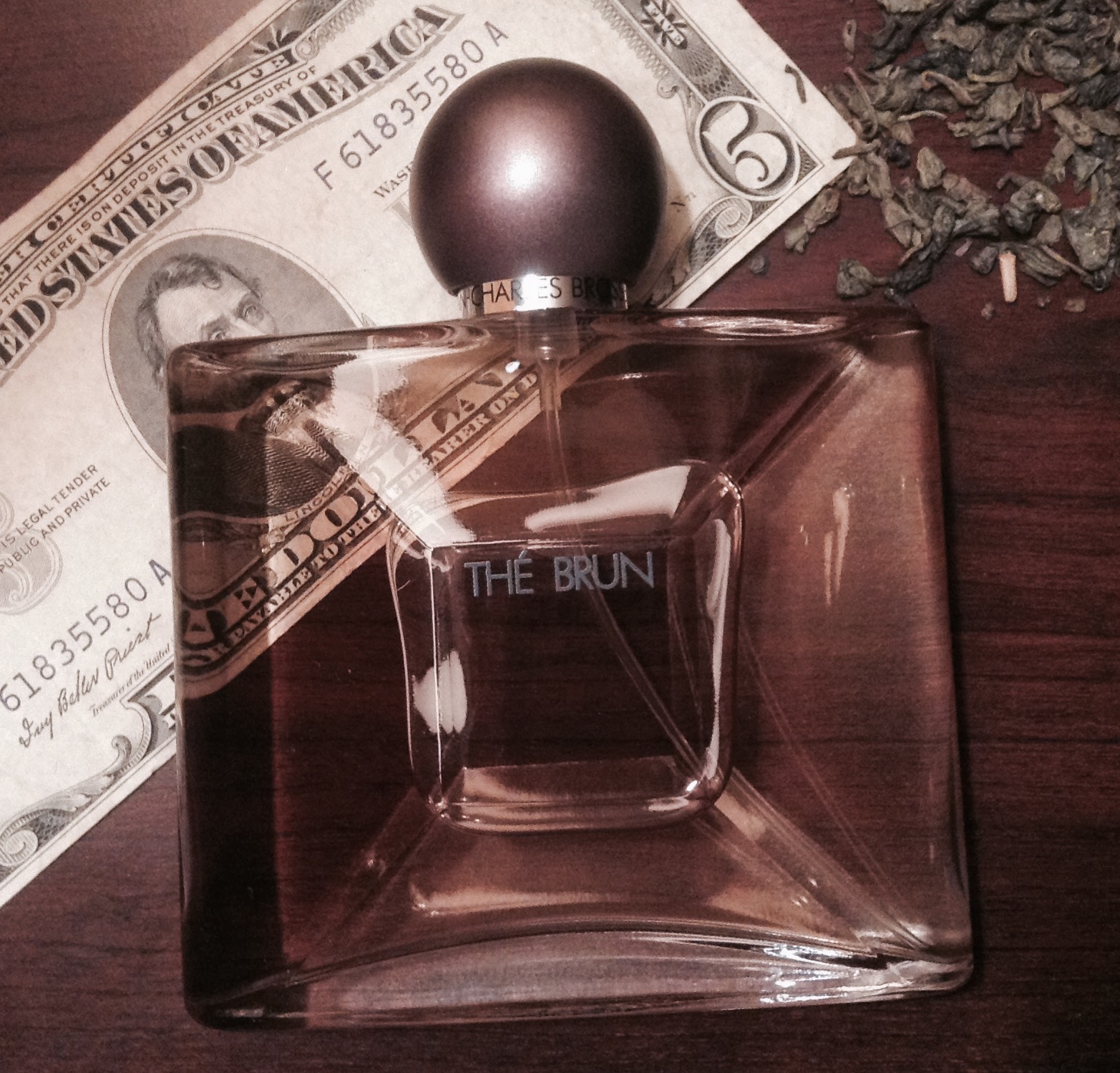
Thé Brun (Jean-Charles Brosseau)


In 2005, Pierre Bourdon created this now-forgotten tea fragrance for the somewhat obscure firm of Jean-Charles Brosseau. Thé Brun is an oddity, a Bourdon creation that flew under the radar, and never landed. It has attracted a bit of attention in the past few years via basenotes threads such as this one, with speculation that Bourdon is the nose behind Creed's Aventus, and that he "tested" the Aventus concept five years earlier in JC Brosseau's scent.

To my nose, no such "test" occurred. Thé Brun's note pyramid lists pineapple, but I get none from any stage of the fragrance. If the idea is that Bourdon rehearsed Aventus' "smoky" accord in Brosseau's frag, then it was by accident, because the smokiness in Thé Brun smells like an extension of its sweet, milk-and-sugar black tea drydown. The scent evolution is as follows: a trite fougere top note of cheap and unnecessary lavender, rapidly followed by a cloud of campfire smoke, which coalesces into a bitter, somewhat smoky Lapsang souchong note.

In Aventus the smokiness is papery, birch-like, reminiscent of American bills, and it lasts forever. Here, the smoke communicates a specific kind of aromatic Chinese tea, and is more complex. The Lapsang trails off after an hour, leaving a hyper-realistic British Colony mug tea in its wake. It smells like cheap English Afternoon tea, a commonplace beverage you might sip on your lunch break. It is recognizable, mellow, and pleasant when used judicously.

What does Thé Brun signify to the culture? Newsflash: Bourdon was obviously making charming niche scents for down-market brands while also allegedly creating upscale niche for Creed and Frederic Malle. He may have authored Aventus, but I wouldn't point to this frag as proof of that. There's no tea in Aventus. Thé Brun, on the other hand, is 100% about tea. When I sniff its atomizer, it smells like a cup of Twinnings. Truth in advertising! By the way, its minimalist gem-cut bottle is a nice touch.

12/11/19

A Few Words For Dan Mish


I discovered Dan "Mickers" Mish's channel in late 2011 or early 2012, very early in my fragrance journey, and he was one of the first reviewers I watched. With his infectious positivity and memorable chuckle, Dan always came across as a genuinely good person, with a great sense of humor, and nary a mean hair on his head. He was always entertaining to watch, and his channel became a sort of "institution" on YouTube. In short, he was one of the good guys that kept fans coming back.

I appreciated Dan's love of Creed's Green Irish Tweed as the mark of a man with good taste. Dan was more than just a snappy personality; he had a good nose. Near the end, Dan pointed out that he got a sort of "evergreen" note (I'm paraphrasing) out of Old Spice. At first I didn't understand what he meant, but after revisiting the current formula, his impression "clicked" with mine, and one of the woodier spice notes, maybe the clove, struck me, for the first time ever, as "piney." The ability to notice and recognize subtle notes is what the better noses do by nature, and Dan did it daily.

It saddened me to learn of Dan's passing, particularly because he was so young and had a family. He will be missed and remembered fondly as a man who did everything he could to share his love of scent with the world. For that, the world is a better place, and I owe him my thanks. It's safe to say that if I hadn't watched his channel prior to starting my blog, I may never have undertaken the task of writing about fragrances. He was an inspiration and a gift to the community, and I am forever thankful for him.


12/31/18

I'm Still On a Break, But I Had To Talk About The Awesomeness of Barbasol "Canned Goo"


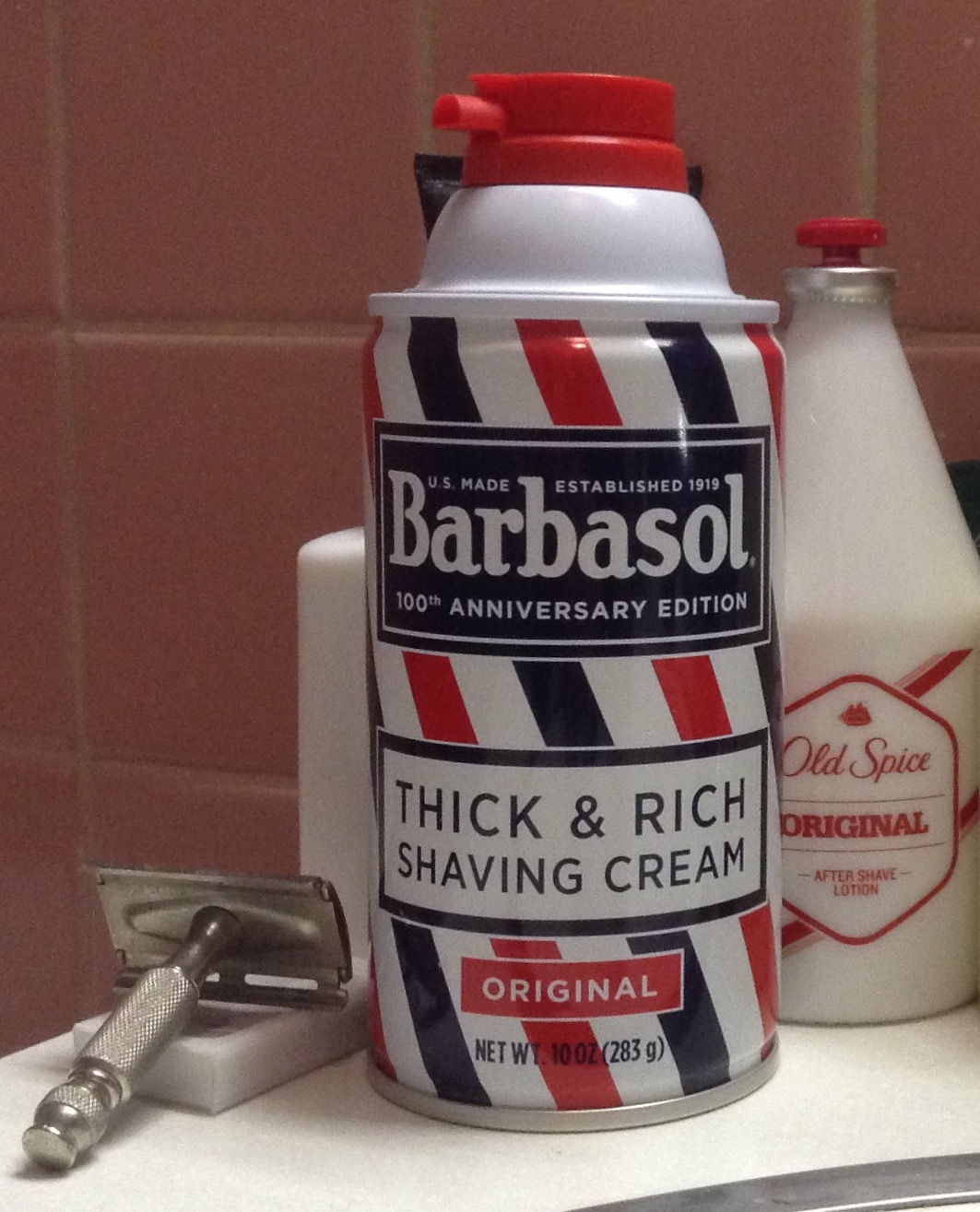
I would be remiss to not mention this, especially at the end of the Year of Barbershop. It came to my attention that Barbasol issued a 100th anniversary can, which is essentially the original graphic design from 1919, a lovely striped barber pole look. It's simple, eye catching, and the retro approach even carries over to the copy on the back, which touts Barbasol's "thick, rich lather."

I love this kind of stuff. Pepsi recently reissued their 1980s graphic design, and that looked awesome, and now Barbasol has successfully appealed to appreciators of retro Americana with their celebratory can. I hope they keep it on shelves at least until June, because I want to stash two or three of these around the house.

I also happened across a can of the mythical "Yellow Barbasol" - the skin conditioner version that was very recently replaced by "Purple Barbasol." If you frequent Badger & Blade, you're familiar with the countless threads about Yellow Barbasol. For some reason Barbasol distributes its color-coded variants unevenly across North America. Everywhere you go, you can find the original "Red" version, and it seems that "Green Barbasol" is also everywhere (that's the aloe infusion, which is my favorite). But nobody can find "Yellow Barbasol," for reasons that have never been clear. Stores don't stock it, and Amazon charges a small fortune for it.

There used to be "Blue Barbasol" with menthol, which if I'm not mistaken was called "Arctic Chill." That was discontinued a few years ago, and I'm sure I used a can or two, but can't remember what it was like. "Blue" has been replaced with "Teal Barbasol," now with both menthol (cool) and caffeine (not cool). I'm not a fan of the new caffeine trend in hair and barber products. Yes, caffeine constricts blood vessels and prevents swelling and irritation, but those of us with caffeine sensitivity are forced to buy Gillette's menthol aftershave, which I believe is decaf. Bummer.

Perhaps the second-rarest Barbasol is "Orange," which is the "Sensitive Skin" formula, full of precious herbs and woods to soothe inflamed cheeks. But I've seen the orange stuff on shelves. I've never seen the yellow label. Until the other day, when I spotted it in an IGA grocery store in a backwoods town in central Connecticut. This stuff was impossible to find when it was still in production, and now it's discontinued, and I find it. Life is weird. Probably shoulda bought three cans.

So what is "Yellow Barbasol" like? It's excellent. This is the formula with Lanolin oil, which is a natural skin conditioner. Yellow smells like a lighter version of the original Barbasol, sort of an Old Spicy scent, but it's not the smell that makes it great. It's the slickness. Let me address the slickness of Barbasol for a moment.

Many forums are inhabited by men who deride Barbasol as being "canned goo," a product they will never allow into their shave den. They turn their noses up at shaving foam, favoring expensive shave soaps instead. I understand their point of view, but I'm not especially interested in spending thirty bucks on a decent puck of shave soap, and then spending forty-five minutes preparing and cleaning my shave mug and badger brush at six in the morning.

Enter Barbasol. Canned foam is fast. Canned foam is easy to use. Canned foam requires zero cleaning. Canned foam works. But there's a trick: you have to mix it with water. Countless posts abound of men complaining that Barbasol lacks slickness, Barbasol is drying, Barbasol clogs razors. Barbasol lacks slickness in its virgin state. You're supposed to use one part Barbasol to two parts water. The result is a stable sheen of fairly slick foam that actually handles a DE razor quite well.

Barbasol has never clogged any of my razors. It rinses quickly and almost too easily. You know what does clog my razor? Cremo clogs it to death, and Cremo is three times the price. Not only did Cremo clog my razor, it also clogged by drain. I had to spend two hours disassembling my bathroom sink and cleaning Cremo gunk out of its pipes. Cremo is crap.

Four years of using Barbasol in that same sink yielded zero clogs, and when I watch it dissolve in water, I'm not surprised. And as for its drying qualities, yes, the original formula does dehydrate skin a bit. I need a moisturizer after shaving with it, especially in the winter. But so what? It's like $1.50 a can. For that kind of money, I don't expect perfection. I expect functionality and convenience. When something works correctly and doesn't cause any serious problems, it's successfully functional and convenient, and therefore worthy of use.

The Yellow Barbasol formula doesn't dry my skin, and I noticed its moisturizing qualities carried on for a few hours after my shave. It's also very easy to use, allowing the razor to glide freely across my face, perhaps a touch better than any of the other colors in the Barbasol line. Is the yellow label worthy of high praise? Should it be sought after as the stuff of legend by wetshavers everywhere? In my opinion, yes. This is good stuff. If you enjoy shaving, you should have a can of this.

I've used other foams. Noxema has a decent canned foam that I have no complaints about. Gillette has good foams, and I think they still make their lemon-lime foam, which is pretty good. But Barbasol has always had the extra old-school cool factor. I'm not a huge fan of their latest logo redesign, but lately most drugstore brands have been sucking in that department, so why should Barbsol be left out? They should make the 1919 anniversary can their regular design, and just change the color of the stripes for each version. I think if they did that, they'd destroy the competition.

Okay, now I'm taking a break. Happy New Year, everyone. See you guys in 2020.


12/8/18

Taking A Break


Ancient Greek perfume bottle

When I started this blog in 2011, my circumstances were very different. I was living at home with my parents, employed part-time, and adrift in a lake of financial insecurities and relationship problems. Fragrance was an escape, and blogging was a useful creative outlet for those days when there was little else to do.

In the subsequent seven years, my life has changed dramatically. I'm now over-employed, working a full time job with an additional stipend attached to its salary, I own a house, my financial outlook has improved significantly, and I've managed to make friends with my ex. But fragrance and fragrance blogging are no longer escapes for me, at least not in the way they were.

I've seen a fair few fragrance blogs die in the last ten years (I've been reading them since 2008), and what always surprises me is the finality of their demises. There was a very good blog called Pere de Pierre that very suddenly died and was cremated altogether - you can't even visit the URL anymore - and it was ended with a post, titled "Perfume is Boring." That's just one example - there were at least ten or fifteen other blogs that met similar fates, often without warning. It's as though their authors just died. One day they're posting something interesting to read, and the next, there's nothing. And that nothing stretches on for days, then weeks, then months, and finally years, and at that point you know the blog is finished.

This will not happen on From Pyrgos. This blog will not die. I will not forget that I am its author, nor will I abandon the URL. I will not delete the blog, or let it be labeled "dead" by anyone who wishes to replace it.

However, I'm entering a stage in life right now where I'm not as interested in shouldering the persistent cost of maintaining the blog. It takes money to buy fragrance, and to keep reviewing new and interesting things, and I'm getting tired of spending that money. I've recently grown interested in saving and diversifying my wealth. I'm looking carefully at investing in the stock market. I'm considering buying some gold coins from the mint. I need to contribute to my 401K. And I'm looking to put together a few stacks of hundreds, maybe save a few grand in cash.

Do I think perfume is boring? Absolutely not. It's always interesting. At some point in the next year, I'll purchase something, and it'll probably be something expensive. When that happens, I'll take note of it as something to write about. But meanwhile, I'm officially taking a year off. I know that doing this will reduce my page views and subscriber count significantly, but that's no longer a concern of mine. Hopefully faithful readers will return in the future. Consider this the last blog post you will read here until 2020, unless something cataclysmic happens in the news (and I hope it never does). I'm signing off for now. Keep smelling awesome.

Bryan

11/24/18

The Razor's Hedge: Why I Play It Safe and Stick With Two Types of Blades (and The One I Prefer)


When it comes to pre and post-shave ablutions, my shave game is flexible to a fault - I have a dozen aftershaves and several soaps I use on a regular basis to "condition" my skin for optimal shaving. The key to wet shaving isn't to have the best "technique," or the most expensive and exotic gear. It's actually about familiarity, and keying in on what you know.

I often wonder at the dudes who make videos about their "first time" using a straight razor, or any razor. I also shake my head at the ones with collections of fifty razors and two or three dozen different blades. I get the enthusiasm, I totally understand the "collector's mentality," and it's no mystery that wet shaving is an addictive practice. After doing it for ten years, I can never see a return to an electric razor. There's just no way it's ever happening.

In my experience with wetshaving, choosing a razor from a customized, velvet-lined drawer, and fumbling through a mound of razor packets isn't how I want to "mix it up," and lend variety to the morning. Aftershaves are safe for that, but razors? Not so much. With blades, getting adventurous ends in pizza face. I see no reason to have a razor collection, or to get gung-ho over a "shave den" stacked with paraphernalia. But then again, I learned to wet shave with Feather DE blades in a Feather razor. My only paraphernalia were band aids and tissue paper.

Trust me on this: there's nothing harder to use than a Feather DE, even one with a closed comb. It can slice through a gourd like hot butter, and mine had a stunted top, with way more blade exposed than your average three piece DE. Ten months into a regular routine, and I was still skewering my cheeks, but you know what? I learned. When I switched to Gillette and Astra blades, it was like going from Chess to Checkers. Suddenly the focus on precision shifted to a focus on handling, on wrist action, on easy angles, and as my fear of slicing flesh diminished, my eagerness to practice various strokes increased. I developed a sense of pressure sensitivity and grain patterns, with every knick and slit aiding the process of mapping out my face and neck. Now all I had to do was accelerate the process and become more efficient with my time.

I probably struggled through a dozen different blades before my Feather razor broke (shoddy craftsmanship, surprisingly), which forced me to seek out something similar, but better. Enter my trusty 1960s vintage Gillette Travel Tech, a notoriously easy daily shaver with a very simple three piece, closed comb design, and much better unibody molding that will likely last me the rest of my life. With that razor, it suddenly got much easier to settle into a blade. For a couple of years I used Derby Extras exclusively, and though I was aware of their crappy reputation, I wasn't dissatisfied with their performance. They're Turkish blades, known for being a bit duller than average, and even perhaps a bit of an underperformer in the closeness department. But for my three or four-day stubble, they work fine.

Occasionally I'll notice with Derbys that my skin gets a bit chaffed. Not sliced, not knicked, but chaffed, like someone rubbed sandpaper across my cheeks. This is a result of their dullness. Duller blades are a trade-off, as are sharp blades. When the edge is too mild, the shave might be safer, but the wrist does a subconscious trick, and sends the blade angle closer to ninety degrees than it would if the follicles were shorn with more ease. The end result is skin well shorn, with little visible irritation, but with more long-term, delayed irritation, which is a dramatically negative sensation. After a few shaves like that, I develop redness, patches of rash-like irritation that linger for weeks, which aren't easily assuaged by menthol or balms.

When a Derby shave goes well, it's usually because (A), I softened my hairs prior, or (B), I allowed for an extra day or two of growth. Hard to say why, but when my hairs are longer, Derbys work better. They cut closer, and rarely leave irritation. In these cases, I'm happy to follow up with some Old Spice, particularly Indian OS, or Pinaud Virgin Island Bay Rum, mainly because I can afford the burn. A perfect shave happens maybe once out of every five shaves, and in that case it's almost like I never touched my face with metal at all. It's the aftershave that reminds me.

Still, shaving with just one blade (and following it with just one aftershave, for that matter) is a bad idea. My skin has a mind of its own, and it "learns" what I'm doing. After a month or two of the same routine, it suddenly doesn't matter how carefully I go about things - my skin will begin to rebel. I'm not sure why this happens. My best guess is that its chemistry adapts, and begins to institutionalize against external conditions, which is to say that it registers a uniform treatment despite changing weather, humidity, seasons, etc., and thus has adverse reactions.

When this happens, I'm reminded that it's time to change things up a little, although not by much. When I'm repeatedly reaching for Skin Bracer or Osage Rub, it's time to reevaluate what I'm doing. My second razor of choice is Astra Superior Platinum, which is a more well regarded blade in the community. ASPs are sharper than Derbys, are better made (straighter lines, fewer defects, a good Russian blade), and are arguably more versatile. Astras are more agile after two or three days growth, but they're a blade of precision customization. They're easy to use, but easier if you have the right kind of razor. The Gillette is perfect, it has a fairly narrow comb with just enough metal exposed, perfect balance, and no aggressive stroke risk, unless you're a real novice who thinks he has to karate chop his jowls apart.

The plus side to Astras is their quality - overall, these are well made and effective blades. It's hard to find fault with how the factory is churning them out. Derbys are also decently made, but occasionally (maybe in one out of ten shaves) I get one with an uneven edge, the slightest depression in the metal, or a slightly crooked edging, and that can add to whatever irritation I'm at risk for. This risk is lessened when I use Astras - I can't think of a single time I've encountered a noticeable defect, although I do notice that they warp easier than Derbys.

Warping blades isn't a "thing" per say, but it is for me. That's because I tend to leave a blade in the razor for a day or two after using it, or put it in the razor a day before the shave, thinking I'm going to use it sooner. By the time I get to it, the metal has bent ever so slightly under the pressure of the three piece Gillette, and that can be no big deal, or it can yield some surprises, depending on hair length. I've had instances where Astras were warped a little too flush to the comb plate, rendering its cutting power virtually useless. It's something to watch out for.

Which blade do I prefer? If I had to choose, I'd say I prefer the Astras. I like Derbys, and still use them, and probably always will use them, but Astras are a better default, and in the last year or so, I've switched from using Derby to using Astra as my default blade. I'll never return to Gillette or Feather, although I certainly wouldn't object to the occasional Gillette in a pinch (they're overrated in my opinion), and Feathers are, well, Feathers. No use mincing words. The blade has already minced them for me.

The toggle between the two blades keeps my skin from getting too institutionalized into a learned routine, and for every six or seven Astra shaves, I can get a couple of Derby shaves in, and find little to no irritation in that pattern.

If you're a novice, just starting out in the world of wet shaving, and you've chosen your first DE razor, my advice is this: try the sharpest blade first. This might be something like a Feather, Gillette Seven O'Clock SharpEdge, or Wilkinson Sword for you, or it could be another brand, depending on where you live, but if it has a reputation for being aggressive and tough to use, all the better. You'll develop a sense of the physicality of shaving, and the feedback you get with your styptic will be a postgame rundown of what went wrong. It'll be a few months of ugliness and pain (your face will persistently resemble a Papa John's stuffed crust pepperoni pie), but when you feel like you've mastered the hardest blade, you'll have earned the way to more comfortable blades, and you'll have developed, on a subconscious level, a set of skills for minimizing the nefarious pitfalls of duller blades.

Why not start with milder blades, you ask? Sure, go ahead. But the issues with milder blades are exactly like what I've described with my Derbys - they're sneakier, latent, harder to correct if you're new and don't know the angles - literally. My experience with post-shave pain has consistently been that delayed razor burn, rashes, and chronic irritation are far worse than getting cut by a super sharp blade. Cuts and knicks hurt like hell, but the pain fades fast, and styptic takes care of the rest. So really, start with the hard stuff, and then work your way to something friendlier. You won't regret it.