2/14/22

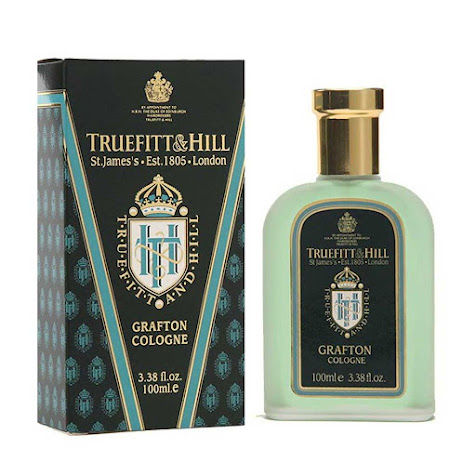
Grafton (Truefitt & Hill)

Everyone's nose is different, and while some smell Grafton cologne as being similar to things like Rive Gauche and Égoïste, I smell a clumsy reinterpretation of YSL Jazz in this quiet little aromatic fougère. The funny thing about Jazz is that it used to cost less than Grafton, but since it's been discontinued, reissued, and discontinued again, the more stalwart Grafton is now the bargain of the two. Go figure.

The differences are obvious, however. Where Jazz is tighter, more lucid, and more closely focused on the aromatics that comprise its crisp fougère accord, Grafton inhabits the laid-back mould of barbershop fougère, with brighter green notes of citrus and stemmy florals on top, followed by a dustier coriander-spice midsection, before it settles on an extremely dry woody amber that acts like a snooty glorified aftershave rather than a properly realized upscale fragrance. Longevity is middling, note separation is just okay, and the whole affair makes me want to reach for Jazz to energize things. 

Between Grafton and JF, I've come to think of the Brits as being relatively clueless about perfumery compared to the French. British compositions seem unoriginal, and the quality isn't where it should be. Geo F. Trumper's colognes are an exception, although even those could be better. Perhaps it's why Luca Turin had nary a good thing to say about English perfumes in The Guide. Genius in perfumery is clearly not found in London. 

2/12/22

A Brief Note on Decanting Pinaud's Lilac Vegetal


About a year ago I decanted my entire supply of Lilac Vegetal into a glass bottle I'd purchased from Home Goods, in an attempt to eliminate the funky plastic off-notes that haunt its otherwise-pristine beauty. I'd had pretty good luck doing this with Clubman, which goes from a cheap-smelling powdery fougere to a beautifully soft and elegant citrus musk within two months of decanting. I figured it was worth a try with Lilac Vegetal, which suffers much more than Clubman does in regards to off-gassing (the unfortunate leeching of plastic odorants into alcohol-based fragrances). 

I shaved the other day, and found myself with a choice between two lilac waters. Bear in mind that I also own a full vintage 1960s glass bottle of LV, which contains mostly unused fragrance that smells as new as the day it was made. The differences between the vintage and new stuff are unmistakable, as the former possesses a sweet and powdery ambergris aura that is entirely missing from the plastic-bottled version. Now that I've decanted and let sit, I was eager to see if the newer formula's pesky urine-like plastic problem had dissipated, or if it is as die-hard as the internet chatter says it is. 

To my surprise, the result is inconclusive. I figured it would hew one way or the other, but it's entirely possible that I haven't given it enough time. While it smells significantly better than it did in plastic, with a fresher and more floral profile, and much more of that powdery ambergris-like base, there's still a hint of plastic tainting the lilac note. It's fainter and far less intrusive than it used to be, and I'm hoping that another six months in glass (with air in the bottle) will improve things further. One can certainly make the argument that Lilac Vegetal improves when decanted into glass. 

Even if the plastic note doesn't disappear entirely, it has diminished down to a far less noticeable degree. The trick with Pinaud's products is to decant them into quality glass that allows aeration without evaporation - a tight seal is necessary. My bottle came with a pretty good cork. You could experiment and mix with witch hazel to see if that cuts the plastic note, but I'll wait on that. Lilac Vegetal is a delicate floral scent with a powder-puff cushiony drydown, pure heaven for a wetshaver, and it should be decanted if it's to be enjoyed at its best. I'll update on this later in the year.

2/1/22

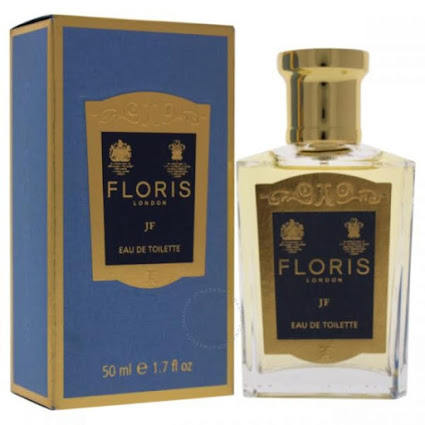
JF (Floris)


Floris is one of those oddball brands that are nearly impossible to purchase, not for scarcity, but for value. Here in Connecticut there aren't any brick and mortar stores with a Floris counter. Can't sample 'em. This makes Floris a blind buy by default (unless you pay Luckyscent), which brings me to price: eighty for a 1.7 oz, and over a hundred (well over) for a 3.4 oz. Their reputation is stale, with little in the way of accolades or press beyond fond memories of older guys championing No. 89 in the days when brands like Czech & Speake and Maître Parfumeur et Gantier were all the rage.

For the hefty dollar it commands, I expected JF, one of their aged masculines, to smell a few leagues better than its competition. I chose a 1.7 oz bottle because it's a familiar brief aimed at stealing a slice of Cool Water's pie. I also had the edge of a gift card from Neiman Marcus, and forked over a small fraction of the price for my bottle - the only way I'd ever buy one. I've been wanting to write about a Floris frag for ten years, making this post past-due. So what's my opinion of JF? I'll keep it simple: it's overpriced and nothing special. Hold out for a gift card to buy it, or else just forget it. It's a disappointment. 

Ingredient quality? Designer, albeit high-end designer. Strength? Average. Longevity? Decent. Compositional prowess? Eh. Here's the shocking truth about JF: it smells like vintage Aspen (1998 Aspen) for about five minutes, then shuffles sleepily into vintage Cool Water (1993 Cool Water) in the twenty-five minute drydown. If you're familiar with the aforementioned, you know exactly how JF smells, which is to say it's fine, but it's nothing new and interesting. Only vintage Davidoff fanatics could love it. Still, I appreciate the novelty of hearing "Rule, Britannia!" every time I depress the atomizer.

1/16/22

I Ran Out of Vintage Old Spice, So I Replaced It With New Juice. Then This Happened . . .


Back in August, I chucked the remainder of my European Old Spice Original aftershave and refilled the bottle with the new American formula by P&G. My thinking was that I would run out of vintage Shulton by mid-fall, and by that time I wanted the newer formula to be sitting in glass for three or four months, so it would be mellowed and ready for use when I transferred it to the milk glass vintage bottle.

The three months went by with me thinking the transfer would be seamless, but would be marked by a distinct difference in the two formulas. I figured the change from the smooth vanilla powder of vintage to the crisp, clove-laden P&G formula would be stark. Yesterday I transferred the liquid from the European Original glass bottle to the newly-emptied Shulton bottle, and topped it off with about a quarter of a four-ounce plastic spray I purchased at Walmart. I filled the Shulton bottle up to the top, stuck the little grey stopper into it, and let it sit overnight.

When I came back to it today, I braced myself for a disappointing change. I'd grown used to the vintage formula, and wasn't really looking forward to switching back to the stronger "butch" formula P&G sells today. At noon I showered, changed, and splashed the vintage bottle's new contents into my palms, rubbing the liquid across my neck and chest. To my surprise, I found it smelled a lot like the vintage cologne! I stopped and sniffed the bottle, then added a bit more splashed it across my arms. Another few sniffs later, I realized something had happened to the formula.

Either it changed a bit in glass, or it leeched whatever oils were clinging to the Shulton bottle and blended them into the new formula, but somehow the new stuff smells soft and powdery and sweet, with a distinctly musky vanilla note, much like vintage. Perhaps it's a combination of the time spent stored in glass and the vintage oils caked into the Shulton bottle, but the overall smell is very, very close to the Shulton formula. I don't get the sharp spicy accents that I usually get from the plastic spray bottle, I don't get the slight plastic undertone, and there's no harsh clove. Honestly, if I didn't know better, I might not notice any change from the 1970s formula to the new stuff.

My advice to any guy who buys vintage Shulton on eBay is this: buy a glass bottle and decant the plastic spray formula of OS "Classic" into it, and let it sit in the glass for however long it takes you to use the vintage juice. When your vintage is empty, transfer the cologne from the glass to the Shulton bottle, let it sit in there a day or two, and see if there's a big difference in the scent. You may find that the new formula has somehow morphed into something very, very close to the vintage.

1/15/22

Is Van Cleef & Arpels Pour Homme Worth It?


Van Cleef & Arpels Pour Homme was recently discontinued, and predictably the many unicorn breeders on eBay had a field day with it. The picture above is just one example of what a seller is currently asking for a 50 ml bottle (that's right, the 1.7 ounce itty-bitty bottle). You should feel privileged to spend three hundred dollars on a relatively obscure bitter-rose chypre from 1978, because Captain Random Price in his grungy grey market janitor's closet stock room says so. 

Should you, though? Let's break down what it means to buy a bottle of VC&A PH. Then let's consider whether it's unique enough, well made enough, relevant enough, and desirable enough to warrant spending cheese on it. Usually I would consider vintage and discontinued eBay fragrances a rip-off if they're priced beyond an inflation-adjusted amount, but VC&A's signature masculine is just oddball enough to make me stop for a moment and consider it in context. It isn't your usual forty year-old moth-baller. 

Is it unique enough? This is the easiest question to answer: Yes. Having smelled six hundred fragrances, I can say without any exaggeration that I have never encountered anything that smells like VC&A PH. There is an asterisk to this, however, for there's a common drugstore bar soap that does smell like it - Dial Gold. That presents a problem for anyone looking to high-roll a clever buyer. When I put my nose on VC&A PH for the first time, back about nine years ago, my very first thought was this is exactly and very weirdly like Dial Gold antibacterial soap! 

There are two ways to think about VC&A PH. You can buy into the internet mythologies people have built up around it - it's a gothic rose, it's a "powerhouse," it's testosterone in a bottle - and all of these notions lend it immense popularity among connoisseurs of fine fragrance. But you could also get your nose on a bar of Dial Gold and compare them both, and decide it's just a soapy chypre with vague floral flourishes. Over the years I've found myself leaning more and more to the latter sentiment. Still, aside from the bar soap comparison, it's strange that no other proper perfume even comes close to the scent profile. Its brusquely bitter juniper berry and uncured tobacco medley should be replicated a dozen times over in the pantheon of late seventies masculines, yet most travel a significantly different path. VC&A PH travels alone. 

Is it well made? This one's a little bit tougher. The easier way to state the answer is to discreetly point out that the fragrance is congruous, balanced, and totally wearable. You won't find yourself sitting down to lunch and regretting that you reached for it. There's no time spent wishing this note were toned down, or that note were more successful, or wondering what in god's name that note is. Sure, you'll probably experience the rose crisis that everyone eventually goes through with VC&A PH. As in, where the hell's the rose? Everyone keeps going on about it, yet I struggle to smell it in the composition. There's some floral notes, yes, but it's hard to say what they are, exactly. I often think it's carnation. Then I'll waffle and think, okay, yes, there it is: the rose. Roses or not, the fragrance doesn't smell like a near miss. It smells quite good. 

But it also smells very, very soapy, and herein lies another set of divergent paths to take in one's understanding of this stuff. Anything that smells overwhelmingly soapy is going to smell cheap. The trick is to smell luxuriously cheap. Luxurious is Irish Spring shower gel. That fizzy burst of crisp evergreen and mossy earth with a lick of sweetness, and all coming to life in water. Cheap is Dial Gold soap. Take a wild guess where the danger zone is for Van Cleef & Arpels. The problem with the fragrance is it attempts a soapy formula that also smells perpetually dry. Smart soapy masculines inject the illusion of moisture into their drydowns to better animate their complexities, and breathe life into notes that might otherwise be unrealized. Think Sung Homme and Z-14. But VC&A made the crucial mistake of keeping their chypre bone dry, which parches the fidelity of its constituents, keeping it overly blended, a little too tight, and not as luxurious as it should be. This is why it frequently disappoints me.

Add to that its reliance on mid-shelf designer-grade materials, and the issue is compounded. The fragrance doesn't smell natural enough, nor is it lucid enough at any stage to warrant Creed prices. And that brings me to the next question - is VC&A PH relevant enough? Is this a fragrance that every collector MUST have? The answer is decidedly no. Its uniqueness is a double-edged sword; the astute collector may value its rare character, but might also interpret its one-off nature as something not apt to inspire imitation. Where things like Drakkar Noir, Polo, Le Male, and 1 Million have each carved out their legions of clones, many of them disguised as original designer releases competing for marketshare, VC&A isn't setting the world on fire. Both of their signature masculines have been discontinued. Many of their ancillary releases have been minor hits, or have gone unnoticed. This isn't the world's most relevant brand.

All of this brings us to that final daunting question: Is VC&A PH desirable enough? Would you default on the month's heating bill for a bottle? Would you defer a car payment for it? Cash out on those political science textbooks and risk failing a course? At what point do people decide a fragrance isn't worth it? Or harder yet, when do they decide it never was? I think the answer lies in parsing the answers of all the previous queries. It's unique as a fine fragrance, but stick your nose in the soap aisle at Walmart and you'll find something for $1.79 that smells as close as possible to an exact match. It's competently made, but perhaps there were a few key miscalculations made in the design of its formula. Nineteen seventy-eight was forty-four years ago, and the glitzy jewelers image of VC&A has since lost its shine, at least as far as the perfume brand is concerned. Thus the desirability of this fragrance is limited to the achingly curious, or the die-hard fan, and neither party would be wise to spend more than $120 for a bottle - a large bottle. Sentimental value isn't as volatile as grey market prices. Its fixed nature means even the most devoted and ardent admirers would be stymied by a $300 tag. 

So where does that position this one in the wild west world of internet auctioneering? VC&A PH is eclipsed in both beauty and versatility by its younger brother, Tsar. I blew through my bottle of final-formula Tsar. It was, quite literally, the smell of an emerald. Thick, lush, green, kinetic, a perfume of shimmering woody and floral proportions that bloomed into a veritable garden party on my skin, Tsar was far and away the better of the two legacy perfumes by this house, and frankly I'd consider spending two hundred for it. (Three hundred isn't happening.) You can lead a unicorn to water, but it can't drink because its horn has a nasty habit of getting in the way.

1/1/22

French Lilac (Pacifica)


The copy on the box for Pacifica's French Lilac perfume reads, All of our perfumes are hand-poured in micro-batches using the best grain alcohol. Made in the USA with the best globally sourced ingredients. It's called a micro-batch, presumably because there are changeable aspects inherent to the production method for French Lilac, a fragrance that isn't mass-produced with cheap synthetics. At first glance, this might seem dubious, given its wide availability in Whole Foods grocery stores for twenty bucks a bottle. 

But looking at things more closely, it makes sense. It's twenty bucks for one ounce of French Lilac, which is actually a bit pricy. Also, there appears to be a limited number of bottles per store (I counted six at mine), which at an ounce a pop equals two 3-ounce bottles, which is about $120 worth of fragrance. With these eensy-weensy bottles and their restricted distribution (who else sells these?), it's probably not such a stretch to suppose the Pacifica production method incorporates variable natural materials, albeit in limited quantities, all used in relatively small commercial batches. Maybe the brand values a certain degree of quality after all. The perfume speaks for itself in this regard.

French Lilac is the best lilac perfume I've encountered. It's a rich and heady lilac accord, and it's nuanced with green sap notes, fruits, and inedible vanilla. It is to lilac fragrances what Perfumer's Workshop Tea Rose is to rose perfumes: a cheaper alternative to the less-compelling and far more expensive niche variants on this kind of floral theme. What impresses me about French Lilac is its layers; the fragrance opens with a green wreath of magnolia and hyacinth, which settles against a lilac-centric spring floral bouquet. There's a hint of peach to lift the honeyed florals above their woody leaves and balance them against the sacchariferous warmth of heliotrope, which is in turn counterweighted by unsweetened vanilla. This isn't a soliflore. This is a pyramid. 

An hour in, and the bouquet coalesces, its distinct floral tones merging with that sturdy vanilla foundation to form a lilac note. This lilac effect is full, rich, rounded. It escapes sliding into that slightly plasticky off-note that lilac reconstructions often fall victim to (I'm looking at you, Demeter), and thanks to the strength of the underlying peach and vanilla notes, never strays into air freshener territory. To be clear, room sprays tend to smell overly harsh and strident to fill large spaces. French Lilac maintains a few degrees of smoothness and subtlety to keep its usage within the scope of personal fragrance, at least to my nose, although any perfume can double as room spray. 

Five hours after application, French Lilac's warmth cools and its lilac note thins a bit, becoming sweeter and fruitier, until I'm left with a simple peach base, which itself smells remarkably crisp and realistic, especially for something that's been simmering on skin all day. This far drydown tells me Pacifica's formula is something well thought out and executed, not corner-cut or trite. Unfortunately it has its share of internet detractors who annoyingly elevate Highland Lilac of Rochester's perfume over it at every opportunity, with some even claiming FL doesn't smell anything like lilac at all. I guess if you spray it on paper and give up on it after three minutes, you'd reach that opinion, as the other fruity floral notes smell like things other than lilac. But if you spend an hour with French Lilac and say it isn't a good lilac, your nose is broken. 

Every guy who is into old-school lilac water aftershaves should try French Lilac. Shave, splash some Lilac Veg, or whatever lilac water is in your den, and then give French Lilac a spritz or two, and it will top off the retro experience. This is exactly the kind of robust nineteenth century floral scent that was in vogue among well groomed dandies. In 2021, women owned the lilac fragrance space. In 2022, it's time for men to reclaim it. 


12/26/21

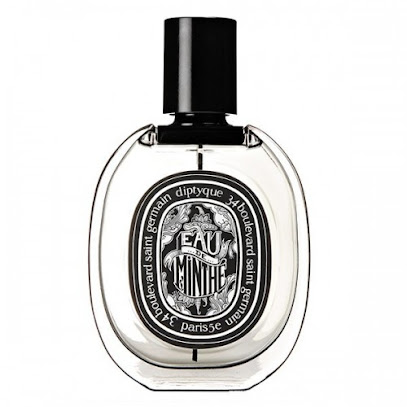
Eau de Minthé (Diptyque)


This fragrance was released shortly before this awful pandemic began, and I almost wonder if the world would know what to do if something this bright and fresh and happy were released in our grim times. Diptyque's 2019 eau de parfum is a clean, green little entry in their growing catalogue of exclusive EDPs (kaa-chiing!!) 

When it comes to mint notes, perfume houses usually stray into a distinct danger zone. Many fragheads are criminally unaware of what the government gold standard for mint is in contemporary perfumery, a pricy aftershave by Myrsol called Formula K. Now granted, there are several different types of mint, and no one fragrance can corner the market on all of them, nor can one represent a fair standard for each type. Formula K is the most lucid peppermint note you could ever hope to smell in a fragrance, and there's no doubt that at least some natural peppermint oil was used in its making. Paired with a healthy dose of added menthol, the overall effect is incredibly crisp, lucid, and natural, and because it's so realistic it doesn't fall victim to the thematic danger of smelling like toothpaste. It's just a beautiful herbal aroma that goes far beyond the call of duty. 

Formula K is about six dollars an ounce, making it expensive for aftershave, but a good value for 180 ml. When I turn to a European niche perfume brand like Diptyque, which asks seventy-five dollars an ounce, I expect at the very least that something called Eau de Minthé will be on par with Myrsol's peppermint. All considerations are made here - the mint note in Eau de Minthé is supposedly Oregonian spearmint (whatever that is), the concentration is EDP, hard to manage with mint, and there's no telling which stylistic direction they're aiming for - yet to my nose, the mint note falls short. This isn't a lucid herbal spearmint. This is drugstore aftershave mint, in the same league as Skin Bracer and Aqua Velva. It's a nondescript, mentholated, mint-like spearmint note. It's okay, but disappointing. But, to be fair, it smells serviceable and works in the composition. 

Diptyque was going for a mentholated patchouli here, an interesting choice. The top is a fizz of menthol, spearmint, and what feels like a drop of green apple, but the patchouli note steps quickly to the fore, and maintains a central stance for the three to four hour duration. Ghosted into the background are supporting notes of lavender, geranium, and nutmeg, all lending a familiar wet-shaver fougère thing to Eau de Minthé's midsection, and I think it's safe to call the fragrance a fougère. While the lo-fi mint note is annoying, the menthol effect is dynamic enough to elevate the proceedings into what smells like a niche-budget luxury version of some proletariat splash at the dollar store. Its Australian sandalwood drydown, which is subtle and lightly tinged with smoky patchouli, saves this fragrance for me. I might complain about the mint, but I can't deny that the woody structure underlying it is well made and smells great.

There's a hundred reasons to avoid spending big bucks on something that postures as glorified drugstore aftershave, but then again if you're like me, a total weirdo who loves drugstore aftershave, Eau de Minthé tugs at heartstrings in all the right ways. It's complex enough to be interesting, luxurious enough to smell great in all circumstances, and conceptually sound for something priced near the $200 mark. If it sells well enough, they might even reformulate it and upgrade that spearmint note, which would be the sort of bitch move that would force me to buy a full bottle. 

12/23/21

Lemon, Cedar, Amber (Pecksniff's)


My memories of England are fond ones: sitting in a hotel lobby at two and a half years old, playing with a toy double-decker bus and a London cab while waiting for my folks to check in (which incidentally is also my very first memory, period). Then at ten years old, peering through Cornish morning fog so thick I couldn't see my hand in front of my face. Visiting the apartment of Sherlock Holmes. Seeing the Queen open a police station in a London park. Fighting with my brother in the backseat of the car. Good times.

Nineties England was a land of wilted empire, its citizens proud and rather nationalistic, its weather glorious and catastrophic, its food abysmal. The country is known for its stiff and unadventurous perfumes, with esteemed houses like ye olde Truefitt & Hill, Floris, Penhaligon's, Trumper, and Pecksniff's offering a slew of proper things. I approach them gingerly and with the expectation that my teeth could wind up crooked and my wardrobe flush with floral-print dresses. To meet British standards, they must be quietly manly and forgettable. I didn't think I'd like Pecksniff's "Professional" scent, with its bought title of Lemon, Cedar, Amber. But my colonial nose does not deceive me - I fancy it! It smells very cheap, but nice. I'm interested in other Pecksniff's fare now, which is a surprise. 

There isn't much lemon detectable in the mix, no citrus aldehyde, although I do get the slimmest curl of woody rind behind the actual wood notes. There are also no top notes to speak of; the fragrance falls victim to an alarming blast of blatant alcohol in the first five seconds, which is usually a sign of bad tidings. Fortunately a robust accord of cedar with a touch of sandalwood emerges, and this one-note cedar carries on for a few hours before thinning into a discreet woody amber. It's very dry, and there's no sweetness to be found. It's perfect for after a shave, and pairs nicely with Clubman Classic Vanilla. 

Dull as the fragrance is, its cedar note is so nicely rendered that I can't help but enjoy it. Good cedar smells rich and rounded and not at all like pencil shavings, and Pecksniff's manages to hit close to the bullseye with minimal effort. Rather than blow his wad on unnecessary notes, the perfumer poured his rather limited resources into a single easy note, and the result is something that smells simple but quite good. I'm reminded of Krizia Uomo whenever I wear it, which is a compliment to the nose. Oh, and due to a sale, I paid $6 for 3.3 ounces, my nod to the Scots. 

12/19/21

Alcolado Glacial (Curacao Laboratories Ltd.)


Curaçao is a tiny island country of about 150,000 people off the coast of Venezuela, and yet it has given us Alcolado Glacial, a world-famous mentholated aftershave lotion. It isn't the easiest to find in stores, yet I managed to locate a massive bottle at an ethnic grocery store in Bridgeport, and snatched it up immediately.

Why is this stuff so loved by wetshavers? It smells good, it hits frigidly cold, and works beautifully after a shave. According to their website, the Alcolado formula was crafted by an anonymous chemist back in the late 1940s, and was then marketed to the islanders. I find this interesting because it smells like something that would've been more timely in the 1970s, with its hippie-like accord of lemongrass, mandarin orange, and eucalyptus, something truly charming and fresh. It's a little green, a little citrusy-sweet, a little soapy. Catnip for a guy with a safety razor and badger brush next to his sink. Hard to imagine it in 1948, but not such a stretch in the Nixon years. 

Menthol lovers rate Alcolado Glacial highly, putting it in the neighborhood of Osage Rub and Skin Bracer. It's easy to see why. It's pretty damn cold. The freeze comes on faster than anything else in my den, within five seconds of slapping it on. This stuff lives up to its name, as it's truly a "glacial" menthol. Thumbs up for me.

12/17/21

Florida Water (Lanman & Kemp Barclay)


With a birth year of 1808, Lanman & Kemp Barclay's 214 year-old original Florida Water is the ultimate American institution of colognes. For a history lesson, just refer to its interesting Wikipedia page, which is quite informative. What isn't mentioned is the implicit historical passage that such an antiquated water has taken along the riverbanks of time, nor are there any detailed imaginings of those who traveled with it. 

Florida Water joins the league of old-fashioned lilac and lavender waters as being the sort of thing the local general store carried while selling to barbers in bulk. A shave and hot towel were followed by a splash of this stuff, but its unisex utility meant women of all ages carried small bottles with them, soaked their kerchiefs with it, and relied on it to ward off ailments. Soldiers drank it and detered mosquitos when they sweated it out. In those days, cologne water was all-purpose, a luxury recognized as such, yet suited for many uses. Its endurance on the market is a testimony to its quality and durability. This cologne is something people still like - a lot. 

It begins with a bracing burst of warm citruses, mainly lemon and orange, which is soon suffused with spicy aromatics. I get a ton of lavender and clove, followed by a pleasant cinnamon note. There's also something terpenic in the heart of this accord, akin to pine sap, sometimes reminiscent of crushed needles. This wavers into a dusky territory oft shared by cedar wood. Its woody backbone carries the ghostly aromatic drydown to its rapid conclusion, where remnants hang for another hour or so before completely fading away. Florida Water, like 4711 and Extra Vieille, is a perfect accord. 

Of course wetshavers love it, but what remains mysterious to me is why companies like Lanman & Kemp Barclay continue to degrade their products by selling them in cheap plastic. Putting something this nice in plastic is a crime. I'll give them a nod though for at least issuing this also in glass, albeit in apparently very short supply (good luck finding a bottle). I still prefer 4711, but Florida Water is a great alternative, and a must for any collector of 18th and 19th century eau de colognes. 

12/12/21

Polo Ultra Blue (Ralph Lauren)


"I'll take a pack of Ultra Blues, please."

If you're gonna go fresh, you need to know your options. There aren't many. Not if you want to go fresh, and still smell good, that is. Of course there are hundreds of freshies out there, most of them crap, but it takes a multifaceted understanding of perfume to make sense of them all. Market dynamics, the reality on the street, and the hierarchy of choices complicate things. How does one pick something shampoo-like and ubiquitous in nature, yet also truly beautiful to wear? 

Ralph Lauren issued his first Polo Blue in 2002, and since then has thrown a few others at the wall, hoping something will stick. We got Blue EDP, Gold Blend, Sport, Parfum, Red, White & Blue, and Deep Blue. Ultra Blue quietly joined the club in 2018, which is a funny story. Lauren seemed a bit unsure of Ultra Blue, and for several months released it only in 1.6 oz bottles, with fairly limited distribution. I saw maybe two or three of them, and not much on the internet. I think it was being road-tested at places like Macy's and Neiman Marcus. It was as if the brand wanted to know if this formula would sell before committing to the regular 4.2 oz size. I'm not even sure you could buy them directly, or if they were just bait for sales stats on pre-season preorders. 

It must have done at least okay, because by the fall of that year the bigger bottles were everywhere. Ultra Blue is the lone Polo in my collection, and I only own it because it's exactly the kind of thing that appeals to women. If you read reviews, you know the guys who like to sing the Polo Blues about blue frags. They're "boring," they're "safe," they're "not for me." Well, the joke's on them. The sad truth is that these are the fragrances that today's women want to smell on their men. They were raised around boys who wore this sort of generic stuff, their dads wore it, and the overpriced deodorant aquatics are the only things that really turn them on as adults. Believe me, every woman I've dated has insisted on my wearing the freshest thing in my wardrobe, whatever it was. 

The cool thing about Ultra Blue is it's the most unisex of the Polos in this line. A woman could easily wear it without anyone even questioning it. It's in the same wheelhouse as D&G's Light Blue, which is of course a big hit with the ladies. But Ultra offers something interesting: a minimalist approach to the aquatic, with heavy emphasis on a couple of high quality synthetics. Someone suggested that original Polo Blue, with its melons and cucumbers, could be just as compelling in an austere and streamlined state. It was made quite a bit colder with the complete removal of the melons and cucumbers and woody notes, and using only lemon verbena, heaping doses of salt, and a few sprigs of fresh basil as garnish held the temperature. It would be a lot cheaper to make, but also a little harder to market. What if this level of simplicity was just too weird?

The opening smells cheap to me, as if the bareness of the pyramid is struggling to cover the scent of alcohol. This only lasts about ten seconds before the lemon saves the day, smelling brackish, but, you guessed it, fresh. There's the mineral limestone tanginess of dry sea salt, undergirded with crisp lemon verbena and a pert basil that happily peeks through the chems. It's clean yet tony and mass-appealing, and most importantly, it's well made. It takes skill to make something this basic smell good, but they pulled it off. The citrus is ghostly, floating in and out of my consciousness, taking turns with the rich accents of pure salt and delicate herbal greenness in commanding attention. 

If you have the money, you'd probably rather buy something like Heeley's Sel Marin or Creed's Erolfa, both of which employ similarly direct aquatic-themed pyramids with only a handful of notes. But I'd caution you there. Sure, you'll get better top notes with those more expensive fragrances, but you won't get significantly better fragrances overall, and Ultra Blue destroys them in the longevity department. It's also more likely to appeal to your significant other, who might raise issues with the overly realistic low-tide effects found in high-concept niche. Buy all the macho musks and woody orientals that your bank account can bear, but leave at least one spot on the shelf for Saturday night.