8/1/23

Sel Marin (Heeley)


When you chew the fat with fragrance enthusiasts, they tend to lose interest in the conversation when it touches on the "aquatic" genre. Something about the words "fresh," "blue," "salty," "clean," seems to irk them, and if you start rattling on about stuff like D&G's Light Blue and Nautica Voyage, they get up and leave. Aquatics have long been considered a boring topic, although why is less clear; there's nothing wrong with harnessing the feel of the ocean and interpreting it via scent. 

Heeley's Sel Marin was released in 2008, at the height of the 2000s aquatic wave (pardon the pun), and it immediately made a splash (pardon the pun). What I found interesting was that it was the first aquatic that many enthusiasts seemed pumped about. I find it to be a flawless exemplar of the theme, with a salty seaweed accord that smells vaguely fishy, overtly briny, and a bit like low tide. It begins with a crisp lemon and bergamot snap that fades into the salty ozonics typically found in aquatics, except here the effect is very literal, devoid of sweetness, and evocative of the sea. If you want a fragrance that will have you smelling like you spent a weekend at the shore, Heeley gives you your money's worth.

A true aquatic isn't fresh and soapy, but sharp and funky. It contains facets of mollusk shell and rotting dulse, sea spray and salty air, cold stones and wet sand. If you want a user-friendly fantasy aquatic that will make your girlfriend snuggle up, go for Cool Water or Voyage. But if you're looking for an expression of nature, something that smells like the ocean crashing against rocks, you'll need to check this stuff out instead. It's timeless, impeccably crafted, and arguably the best aquatic ever made.  

7/23/23

How to Navigate the Endless Spiral Galaxy of Niche and Designer Releases


Ever go on Fragrantica, and wonder what the fuck you're doing there? You're not alone. I've done it many times, and every one of them leaves me with brain fog. The sheer magnitude of the spectacle makes me want to curl up in a fetal position and shut my eyes to block out the light. It's like how I imagine I would feel if I boarded a starship and traveled to the Andromeda galaxy: terrified and overwhelmed. 

Fragrantica is a fragrance database first, and an online "magazine" second. Its database is dwarfed only by NASA's catalog of observable stars in the universe. There are now so many perfumes, most of them new, that it's impossible to keep track of them all. It used to be just the perfumes that were infinite, but now even the brands themselves have grown in numbers that are difficult to parse. For example, the headline on Fragrantica when this article was written features a fragrance by the house of Gritti. What the fuck is Gritti? Whatever Gritti is, wherever it's from, it exists, and I had no idea until a minute ago. 

If you're a newbie to the fragrance scene, this universe of releases, new and old, is beyond daunting. Where to start? But if you're a seasoned enthusiast like me, you know some old tricks to help manage the onslaught of commercial releases that steadily flows past your computer screen and into your consciousness. There are ways to navigate this spiral galaxy of niche and designer perfumes, and I'm here to help you go about it. But first you need to remember something very important. You're not "smelling things" when you get into perfume. If you want to smell stuff, go to your local Converse-sneaker convention health-food grocery store and inhale deeply. That place has all the smells you need.

Your nose isn't the main instrument in this endeavor; your brain is what you must depend on. You discover a "fresh" fragrance, but smell musks and powders? Know what you're smelling, and learn to ignore the note pyramids they give you ('they' being the corporations). A fragrance smells out of balance, but still good? Learn to find and read batch codes to identify the year of release. A $30 scent smells as good as (or better than) something priced at $500? Get familiar with brand histories, brand legacies, and the power of subliminal persuasion. Perfume isn't about smelling. Perfume is about reading.

Once you learn that, you can navigate the world. Read first, then smell. Read about classical fragrance families, as they were defined in the late nineteenth and early twentieth centuries: Chypre, Fougère, Oriental, Hesperidic. If you are in danger of being sidelined by "woke" railings against the oriental category, just remember this article, and that it told you to jettison any attempt to align the term "amber" with "oriental," as not all orientals are "ambery," and not all "ambery" fragrances are orientals. "Oriental" is not a racist term, it's an English word that Westerners developed to suggest that explorers of foreign lands needed to "orient" in a new direction to proceed, i.e., the East. 

When you've successfully pushed past linguistic misdirection, focus on what each category represents. Study the historical representations of each. For example, if you're interested in chypres, try to get your nose on the oldest available batch of Coty's Chypre, and then get a bottle of Mitsouko by Guerlain. If you're interested in fougères, get acquainted with Houbigant's Fougère Royale, Trumper's Wild Fern, YSL's Kouros, and Caron Pour un Homme. If you're into masculine orientals, look no further than a pristine bottle of vintage Old Spice. For a hesperidic cologne that has survived centuries, 4711 is cheap and readily available. All of the touch points for understanding these realms are at your fingertips with the internet, and if you're lucky enough to live in a metropolitan area, you can probably cross the street to a department store and find them behind the counter. 

After you've covered the basics, you're in a prime position to branch out. Understand and internalize everything you've learned, and follow your interests. Now that you've experienced the best exemplars of each fragrance family, you know what you love, and what you don't. You love chypres? There are survivors that were released in the last forty-five years that are still terrific chypres, and the fragrance forums will help you find them. People talk about the stuff they wear, not what Fragrantica puts on its front page. Get to know the community. Get to know the talk. Read what your fellow enthusiasts, many of whom are more experienced, have to say. Collect the aggregate data over the course of several months of reading, and recognize which fragrances are getting the most conversation, the most praise. Go from there.

Whatever you do, don't get stymied by incompatible data. For example, if a fragrance is getting overwhelming praise, and yet there's roughly 25% of respondents who say they hate it, don't let that minority percentage dictate your verdict. Pro-tip: there's always 25% of people who hate what the other 75% of us love. There are little "pro-tips" in the perfume world that you'll eventually figure out. Into Creed? Like how Creeds smell? Great, you're in the majority. But what are the majority of Creed lovers saying, vs. the legion of keyboard warriors who happen to know that Creed exists, and just want to spout off about the brand on the internet? Chances are a huge chunk of the Creed lovers are actually drifting toward an Arabian brand called Armaf, which sells Creed dupes that are deadly close to the originals for an appallingly slight fraction of the price. 

Follow that drift, don't fight it. Explore alternatives. Explore the "popular" stuff. Go ahead and try all the A*Men flankers by Thierry Mugler. Give Cool Water's 600 flankers a go. Happy with CK One? Get your nose on as many "summer editions" as you can. In love with Creed? Visit the boutique and sample every single Creed there is. When you've had enough, take a jaunt down a few lonelier paths, some unpaved byways that branch off of the food court at the mall and lead you to dusty forgotten shops full of junk, with the occasional hidden treasure. Indiana Jones that shit (without Phoebe Waller-Bridge). 

That's where niche is, real niche, and if you poke around long enough, you'll find that rare hidden gem by some unknown brand that even Fragrantica barely acknowledges. Take the highway to get to secret rooms. You'll find them faster, and you'll save gas. When exploring a galaxy, that kind of savings comes in handy. 

7/16/23

Eye, Hatshepsut (Charenton Macerations)


Charenton Macerations opines on its website that customers should "disobey the rules of olfaction," and that it strives to "create fragrances that make a statement . . . The final ingredient is always you." Yikes. Anyway, this conceptual perfumery has one thing on point, which is its interest in ancient Egyptian perfumes and smells, something that has captured my imagination since I was a child. When I was five, I had a View-Master with a color reel of King Tutankhamun's tomb shortly after it was discovered, full to the brim with every manner of ornate furniture, bottles and pots, and statues. For those who weren't around, the 1980s saw a huge revival of interest in King Tut and Egyptology, and The American Museum of Natural History led the charge with an explosion of shows around the lost civilization and its rulers. You never quite grow out of that. 

It was thus mandatory that I wear Charenton Maceration's 2016 release, Eye, Hatshepsut, which was composed by Cecile Hua. The brand says it's "an olfactive homage to one of history's most notable gender rebels: Pharaoh Hatshepsut of Egypt." Good grief, who writes this stuff? The perfume opens with a dazzling snap of bright green and smoky incense notes, which modulate off of their opposing frequencies to create a bracingly resinous impression of a "fresh" oriental, something I typically enjoy. This accord is not unpleasant but contains a slightly pickled accent that makes me wonder if palo santo is in the mix, and it's a little distracting. Swirling around in the ether are hints of fruity and floral notes, which only increase the curious draw of Hua's composition. After fifteen minutes the incense backs off and lets a distinct labdanum and patchouli accord step forward, with a notably powdery orris and musk to balance the resins, and it feels rich and civilized, but also overwhelmingly masculine to my nose. I guess that's the influence of our gender-bending female Pharaoh? I get serious seventies men's cologne vibes here. 

Eye, Hatshepsut buzzes along on this trajectory for six or seven hours before the musk fades out, with only gentle spices remaining (cinnamon, coriander). This fragrance is traditional, but it doesn't make me think of ancient Egypt and its female Pharaoh glass-ceiling smashers. Instead it has me reminiscing about Jimmy Carter-era aftershaves, things you would've paid $1.99 for at Woolworths in 1979. It does have superior clarity and blending, which is good, because a bottle of Eye costs a C-note, plus tax, the price of entry for anything expertly crafted. However, I'm struck by a strong feeling that this one is riding the waves of its bizarre marketing, and I think it's an egregious example of an ad campaign/product misalignment. 

7/15/23

M for Men Eau de Toilette (Banana Republic)


Jean Claude Delville should be recognized alongside Alberto Morillas and Francis Kurkdjian as one of the three most influential perfumers of the nineties. Cabotine, Curve, Pleasures for Men, and Banana Republic's forgotten M are all noteworthy for shaping the olfactory landscape of the period. If you want a fresh and friendly fragrance to wear while kicking it at the mall, Delville's got your back. His specialty is sneaker juice. 

M for Men (1996) has been through several iterations over the past 27 years, and has currently settled on what appears to be an eau de parfum concentration, which is much lauded on the interwebs. I can't be bothered to go out of my way to drop coin on that, but recently I did stumble upon the EDT formula on a discount rack, and figured that a Banana Republic fragrance isn't the gamble I once thought it would be (thank you, Icon Collection). The box for M cites Gap EU as a distributer, itself a major nineties throwback. It turns out to be a pleasant valencia orange scent, an intense blast of sweet and juicy orange zest that skirts floor cleaner by dint of smelling surprisingly natural, followed by a mellow and unapologetically chemical woody-musk drydown, suggestive of department stores. 

M isn't the statement-maker nineties scent that Cabotine and Curve were, nor is it particularly complex and exciting, but it's an easy, sunny sort of smell that lifts spirits and conveys the neon-lit optimism of the time. I don't often encounter fragrances that focus on orange fruit, and when I do, the Italian in me perks up and gets excited, so I personally enjoy M as a gentle warm weather spritz for casual wear. For the bad boy version of this scent, try Juicy Couture's Dirty English, which adds terpenes and animalics.  

7/9/23

Moon Carnival (Vilhelm Parfumerie)


Vilhelm Parfumerie brands itself as a sort of nostalgic perfumery, one that builds fragrances elicited by memories, a worthy exercise. Founder Jan Ahlgren aims to capture the zeitgeist of the twentieth century's earlier years, and update it into fragrances to wear while listening to Miley Cyrus and Bebe Rexha on Spotify. 

Moon Carnival was released in 2018 and costs $2.45 per milliliter. My understanding prior to smelling it was that it's a modern white floral with a generous Ambrox and vanilla base, which has appeal. Wearing it, however, was a let-down. It smells like body wash. A good body wash, mind you, but body wash nonetheless. It opens with a citrusy pear and freesia accord that is very familiar (reminded me of Valaya) and quite comfortable, but unexciting. This segues into a decently sturdy structure of tuberose, gardenia, a hint of jasmine, tonka, with a skin-musky vanilla finish that we've all encountered before in far cheaper and better fragrances. Why belch out big bucks for this?

Niche brands need to remember something: we're not stupid. Yes, we overspend on perfume, and yes, we're willing to look past the cornerstone "crowd-pleaser" fragrances that every brand is compelled to release to secure their bottom line. But if you're charging $200+ for a bottle, it better smell mind-numbingly great, and not like the stuff we lather on and rinse off after work.

7/4/23

Club de Nuit Sillage (Armaf)


I should start with an updated review of Silver Mountain Water by Creed. I'm smelling the current iteration of that scent as I write this, and since it's from Lucky Scent and it comes in a carded Creed 2.5 ml spray sample, I assume it's the most recent batch, or at least one of the most recent. What surprises me about it is that it opens with a very synthetic and sweet accord that smells almost identical to the clones -- almost. The only difference is that it's noticeably smoother. But if I were to smell it in a hurry, I wouldn't really pick that out. I'd just assume it's another SMW clone. That's how unremarkable the top is. The real thing lacks "wow" factor, and that surprises me. I expected more citrus, more naturals. 

Silver Mountain Water rapidly dries into an "inky" blackcurrant note, and it smells dry, quite dark, and rather flat. My girlfriend thought it resembled cinnamon and vanilla, which is interesting. To me it smells like the many clones of SMW that I've owned over the years, only smoother, and not as sweet. It's nice, but that's it. So there you have it. If you want the "smoothest" version of SMW, get SMW. It maintains this subtle inky blackcurrant note for ninety minutes before fading off into a light musk. It's pretty linear, pretty soft, and just pretty. I guess I can chalk it up to BlackRock fucking with the formula, but to be perfectly honest, it smells almost identical to the last pre-BlackRock SMW sample I had, which was also a synthetic berry over musk, and as transient as a fart in the wind. 

This brings me to Armaf's Club de Nuit Sillage. I'll get the bad news out of the way first: It smells a little harsh in the first thirty seconds. But the more I smell it, the more I think that might be on purpose. Again, as I mentioned in the previous article, Armaf was supposedly aiming to clone a much earlier formula of SMW with Sillage, so the weirdly metallic citrus I get off its top accord might be how the Creed used to smell. It quickly segues into a more robust "inky" blackcurrant note, which smells to me like it has more depth, and also an undergirding of bergamot. My girlfriend confirmed it was "sharper" and "more citrusy" but felt she liked the Creed a little more (and confessed she wasn't wild for either of them). Maybe it's because I can smell it better, but I think Armaf, as it smells today, does a nicer job at rendering blackcurrant. A much nicer job. 

There's a hint of tea alongside it, which develops about twenty minutes into wear, and frankly I got zero tea out of the Creed. Literally none at all. The current formula is really basic to my nose, with just a soft blackcurrant that fades into nothing. Armaf smells juicier, richer, and a little greener, and it's silly to pretend that there's any serious attempt at a tea note, but that hint of greenness is probably it. Just like real SMW, Sillage remains pretty linear, with much better longevity and waaay better throw (one or two sprays will catapult eight feet across the room, easily), and the fact that there's no ambergris note isn't a problem, because the current Creed has no ambergris note in it, either. 

Let's be serious about SMW for a second: people, what I'm smelling isn't worth $500. It's synthetic, super-duper weak, and there's no reason to shell out for it. A more natural and realistic version is found in the $30 Armaf. Sorry guys. I said it. Verdict in. But with that said, I think Armaf's clone is the smoothest, the roundest, the deepest, but it's not wildly different from the other clones in my collection. It's definitely the most refined, and I can see how people would argue it's a SMW killer, because let's face it, it is. If you've smelled Silver Shade, Al Wisam Day, and Sun Java White, you're familiar with how ubiquitous this has become. This is the most cloned Creed in existence. Turns out the clones are pretty good. Club de Nuit Sillage just happens to be the best. 

6/25/23

Creed Silver Mountain Water is . . . The Lost Creed?

Oh 4 oz. bottles, how I miss you!
I have two things coming in the mail this week: a full bottle of Armaf's Club de Nuit Sillage, and a 2.5 ml spray sample of Creed's Silver Mountain Water from Lucky Scent. It's pretty obvious why those two things are simultaneously traveling my way. But there's a major problem with making the comparison that might not be obvious to fragrance community newbies, and I'm going to pre-game my review of Sillage by getting into that here. 

Silver Mountain Water was released alongside Millésime Impérial in 1995, and both perfumes were emblematic of the times, smelling fresh, fruity, sweet, green, and musky. You had to be alive and sentient in the nineties to really understand what this means. When I'm in department stores, I see twenty-one year-olds shopping for Le Male or one of its flankers, and I think about how far down the food chain that perfume has sunk. My best friend used to wear it, and he bought it just after it was released in 1995. From 1996 to around high school graduation, I existed (part-time) in a haze of Le Male. The stuff was fresh, sweet, powdery, yes. It was also nuclear. Nuclear. 

I had a professor in high school who wore Chanel Allure Homme upon its release in 1999. This prompted me to buy a bottle that year, and in the years shortly after. Allure Homme is an ambery synthetic wonder, now muted with a crisp woodiness. But in 1999, it preceded my teacher two minutes before he entered the room. You still smelled it ten minutes after he left. Allure Homme wasn't a perfume; it was a presence. And so were many perfumes of that decade, as the styles of the eighties had changed dramatically, but their volume had not changed at all. 

This brings me to Silver Mountain Water. It turns out that it's 2023, and the nineties have been dead for 24 years now. The last time I smelled SMW was in 2011, two years before what I've read were the best batches of that particular Creed, and a year after I smelled it the first time. I've worn it twice, both from carded boutique samples, and both times I found it to be incredibly difficult to smell. My perception of it stopped short at sharp citrus and a vague sweet fruitiness, with a sheer musk tingling just under the surface. There was a difference between the first sample and the second, however. These were parsed under duress, but I could make them out. 

Sample one smelled mineralic, a little stony, a bit green (the tea note), and inky, thanks to a bitter blackcurrant that was sweetened with a dusting of musk. All hard to make out, like trying to glean information from an overexposed photograph, but all there. The second sample was clearly a batch variation, and SMW is really the only Creed where batch variations were dead obvious. It wasn't as stony, wasn't as green, and was basically just a fresh pink-berry fizz atop a white musk. Harder to make out, with even less information for my nose, and it lasted maybe thirty minutes before disappearing completely. 

My experience with SMW is limited to batches dating from 2009 to 2012. This is a problem if I'm going to accurately assess Club de Nuit Sillage as a clone of SMW. Why, you ask? Because the word on the street for the last three years is that Sillage is a clone of vintage nineties SMW. A version of SMW I have never, ever smelled. Also, a version I never will smell, due to its unavailability. There are probably many nineties and early 2000s bottles of SMW floating around in collections out there, and perhaps even a few left on the grey market, but good luck getting your nose on any of them. 

All I can do is imagine that the main difference between the SMW samples I've smelled and nineties SMW is the intensity of its notes, and its overall strength. If my memory of nineties perfumes is anything to go by, deep vintage SMW may have been significantly stronger than what we've all been smelling lately. 

There are some reviewers who say that Armaf cloned 2013 batches of SMW, and that this was the last great year for the fragrance before the corporate buyout of Creed. This may also be true, but it's a little hard to care when every other guy is pointing to a different deep vintage for their comparison. I can't really isolate a particular year when I make my own comparison. All I can do is acknowledge that Armaf has cloned an earlier vintage, probably pre-2010, and I have to take that on faith. Having never smelled the older Creed batches, I can't possibly know how close Sillage comes to any of them. 

But this is precisely why I have a sample of current SMW coming. I remember the older samples. I remember what that particular vintage smelled like, although unfortunately my ability to truly discern all the details of SMW has always been challenged. I'm hoping that I can do three comparisons here, one between the new sample and Sillage, another from memory between the new and older samples, and yet another from memory between Sillage and the older samples. This triangulation is the best I can do when assessing Sillage, and how much SMW has changed in the past decade (pre-to-post buyout). 

When I say "comparisons," I mean comparisons on a few levels. First, I want to know how close they are in quality, i.e., are the materials in Sillage adequate enough to successfully mimic something at Creed's level, despite not having access to Creed's captives? Discerning this requires a fresh sample, and hopefully Creed is still using top-tier chems. Next, I want to know how close they are in composition. Lastly, I'll be curious to see how Sillage performs relative to its template, which has now become notorious for abysmal longevity. Some say Sillage is "beast-mode," and others say it isn't. We'll see. 

In closing, the problem with Silver Mountain Water vs. Sillage reviews is that SMW is no longer SMW, according to many reviewers. They call it "formula drift." It's what happens to older fragrances that have been reformulated numerous times; those lucky enough to do direct comparisons between new and old versions find completely different perfumes that share the same name. Post-buyout SMW is widely reported to be so pathetic in longevity that it isn't worth buying anymore. There are people saying that Sillage smells more like SMW than SMW does. My new sample of SMW will shed light on that for me, and hopefully for you as well. 

It's possible that Sillage will smell like one of the Creed samples I've put my nose on, and maybe by a stroke of luck it'll smell very close to the current sample. But it's a distinct possibility that it will smell nothing like any version of SMW that I've experienced, which doesn't mean it isn't a perfect clone of the original perfume. I'll say that again: It's entirely possible that Club de Nuit Sillage is a perfect clone of a lost Creed, and that Armaf made it because it's been lost. Let that sink in. 

6/23/23

Smoked Jasmine Black Tea (Marissa Zappas)


According to perfumer Marissa Zappas, Smoked Jasmine Black Tea was inspired "by the scent of black tea spilled over an old book." If I spilled tea on my 1742 edition of The Drapier's Letters, I'd have a panic attack. Putting that unpleasant thought aside, it's another interesting image conjured by a person who connects her olfactory work with visual stimuli, a practice that often yields interesting results. 

I'm intrigued that Marissa names many of her perfumes after the accords they represent, which is an unusual Jo Malone-like marketing strategy. With names like Honey Rose and Violet Hay (after the designer), the compositions apparently strive to match their names as closely as possible. This is most true of The Garden Collection, as her other creations are more abstractly titled, but her floral fragrances attracted me to the brand. Smoked Jasmine Black Tea sets up the expectation of a rich jasmine floral perfume with heady accents of aromatic tea. Sounds like a lovely combination. 

My initial experience with the fragrance was positive. Zappas describes the scent as "wet, like old books," and "quietly smoky." It smells very wet in the first ten minutes, with a translucent bouquet of jasmine immediately hitting my senses in its indolic glory. That she managed to make jasmine smell both rich and wispy is no small feat -- Hedione is probably in the mix. This fresh opening is accompanied by a tangy and citrusy supporting act, which smells somewhat like bergamot, but not quite, and it serves to buoy the florals beyond being sweet/skanky. The first forty-five minutes is very nice.

Unfortunately, everything falls apart after that. The jasmine fades out and leaves a mere whisper of sweetness, and nothing else steps up to the plate. It all happens within two hours. I smell a vague peripheral smokiness that I guess is the tea? It never develops into anything. It sort of hangs behind the jasmine, and when it's all but gone, I'm glad I didn't drop $150 on a full bottle. This is an okay perfume, but it feels unfinished. 

6/22/23

The Soft Lawn, Edition 2.0 (Imaginary Authors)


It's fascinating to me when a brand is fairly open and obvious about a reformulation to one of their well-known perfumes. The Soft Lawn was first released in 2012, and received tepid reviews online, with many saying it smelled okay, but unremarkable. It survived for a few years, and then was discontinued and replaced with Edition 2.0 in 2021, which has been received with much more enthusiasm. What makes this edition more appealing is unclear to me, but apparently the first scent was grassy on top, and smelled strongly of tennis ball rubber in the base, which didn't go over so well. 

I haven't had a chance to smell that version, but looking at its note pyramid side-by-side with Edition 2.0's reveals that Josh Meyer, the nose for Imaginary Authors, reversed the order and added some citrus to the newer scent. Linden blossom was once the primary top note, but it has been pushed aside by a massive (and massively unusual) tennis ball note, and I'm here to tell you that I smell it, in all its rubbery glory. I can now say that I know what a tennis ball in a pitcher of grapefruit juice smells like. This rubbery-citrus rapidly segues to soapy linden and vetiver, with underpinnings of oak moss, but the tennis balls bounce around in the background for the duration of the scent, buttressed by the cheery green-grassiness. Things get a bit soapier and sweeter over time, and it smells pleasant enough, but the blending is a little tight, and I find myself wanting more note separation to better distinguish the fragrance's numerous compelling dynamics. 

The Soft Lawn is a "green" fragrance with grassy and woodsy notes in abundance, but the tennis ball element adds a twist of postmodern conceptualism. It's a moment captured in time and space, not a traditional self-effacing structure. From first spritz to final fade-out, Meyer's fragrance transports me to a grass-lined tennis court with fuzzy ball in hand, and with a cool breeze sending it all to my nose. I'm there all day, detecting everything, even a faint whiff of my own laundered clothes in the fourth or fifth hour. If, like me, you pine after a country club membership, but can't hack it financially, here you go.   

6/21/23

Ink (Akro)


"Akro, in French, means 'addict,' you know?" Olivier Cresp explains on Akro's website. The focus on addiction is his brand's theme, with each fragrance representing another facet of compulsion. Ink is an "exploration of indulgences" in the tattoo direction, playing off the fact that some people get hooked on having untalented strangers brand them with permanent eyesores. Why not a perfume that smells like a tattoo parlor? 

Akro’s fragrance begins with a striking lime note so sharp it nearly veers into vinegar territory. Within moments, it transitions to a sour, chemical scent reminiscent of the ink used in old cartridge pens, evoking imagery of pen-and-ink drawings. While it brings to mind Encre Noire, it lacks the same buzzy iso E-Super effect. Instead, Akro’s scent stretches the rubbery off-notes of vetiver into a sweaty-onion note akin to jasmine, which results in a pronounced “ink” accord. I wish I could say this smells pleasant, but it doesn't. It brings to mind the pungent aroma of epoxy rather than the clean, enticing smell of fresh magazine or printer paper.

Despite this, experiencing Cresp's interpretation of tattoo ink in a perfume is intriguing. There are subtle woody notes, likely from the birch, but the vetiver dominates, hence the connection to Encre Noir. Beneath these stronger elements lies that hint of jasmine, which reveals a green quality when detected. Cleverly crafted and surprisingly complex, Akro’s scent may not be wearable, but it certainly offers a unique olfactory experience.

6/1/23

Gabe Oppenheim's The Ghost Perfumer: Creed, Lies, & the Scent of the Century: Did Pierre Bourdon Really Admit To Being Used? Something Smells.


Olivier Creed: Master Perfumer, or Master Manipulator?

I want to preface my remarks by saying that my thoughts on the Creed brand are not entirely favorable. Creed's self-image as "royal" purveyors of fine fragrance is, at its core, unintentionally funny. Nobody with an ounce of intellect wants to be recognized solely for being the personal perfumer for inbreds, no matter how wealthy they are. Lacking a Royal Warrant, the commercial projections of tassels and feathers and pomp and circumstance are merely a veneer over talent, which shouldn't be disguised in the first place. The irony is that Creed has always been ahead of its time, despite their insistence on stamping "1760" everywhere, as if the brand is universally known for its eighteenth century masterpieces. This is all to say that Creed doesn't need the extra flair. 

I think Aventus is overrated. Aventus is "the scent of the century" only insofar as we're seventy-seven years away from the end of it. A lot can happen in a lifetime. Several bigger and more influential perfumes are likely ahead. I've always felt that Aventus was more of a timestamp than a fragrance; its release coincided with the moment when internet hype had caught up with the fragrance community, and thousands of "fragbros" could assail the world with news of their chest-thumping expenditures in one unanimous and unending salvo. By 2010, it was clear that we had devolved from a casual word-of-mouth world to a blood-soaked colosseum of keyboard-warriors, and Aventus proved it. 

Lastly, Creed's retail prices have become utterly absurd. I remember when a four ounce bottle cost $250 directly from the boutique, which was bad enough. That 3.3 ounces now costs $500 is patently insane. Creed is good, but they're not that good. When a brand hikes itself over the $400 mark, it's time to pass. I don't care what the story is, or how good the fragrances might be. There's pricing for premium quality, and then there's just pricing to keep people out. Creed is clearly engaged in the latter practice. I'd have a modicum of respect for them if they kept churning out Aventus-sized hits, one after another, but Viking and Viking Cologne were both met with tepid reviews, and Wind Flowers has a flatulence-inspired name that the company should be embarrassed of. 

I mention all of this to point out that I'm not a "Creed Fanboy" who takes every simpering opportunity to defend Creed and defile its enemies. When someone like Gabe Oppenheim comes along, I give him the benefit of the doubt. His recent nonfiction book, The Ghost Perfumer: Creed, Lies, & the Scent of the Century casts Olivier Creed as a superlative perfume evaluator who twisted his credentials and used one of the best perfumers of the last fifty years to form a billion dollar company. The "Ghost Perfumer" in question is Pierre Bourdon, author of masterworks like Kouros, Cool Water, and Dolce Vita. Oppenheim's core contention is that every time the young and upcoming Bourdon lost a brief for a designer fragrance, Olivier swooped in and stole it for Creed.                           

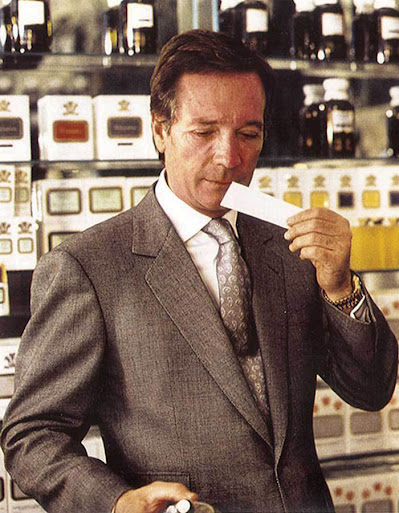
For this to be possible, Oppenheim has to illustrate the character dynamics of these two men in a way that is both convincing and historically accurate. I haven't read the book, but I have watched Oppenheim give several lengthy interviews with various personalities in the fragrance community, and having heard the author's take on the subject ad nauseam, I have some issues with it. The dynamic he describes is one where Olivier was a rakish Hitchcock villain, all tweed suits and ties, tall and handsome, a man who was bored with his family's tailoring business and wanted to make a name for himself in the perfume industry. Pierre was the young and naive son of a Dior executive who sought fatherly approval from anyone who would give it, and somehow found it in Olivier, who promised him the world if he would just look the other way whenever his ideas were stolen. 

The first of these ideas was for Lancôme's Sagamore (1985). When Pierre's brief was rejected, Olivier was there to snatch it up and name it Green Irish Tweed. According to Oppenheim, Olivier paid Pierre nothing more than a few custom-tailored Creed suits. Oppenheim suggests in many interviews that Cool Water was Pierre's revenge bid against Creed; when GIT gained commercial traction, the perfumer sought to undermine its uniqueness by thrusting a near-identical and much cheaper alternative into the designer market. The rest is history: Cool Water wound up being the more famous and popular fragrance, and GIT remained obscure until the internet could lend it a hand. 

I find this anecdote fascinating. It rings true in the sense that there's no way Pierre Bourdon did not at least contribute to Green Irish Tweed. The similarities between it and Cool Water are too strong. Also, Jean-Louis Sieuzac is on record saying that he wished Sagamore had never been attributed to him, because it's been discontinued for many years, while GIT and CW remain in production. What's also interesting about this story is it suggests that something like Tres Nuit by Armaf, which is basically GIT on a designer budget, smells the way Sagamore might have, had Lancôme been a little wiser. But there's one thing that doesn't really make sense to me, and Oppenheim never attempts to explain it: If Creed wanted Bourdon's work, why didn't he just hire him? 

The supposition at play here is that because of Pierre's daddy issues and personal insecurities, Olivier could save money by taking advantage of his vulnerability and pilfering his ideas for free, which might explain why he sidestepped hiring the perfumer. But that's a God of the Gaps theory, the Gap being what Pierre offered to Lancôme in 1985, versus what eventually became Green Irish Tweed. There's no way that the rejected brief that Pierre submitted to Lancôme was turn-key for Creed. Someone had to tinker with it, edit it, and eventually reformulate it into the Creed fragrance. And all of this had to be done in the span of a few months, if Oppenheim's timeline is to be believed. Who supplied Olivier with the finished fragrance? How was Bourdon's vision merged with Olivier's? 

The other problem is one of circumstance. By 1985, Pierre Bourdon had already gained global recognition for his work on Yves Saint-Laurent's Kouros. His landmark musky fougère was hailed as "The Most Expensive Perfume in the World." YSL launched the fragrance with a widely-publicized party featuring celebrities and industry names. Kouros went on into the eighties as one of the brand's bestsellers. It is still in production, and still commands a premium. Finding a vintage bottle of Kouros is like finding a nugget of gold. So the suggestion that Pierre Bourdon was sulking on the sidelines waiting for validation from Creed is a bit hard to swallow. 

But let's give Oppenheim the benefit of the doubt here, and say he's correct in his analysis of what happened. He says that Pierre told him this. He says that Sieuzac confirmed it. And he says that it didn't stop there; in 1995, Olivier stole another rejected brief from Pierre, this time for L'Eau d'Issey, and made it into Silver Mountain Water. He presumably did it again and again with Millésime Impérial, Spring Flower, and Original Santal, although there's not as much mention of these. The SMW story is a mirror image of the one for GIT, and yet here it's even less plausible. By 1995, Pierre Bourdon had authored Cool Water and Dolce Vita for Dior, both hugely successful. He'd also created Féminité du Bois for Shiseido, which was an iconic niche subvariant of the plummy violet-woods idea that eventually became a Serge Lutens mainstay. 

Are we really to believe that Pierre Bourdon was yet again a victim of Olivier's modus operandi? That his brief was pinched and turned into Silver Mountain Water? One thing that Gabe Oppenheim repeats in each interview is that Pierre Bourdon explicity joked with him about how bad Olivier Creed was at creating a formula budget. According to this story, because he was bad with numbers, Olivier would just tell his team to stack the formulas with the most expensive versions of everything. Can't decide which amber to use? Just use real ambergris. This is what Oppenheim claims Bourdon told him. But is that what Pierre Bourdon actually said? Because when pressed by Persolaise on the ambergris question, Oppenheim contradicts himself and says, "Oh no, it's all Ambroxan." 

Again, Silver Mountain Water didn't just magically materialize from the brief for L'Eau d'Issey. Someone had to sit down and reformulate the idea. There are moments in his interviews when it sounds like Oppenheim is saying that Olivier took the formulas and simply upgraded the materials, i.e., took the exact formula for Sagamore and instead of using cheap synthetics, used real iris butter, real lemon verbena oil, etc. But again, GIT never smelled that natural to me, and I doubt that the original formula that Pierre Bourdon submitted for Sagamore was exactly what was used by Creed. Same goes for Silver Mountain Water. So who was doing the reformulating, who was doing the modding, and who actually created these perfumes? Maybe the book explains, and I just need to read it, or perhaps we're all expected to take Oppenheim's word for it, full stop. I don't know. 

He describes Olivier Creed as a "Master Evaluator" of perfumes. He compliments Creed as someone who could identify a "hit fragrance" simply by putting his nose on a whole bunch of things. He suggests that the brand's success has relied on Olivier's ability to detect the exact version of something that will make it hugely successful. He implies that Olivier Creed has an excellent nose in this regard, but in the same breath says that he isn't a perfumer. Everyone says that he isn't a perfumer, and never was. But how can the man be an excellent perfume evaluator for an independent brand that doesn't employ an in-house perfumer, and not wind up being the perfumer himself? Is everything stolen? Are there eight or nine jilted perfumers floating around the industry, hating Creed? If so, why hasn't one of them ever taken legal action? There's a house, and there's a house of cards. Which one is Creed? 

Oppenheim is asked this, of course, and his response is always that Creed strikes a verbal agreement that the other man can never pass up. He tells them he'll help them launch their careers by giving them a crack at a Creed, or that he allows them to cite their Creed creations within the confines of the industry to get other work, or that he simply leases his name to their portfolios to lend them street-cred. Apparently Jean-Christophe Hérault was allowed to tell the public that he authored Aventus, the first to be given this freedom. But again, Hérault was apparently not paid much for his trouble. 

Whenever Oppenheim discusses this, I sense his confusion. He doesn't seem to have a strong grasp on the subject matter, and at times doesn't even seem familiar with the very industry he claims to have covered here. For example, in his interview with Persolaise, he slips up and claims that Thierry Wasser was fired from Guerlain. When asked about this, he backpedals and says he was "ousted," or that he thinks he was ousted based on a phone conversion he had with Wasser. Meanwhile, Persolaise and his audience are like, What the fuck is this guy talking about? 

It's pretty clear what happened there. Gabe had been bumping his gums about Wasser being on the outs at Guerlain, which obviously got back to Wasser, and he phoned to set the record straight. He then grilled Oppenheim for saying he was "sharing responsibilities with Delphine Jelk," and added, "Well, if that's how it is here, why don't you just call Delphine, then?" and hung up on him. Gabe thinks the phone call proves Wasser was unhappy about being made a "figurehead" at Guerlain. It actually proves the opposite. 

This is idiocy of the highest order. It's obvious that Oppenheim was wrong about Wasser's position in relation to Jelk. Wasser knew it, got pissed, and called Oppenheim to make it clear that he wasn't going to discuss anything about the industry with him anymore -- he could call Delphine for that -- sarcasm served. Who knows what made Oppenheim think Wasser had been fired, but he's clearly wrong. If you're just getting into writing about the perfume industry, it's a bad look to offend Guerlain's top nose. 

That particular moment in the canon of Oppenheim interviews is the one that made me sit up in my chair. It was in that instant that I realized that Oppenheim has a processing issue. He reads into things, rather than listening to what is being said. It raises the inevitable question: If he bumbles a basic fact like Thierry Wasser's employment, how much of what Pierre Bourdon told him got scrambled-up in the book? What if Bourdon merely wasn't paid enough when he worked for Creed? In other words, what if Oppenheim simply missed the part about the perfumers wanting their ideas to go somewhere, rather than nowhere at all? If price was no obstacle, and if Olivier was really as carefree about budgeting as he is made out to be, why wouldn't perfumers take their ideas to him first instead of last? 

The thing I find least credible about Oppenheim's story is the daddy-issues angle of his biographical account of Bourdon. Supposedly his Dior-adored father found young Pierre's compositions to be inferior, and frequently said so. This created a sense of insecurity in Bourdon that Olivier preyed on, according to the book. It's silly to suppose that the man who founded Takasago Europe and signed no fewer than five blockbuster releases in the span of ten years was some insecure pushover who got steamrolled by a then-unknown businessman with an invisible brand. The polarities of who these men were was the opposite of how they're described. Olivier Creed was a nobody in the eighties. He was probably fumbling around for a marketing angle well into the nineties. By 1983, Pierre Bourdon had already conquered the industry. What need would he have to turn to an unknown entity? Creed would likely have begged Bourdon for a brief. 

Supposedly much of Oppenheim's book was spurred along by Jean-Claude Ellena, because Ellena's brother Bernard was apparently one of the first perfumers to be taken for a ride by Olivier. Oppenheim says that Bernard Ellena created Creed's Acier Aluminium, and that he was never compensated. Supposedly this gave Jean-Claude the impetus to help him write the book, and again, if this is true, it's mind-blowing. But this tidbit invites another gremlin into the narrative, because prior to Green Irish Tweed, the Creed brand had many "grey-cap" creations on the market, things that were considered excellent, yet which mysteriously have no attributions other than to Creed himself. The listeners can content themselves to say, "Bernard was behind Acier Aluminium," but who was behind Royal English Leather, Royal Scottish Lavender, Ambre Cannelle, Epicea, Orange Spice (which was pre-Kouros), Royal Delight, Santal Imperial, Chevrefeuille, and Zeste Mandarine Pamplemousse? 

I call this the Great Grey Cap Mystery. Nobody has been able to explain it. How did Creed churn out so many solid EDTs before they were even a household name? Who was doing all this work behind the curtain? How did the brand manage to maintain such a high level of workmanship and material quality decades before internet notoriety gained them hundreds of millions in annual sales? Where did this level of perfumery pedigree stem from? If Creed himself was merely an "evaluator," then who else assisted with creating his pre-millennium range? The EDTs were vaulted in the late 2000s, just before Aventus was released. I've read countless basenotes and fragrantica forum threads discussing how fraudulent Creed is, yet I've never seen anyone explain where these fragrances came from. How did Olivier manage it? It remains a mystery. 

Luca Turin thinks Oppennheim's book is excellent, which gives me pause. Turin is so fiendishly biased against Creed that I almost wonder if his real name is Luca Turin Creed, a black sheep trying to disassociate from his family. In the 2008 edition of The Guide, he repeatedly contradicts his glowing estimation of Bourdon. His reviews piss all over Silver Mountain Water and Millésime Impérial. He says, "Erolfa always smelled nasty to me." Tania Sanchez gives Individuel and Thé Brun two stars each, which Turin agreed with. Turin loves Kouros and Cool Water (calls Bourdon a genius), but the only Bourdon Creed that gets four stars and a nod is GIT. It doesn't figure. 

But then again, whenever Creed enters the picture, things seem to get kaleidoscopically weird. Up is down, left is right, cats live with dogs, and Pierre Bourdon is the little guy who got taken for ride after ride. Or maybe Gabe Oppenheim is the wrong man to write a book about this stuff? He was just a sports writer before this book, so I'm not sure how much of what he says should be taken seriously. Then again, I'm just a blogger, so you shouldn't take what I say very seriously, either.