Showing posts with label Social Politics of Perfume. Show all posts

11/18/24

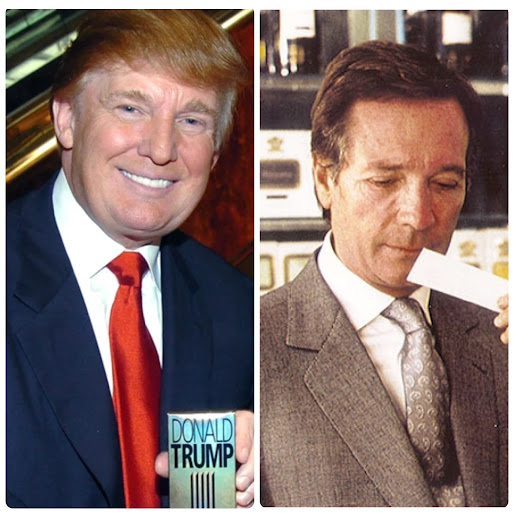
The Trump Anomaly: How Olivier Creed Accidentally Harnessed the Unfortunate Power of "Orange Man Bad"

"Donald, this smells familiar."

This weekend I was on Reddit. I know, I know. What was I thinking? There was a thread on Creed titled "Creed company's origin? How are they getting away with a fake story" -- and I had to pitch in my two cents. I know, I know, I know. What was I thinking? It's not bad enough that Reddit is populated with ignorant trolls that ceaselessly babble about stuff they know nothing about; they occasionally venture into interesting territory, and turf up just enough nonsense to lure the likes of me right on in. And boy, was I in. 

The gist of the thread was that Olivier and Erwin Creed are liars who have conned the world, ala Gabe Oppenheim's The Ghost Perfumer. Nothing new there, folks. I've already hashed and rehashed my opinion on that. But just to choke it up again, and I'll be as succinct as possible here, it's not all that bizarre for Creed to do that. Did they stretch the truth on multiple occasions? Did they exaggerate their pedigree to make their brand more appealing? Did they "con" the world with dubious claims about royal appointments and a three hundred year legacy? Maybe. Sure, maybe they did. 

But let's be honest here, people. We know what the Creeds were doing. It all made sense. They have an old family that does date back several generations, and their forefathers were in the fashion biz. They were in the "riding habits" biz. Eighteenth century leather makers like the Creeds were in a sophisticated business, one which entailed the production of leather goods, but which also required such goods to be palatable to the public, and in the 1700s, that meant making the leather smell like something other than disgusting raw animal hide. Gee, I wonder what would make dead skin smell good?

Aside from that, James Henry Creed and all the Creed tailors of that bygone era were busy making saddles and boots and gloves and jackets, and probably also made saddle soap, powders to condition and scent the gloves, little olfactory trinkets to scent the boots and jackets and get rid of the nasty. Every high-end leather maker since the dawn of time has done that. Every tailor dealing in "sports" equipment dating back to Caesar has done it. Can we stop pretending we don't know this?

This gets me back to the Reddit thread. On this thread were numerous young men who were all about pretending they don't know everything I've just said. It was all about how the Creeds are liars, con men, they have "no evidence" of perfuming anything prior to 1970, how do they get away with the lies, the lying liars that lie? 

One guy commented: 
"If you want a company with REAL history just go with Guerlain."

Another guy said,

"They claim to have made fragrances for the likes of Winston Churchill and such, but there is no proof. Compare that to Guerlain who has an extremely well documented history. Creed = lies lol." 

 And yet another said:

"My take is Creed is probably 50 or so years old and the rest is marketing to convince you that bottle of perfume that cost $10 to produce is worth $500."

This was followed by a response from another user:

"Not true. There are actual receipts etc from the 1800s for tailored goods and royal warrants. The original store in Paris has the actual warrant from Napoleon framed in the store. There is history to the Creed brand but not just for making perfumes. Doesn't matter if they embellish things a little, every company does for marketing reasons."

This prompted a response from the other guy:

"Can you provide a link to a verifiable document? Up until as recently as 2 years ago no documents could be verified anywhere. There seems to be a long history of no documentation, including a total absence of warrants. If they have proof in their shop it seems reasonable the rumor would have ended."

This led to me saying:

"My friend, you clearly don't know what you're talking about. You want to see Creed's royal warrant? Just look at any one of their Private Collection boxes. Their warrant with royal signature is printed on the back of every one of them. I get it's fun to criticize Creed. But you've just embarrassed yourself.

This got a windy response that ended with the sentence:

"If you have something objective to add, let's see it." 


I posted this photo: 


It has the royal warrant clearly displayed. The guy had claimed that he owns Private Collection fragrances and that none of his boxes have the warrant on them, but when I posted this picture he shut up right quick and I haven't heard from him again. Conversation over, as it should be. (Pretty clear the only lie on the line was the one about owning Private Collection Creeds, as evidenced by how easy it was to shut this guy down.)

This got me thinking about how people grapple with what I call the Creed Conundrum. I’ve written about this before: there’s something about Creed that seems to cloud rational thought. Call it Creed Derangement Syndrome: an obsessive need to heckle the brand, accusing it of fabricating its entire history. The prevailing narrative? Olivier Creed conjured the whole legacy out of thin air, hired modern perfumers to craft the scents, and let the truth be collateral damage. And if I don’t buy into that outrage, well, then clearly I must be a gullible fool, a perfect mark for this suave charlatan and his so-called phony empire. How could I be so naive? What’s wrong with me?

This is the same dynamic I see with Donald Trump. For example, he steps up to a microphone in front of a crowd and says something like, "I love Mexicans and Mexico, they’re wonderful people. But they’re not sending us their best. The people crossing the border are drug dealers and rapists." Okay, it’s a bit uncomfortable, I’ll admit. The phrase "I love Mexicans" is meant to soften the impact, but I have to carefully unpack what Trump is actually saying: he believes that many illegal border crossers are young men with bad intentions, no viable way to earn a living in the U.S., and likely to engage in more criminal behavior while here. Laken Riley’s family would probably agree with him on the issues of drug dealers, killers, and rapists.

I then sit back in my chair, and think, "Well, he didn't say that very well. And he's not as clear as he could be. He's trying to say that Mexico and Mexicans are generally likable -- lovable, even. He likes them. But the border problem is the worst of Mexico mixed in with some of the others, and it's those baddies that we need to focus on, because if we're just letting them into the country, no questions asked, we've got trouble."

Then I turn on the news. 

The chyron: . . . TRUMP SAYS MEXICANS ARE DRUG DEALERS AND RAPISTS . . . 

And I sigh. That's not what Trump said. It's on tape. I know what he said. Why are you gaslighting me on what he said? It's the border. We've been having issues down there for decades. They've been getting much worse in the last twenty years. He's addressing that. He's making his case. I don't particularly like how clumsily he's making it, but he's making it, and I get it. Why are you pretending you don't get it, mainstream news people? 

Trump addresses the Charlottesville fiasco with the Confederate statues, and says that in the debate about whether the historical aspect of those statues should be preserved, there are "Very fine people on both sides." The mainstream media and the Democrat party interpret that as, "Donald Trump says white supremacists are very fine people." 

Again, not what he said. 

In 2024, much of these gaslighting messaging tactics have been debunked on X, Elon Musk's platform after his Twitter buyout, and the majority of Americans now have a revised opinion on exactly what Donald Trump stands for, which explains how a majority of voters put him back in office, including about 50% of hispanic voters (mostly men). Now, whether or not that was a good thing is up for very deep debate, and there is a strong case to be made that Trump should not serve another term, and should perhaps serve jail time instead. That case is convoluted, hard to understand, impossible to identify with. I don't get it. Neither do 75 million Americans. But, there is another 75 million who do get it, and to them it's very real. I can live with that. I can work with that. I can respect it.

I bring this up because the same thing happens with Olivier Creed. Olivier does an interview and says to Le Figaro in 2013, "When I entered with my creations exclusively in a provincial perfume store like Le Soleil d'Or, in Lille, in 1963, it was a real challenge against the big brands." Gabe Oppenheim translates this to: "Perfumery was a brand new business for us, so I chose to soft-launch it in the sticks." 

That's not what Olivier said.

He clearly said that he positioned himself in a provincial commercial setting because he was up against the likes of Chanel and Dior. He's stating that when you take your perfumes from the land of bespoke and into the designer market, you have an uphill battle on your hands. What Olivier is implicitly saying is that when your perfumes have to speak for themselves because you don't have a rich financial backer to foot the bill, and your own money is at stake, wealthy as you may already be, it's still a major uphill battle. For comparison, look at how Pierre Montale made out. He was also a "perfumer to the royals" in the Middle East. Despite that, he still needed a rich financier to fund his launch of the Montale brand. Without that, and despite all of his private clientele, he wouldn't have gotten his own perfume business off the ground. 

Olivier has honesty on his side there, the same sort of honesty that Donald Trump kinda-sorta has when he kinda-sorta just is himself and says exactly what he thinks, at least in the moment he thinks it. But here's the thing about Olivier Creed, the thing that Trump doesn't have: he's got mystery on his side. Yes, there are things about Olivier and the Creed dynasty that are not known to the public. He has kept it that way for a reason. Mystery about him and his family gives him cover. 

This cover creates a vacuum of information and knowledge, which gets filled with speculation. But like with Trump, the speculation is touted as fact. "Creed's perfume business only dates back to the seventies." "Creed lies about the perfume part, but the tailoring business was real." "There is no verifiable proof that Creed created perfumes prior to 1970." All of these ideas swirl around in the bleakness that Creed's mystery has cast on the yearning public, those fragrance-obsessed guys who spend all of their time seeking out and buying the most obscure niche crap they can find. 

The claim that Olivier started the perfumery end of the Creed family business is tempting to believe. There are a slew of factual arrows that point in that direction, and many are mentioned in Oppenheim's book. Indeed, Creed did show up at Le Soleil d'Or in nineteen sixty-something with a couple of perfumes that had no clear provenance, and he was, by his own account, looking to sell. He claimed to be a perfumer. He continued to offer perfumes to the shop, and as Oppenheim's book elucidates, those perfumes actually moved units. Oppenheim acted like the number of perfumes that sold was meager, but I was impressed by it. Twelve-hundred bottles sold in 1970? That's a hundred sold every month. That's about three bottles per day. For a small family brand with no designer clout, that's amazing. 

My problem with all of this is that it doesn't track. Just as the slings and arrows fired at Donald Trump fail to land, the same degree of skepticism thrown at Olivier Creed misses the mark and hits something else entirely. Oppenheim fails to deliver the goods on my questions about where Olivier got the "Creed Water" formula of real ambergris and musk from, or how he came up with his impressive list of briefs for the Grey Cap lineup. You can say a guy pulled briefs out of his butt, conned a few perfumers into making them, and touted them as heirlooms . . . but he pulled this off with Fleurissimo, Orange Spice, Épicea, Baie de Genièvre, Bois de Cèdrat, Citrus Bigarade, Sélection Verte, Bayrhum Vétiver, Herbe Marine, Ambre Cannelle, Angélique Encens, Aubépine Acacia, Bois de Santal, Santal Impérial, Chèvrefeuille, Animalis Pimenta, Bois de Rhodes, Cyprès-Musc, Ylang Jonquilles, Royal Scottish Lavender, Cuir Imperial, Verveine Narcisse, Vétiver, Fleur de Thé Rose Bulgare, Irisia, "Vintage" Tabaróme, Royal English Leather, and Zeste Mandarine Pamplemousse?

Sorry, Gabe, but no. 

There is a huge chunk of information missing here. Most of these perfumes aren't color-by-numbers pieces; they are weirdly sophisticated and speak to the sort of Old Money wealth that only aristocratic Europeans enjoy. You can't fake that. You, Mister Oppenheim, have failed to shed light on most of this.

The skeptics sling everything they can at this, and miss every time. The word they like to use that gives away their bad aim? 

"Proof."

They want "proof" that Creed is responsible for creating perfumes prior to 1963. What they ought to be asking for is "proof" of who is responsible for the lion's share of perfumes that predate Green Irish Tweed, and fundamentally question whether the perfumers who have laid claim to some of them, like Pierre Bourdon did with Fleurs de Bulgarie, were acting on brand-new from-thin-air briefs, or adapting archaic, time-worn formulas that needed overhauls to be brought to commercial market. Almost nobody is asking about that.

The narrative that Olivier Creed simply waltzed into labs and stole formulas is more entertaining, even though it doesn't really make sense when you consider the scope of the lineup mentioned above.

If I had a leather riding goods and tailoring firm in the 1700s, my focus would be on the functional accoutrements to leather. This was a time when perfume barely existed. I would create products like saddle soap and homespun perfumes designed to make the hide smell tolerable. The formulas I developed would be proprietary to my leather goods firm. If they proved successful in their duties over the course of a century, I might parlay one or two of them into actual fine fragrance at some point in the nineteenth century. 

These perfumes would be little stocking stuffers offered to faithful clients in tiny bottles of an ounce or less. They might even gain some steam in the late nineteenth and early twentieth century, when the leather goods end of things has closed shop, and the tailoring has picked up. By the middle of the twentieth century, I might have some period-specific pieces on offer like Orange Spice and Fleurissimo. These might migrate from the 1950s to the 1960s, into the hands of a young Olivier Creed, who might eventually decide to "amp up" the perfume piece and make it everything. 

None of this is hard to believe. None of it requires proof.

Orange Spice, by the way, is an example of a perfume that I think adds to the Creed mystery. Pierre Bourdon is not the nose behind it, despite its resemblance to Kouros. If he were, the formula would have been mentioned in Oppenheim's book, and it wasn't. (Varanis Ridari has the scoop there.) I smelled the comparison to Kouros in my bottle, but I also smelled a strong comparison to another fragrance from the 1950s called Max Factor Signature for Men. Same musky orange and wood notes. Slight hint of ambergris and nitromusk in the base. The two fragrances clearly hail, at least in spirit, from the same era. That goes a ways in backing up Creed's claim that Orange Spice is from 1950. 

That might sound trite, but the truth is less glamorous than the narrative we've been spoonfed by the skeptics. Again, anything is possible, but if Creed faked the provenance of Orange Spice, well then, man, did he nail it. Total bullseye. He managed to get a perfumer to make up something that smells quite literally like some obscure fragrance from the 1950s, which happens to also be in my collection. 

The Reddit user is right to say that Guerlain has real history to prove they made perfumes. Creed isn't Guerlain. Guerlain is a behemoth of nineteenth and early twentieth century perfume; Creed is a footnote. When Pierre-François Pascal Guerlain was gunning for a spot in the Eau de Cologne Hall of Fame, Creed was merely doing private little ditties for wealthy clientele. Privately-commissioned fragrance. This is what Olivier Creed and his son, Erwin, have claimed their family dealt in for hundreds of years.

There would be zero proof of any privately-commissioned perfumes. They would not come in mass-produced bottles. They would probably be delivered in little apothecary bottles. And they would not have advertising or a paper trail of any kind, beyond whatever perishable receipts of the tax year might require. 

None of this is hard to believe. None of it requires proof.

These formulas, probably a bit hackneyed and unscientific, unsophisticated even, would eventually need to be made in earnest by trained perfumers, if they were to survive at all. Cue the 1970s. Cue Olivier's quest to hire professionals on the low-down and make things properly. Suddenly Fleurissimo exists in a mass-produced flacon with a label and anyone with money can buy it.

None of this is hard to believe. And the proof is in the perfumes.

Why must we go all Trump Derangement Syndrome on Creed every single time the subject of their historical bonafides comes up? Must we keep pretending that Creed's claims about making perfume are preposterous? The part about making the perfumes, I mean. If you want to poke holes in all the claims about serving perfume to royals, have at it. But making the perfumes. Really? We can't believe that some Creed sometime before 1963 came up with a few perfumes? Even if they were purely functional perfumes used to soak leather hides and give them a signature smell? Scented gloves for ladies? Scented habits for riding? The stuff that people actually used back then, as opposed to the luxury stuff of today that people don't need to use? 

Is it the fake tan thing? If Olivier's tan was real, and not orange, would he be more credible? Or still in the doghouse like Trump? Has Olivier, in being a successful businessman with a knack for exaggerating his accomplishments, harnessed the unfortunate power of "Orange Man Bad?" 

The moral of this article is the following: Stop expecting proof of things that never required proof prior to you coming along and demanding it. If a family made bespoke perfumes for wealthy Europeans dating back hundreds of years, those Europeans would have had titles and nobility. That's how Europeans with money rolled back then. If you had money, it was likely inherited. And it was disposable, and even then, it was used for frivolities like fancy riding habits with citrus and floral scents. Such personal bespoke projects would not survive in any way to yield "proof" of their existence centuries later. They would simply melt into the annals of time. If this is what the Creed family did, then the only proof they need is the warrant printed on the box. Read it, and shut up already. 

10/22/24

Fragrantica Advertises Trump's New Fragrance, Members Lose Their Sh!t

While I can certainly understand why the average Joe on the street might hesitate to say a good word about Donald Trump, I find endless humor in the outrage machine that Trump generates online. Recently, the 45th President released his latest self-aggrandizing marketing gimmick, this time in the form of another fragrance, called Fight Fight Fight, which has a photo of him with upraised fist emblazoned on its otherwise unremarkable square bottle. As you may have guessed, this didn't go down well on Fragrantica. 

My take on Donald Trump and the fragrance community is this: we wouldn't have to worry about Trump if the West weren't so badly calibrated that it gave rise to the fragrance community in the first place. Let's face it folks, we're part of the problem. We spend all day, every day obsessing over very expensive perfumes that most lower and middle class people could never in a million years afford, and most Americans wouldn't buy. As upward mobility has decreased in my country, the 1% have lined their pockets and studded their wardrobes with the latest from Malle, Parfums de Marly, Creed, Guerlain, and Chanel. Designer price brackets have all but disappeared in the last eight years, with ranges that were once tagged between $75 and $95 now in the $125 to $175 range, and any "exclusive" offerings bumped sixty to a hundred dollars over that. 

This isn't strange to us because we're desensitized to it. We see it and read about it every day. We live it. Most Americans are struggling to afford diapers and children's clothing and rent. The last thing they're thinking of buying is the 2025 release of Guerlain's Muguet. Creed's new Kering offerings, Centaurus and Delphinus. Malle's Acne Studios. Chanel's Allure Homme Sport Superleggera. Parfums de Marly's Palatine. It isn't that hard working people don't want them; they simply can't have them. 

These privileged fragrance reviewers flaunt wardrobes that cost more than a new Toyota Corolla, then turn around and virtue signal when Elena Knezevic writes about Fight Fight Fight, as if the usual hand-wringing will change anything. It's 2024, people. We've been living with Trump in the sociopolitical culture for nearly a decade now. Enough already. He was President once. Was it the greatest four years in America's history? Hell no. Covid took care of that. But was he Orange Hitler? Was he Orange Mussolini? Were there citizens being lined up behind the outhouses and shot because they weren't wearing Trump Sneakers? I ask this with the utmost sincerity: how much longer must we pretend that Donald Trump is the antichrist? 

Just look at some of the comments under Elena's article, starting with "Trixie Salamander": 
"How the hell do I delete my account? 

Then there's "SaulGoo":

"When someone's shooting at you and there are innocent people standing behind you, you stay down if you're the target. Why? Because as long as the person firing sees you, they'll keep shooting. Standing up again to pump his tiny fist for what he KNEW would be a great photo op, was an opportunity for new merch GALORE." 

Or perhaps we should listen to "istvan.budda.779":

"Who is the perfumer? And 200 dollars, even Chanel doesn't charge this much and Chanel is well known for being a greedy company." 

And last but not least, my favorite comment by "FiaM":

"Is it time to count the balloons yet?" 

My responses to each in kind: Trixie, you don't have an account. Nice try, though. SaulGoo, to quote Janosz from Ghostbusters II: "Everything you are doing is bad. I want you to know this." To istvan.budda.779: sorry about your Chanel fail, your consolation prize is a $325 bottle of Comète. And to FiaM: don't count them before they pop, sweetie. Trump Derangement Syndrome is clearly a problem for all of you. The sad thing is, it makes you look stupid, because it makes you say stupid things that nobody really believes, or even takes seriously. Eighty million Americans support Trump. I'd wager the majority of them don't have Fragrantica accounts. Time to look in a mirror.

I don't know if these complainers are Americans, real people, or just sophisticated AI bots planted by the Chinese government, but whatever they are, they're not winning, and they still haven't realized it. Their endlessly whiny and logic-free complaints about one man, a man who cut every American's taxes and protected the border as well as he could, is exactly why he's up in the polls. It's 2016 all over again. 

If people want to make the energy monster go away, they should stop spewing their aggrieved energy at him. It's the strained pearl-clutching and the endless whinging that strengthens the case against them and for him. They never learn. 

8/24/24

Is High-End Niche a Rip-Off?

Snippets of my Collection . . . Niche-Like

This year, I've been diving into Zoologist fragrances, and after experiencing Bee, I reached a conclusion: a significant portion of the high-end niche fragrance sector seems to be indulging in a nostalgic revival of the seventies, eighties, and early nineties, tailored for the affluent. Earlier today, while listening to Ramsey on YouTube, I heard him harshly criticize Luca Turin's review of Des Cendres by Les Abstraits, even going so far as to call Turin a "bowel movement" and question his credibility as a fragrance reviewer. While I share some of Ramsey's concerns regarding Turin, I wonder if he's missing the broader significance of Turin's role in the fragrance community. Yes, there is a point.

When Perfumes: The Guide was released in 2008, it coincided with the peak of Creed's popularity, just a couple of years before the launch of Aventus. Turin's disdain for Creed was apparent, despite his positive reviews of Green Irish Tweed and Neroli Sauvage. The review that made me question Turin's judgment was his one-star assessment of Silver Mountain Water, which he described as "An unpleasant, hissy-metallic 'fresh' fragrance with a strange note of wood glue amid the din." It wasn't the fact that Turin disliked SMW that surprised me; it was the inconsistency. SMW is a Pierre Bourdon creation, and Turin had previously praised Bourdon as a "genius" in his review of Kouros. Yet, aside from GIT, nearly every Bourdon Creed was panned by Turin.

What's even stranger is that most of Bourdon's fragrances for designer brands also received poor reviews. Turin’s wife, Tania Sanchez, said that Joop! Homme smelled like cheap floor cleaner, but "coulda been a contender," whatever that means. She also misidentified Bourdon's Individuel for Montblanc as a "citrus green" fragrance, and criticized it as well. Millesime Imperial and Erolfa, both Bourdon creations, were dismissed by Turin as a "mini-GIT" and "thoroughly nasty," respectively. Sanchez gave The Brun two stars, calling it an "interesting greasy-woodsmoke idea" that fell short. Despite Turin's regard for Bourdon, his rating of Bourdon's catalog averages just two stars. It's puzzling, to say the least, and had me wondering for a long time.

Then it hit me. Luca Turin's views on Creed are less about the fragrances themselves and more about what Creed represented in the 2000s. The brand became known for taking underrated designer fragrances and "upgrading" them into "luxe" versions—perfumes that the public was already familiar with, but marketed as superior. The scandal surrounding Olivier Creed's alleged theft of these formulas was the talk of the town, with insiders like Turin casting shade on the house for practices such as retooling Bourdon's Individuel into Original Santal. One can infer from Turin's negativity that he disapproved of this practice. On the surface, it seems like an illegitimate complaint, made worse by the fact that Bourdon was the true author of the Creeds that Turin disparaged.

But after pondering it for years, it's clear that Turin's issue with Creed had nothing to do with the fragrances themselves, but everything to do with their provenance. If you enjoy Original Santal, why not just buy Individuel? It costs a tenth of the price and smells 98% identical. Is that 2% difference in note balance and slightly higher material quality worth $250? (The Guide was released when 120ml bottles were priced around $275.) To be fair, Turin has a valid point here. Let's be honest: if I'm choosing between Cool Water and Green Irish Tweed, knowing both are by Pierre Bourdon, and also knowing neither smells particularly natural, am I automatically going to spring for GIT? Probably not.

Similarly, if I take Mario Valentino's Ocean Rain, a fragrance I bought years ago for under forty dollars, and wear it for a week—a scent formulated by Edmond Roudnitska, Bourdon's mentor—would I then feel compelled to spend Creed money on Bourdon's Erolfa? I can achieve 80% of Erolfa's effect with Ocean Rain at 80% less cost. Sure, Erolfa is a Bourdon creation, and since Creed owns the formula, it smells like an expensive, well-made aquatic. But Bourdon was Roudnitska's student, and the master created Ocean Rain using mostly synthetic materials that few perfumers knew how to use in the late eighties. Even now, at discontinued unicorn prices, Ocean Rain costs less than a brand-new bottle of Creed. So why bother with the expensive stuff?

The question of "why bother with expensive" looms large in this discussion, as much of high-end niche perfumery focuses on superlative materials crafted into artistic compositions, which are then spun off into luxury ranges like Les Abstraits. But consider what Des Cendres represents: a woody-green chypre hybrid loaded with rich smoky and earthy notes—the kind of fragrance you supposedly can't get for less nowadays. Well, if you look at snapshots of my personal collection, you'll see that I have relatively inexpensive but undeniably old and outdated designer fragrances. And guess what? Many of them smell like they could easily be expensive niche fragrances.

My bottle of Bamboo by Franck Olivier, for example, is rich and densely woody, with a camphorous freshness and a spartan structure befitting some hipster New York indie brand that would charge a small fortune for an ounce. If you're unfamiliar with perfume, that indie approach might seem appealing, but once you realize that fragrances like Jacomo's Silences, Ungaro III, and Krizia Uomo all possess an intensity and richness associated with luxury goods, you might start to wonder why those brands didn't charge more. The answer is simple—they charged what they needed to make a profit. They didn't even come close to ripping off their customers because they didn't need to. The perfumes spoke for themselves, and if Krizia wanted $90 for 100 milliliters, that was more than enough to cover manufacturing costs and secure a 50% profit margin. Perfume margins are huge; that's why so many niche brands exist.

Just as Luca Turin was perpetually annoyed by Olivier Creed's business model of transforming affordable designer fragrances into pristine white swans for aristocratic consumption, I find myself constantly irked by niche brands that release fragrances accompanied by marketing copy filled with exotic ingredients like "herbal top notes of Siberian artemisia, heart accords of Australian cedarwood and Turkish fig leaf, and a base of Estonian white birch and Pacific ambergris." Meanwhile, I can stop by my local rack store, grab a bottle of Salvatore Ferragamo Pour Homme for $25, and achieve the same effect as that $300 "global tour in a bottle." Why would I buy Fougere Bengale when I have Vermeil for Men? What justifies a purchase of Mure et Musc when I can wear Creation de Minuit by Lapidus? What niche fragrance surpasses Bourdon's Kouros in its sheer beauty? What niche fragrance outshines Lapidus Pour Homme in its audacity? What $250 fougere from a warrant-wielding British concern could possibly compete with the proletarian versatility of Brut?

Most of the woody "cigar box" (as Turin called them) masculine fragrances of the eighties and nineties were composed with a dozen notes, durable materials, by capable and sometimes legendary perfumers. They were sold at department stores for middle-class money for years, and nobody needed a L'Artisan or a Creed to show them up. In those days, L'Artisan and Creed didn't even try. If you can remember that perfumery practices over the last twenty years have shifted toward the one percenters and away from the 99%, you can look forward to a future era where people's interests drift back downmarket to fragrances that can be made economically without smelling "cheap." And even if they did smell cheap, they smelled good, which is actually different from smelling cheap.

In closing, I recently bought a bottle of Silver Mountain Water on eBay, and the seller, known for its excellent service and honesty, included a sample from their own perfume line. I sprayed it on my hand and recoiled in disgust—it smelled like deck chair varnish. It made me realize that anyone can create a "niche" brand nowadays. All you need to do is mix some Perfumer's Apprentice chemicals into a jar of perfumer's alcohol, swirl it a few times, and cap it. You don't even need a label—just call it an "indie" or "niche" brand, charge a hundred bucks for three ounces, and figure out the rest later. But that's not luxury. I want to enjoy myself, and my nose doesn't wander from price tag to price tag. True luxury is to buy something that exceeds expectations and brings joy every time it is worn. Whether it costs $40 or $400, the questions remain the same: Do I like this? Would I buy it again? If the answer to both is yes, then I've won.

8/21/24

The "Right" Way & The "Wrong" Way: Where to Buy Fragrances?


Recently, at least three people have engaged me in conversations about online perfume merchants, their product experiences, and where I buy my pricier stuff, particularly Creed fragrances. This is always an interesting topic for me because the perfume hunt is nearly the entire thrill: there’s almost something anticlimactic about actually receiving and using the product.

This might surprise some, but it's the truth, and I can’t lie to you: ninety-nine percent of my fragrance purchases are made on eBay. The remaining 1% is split evenly between Amazon and Fragrancenet. What may also surprise readers is the fact that my eBay purchases have been nearly 100% satisfactory, while my experiences with Amazon and Fragrancenet have been just okay, though not terrible. On average, I would say that eBay has the best selection of genuine vintage fragrances, so for those who are after scents from the seventies, eighties, or nineties, I can’t think of a better place to find them.

eBay gets a bad rap because it’s littered with counterfeiters, speculative pricing, grossly variable return policies, and it just feels like the Wild West of the fragrance world. When it comes to counterfeits, there are some basic rules of thumb. First, know your product. Don’t jump on eBay looking to find Bleu de Chanel in any concentration without having ever once laid eyes on an actual bottle of Chanel. Second, don’t buy Chanel on eBay. Of all the designers, Chanel has the tightest grip on its distribution channels and doesn’t allow "grey market" bottles to siphon onto discounter or auction sites.

Third, know your prices. When thinking about value, especially vintage value, you’re thinking of inflation, not arbitrary greedy-boy pricing. There are plenty of guys sitting in their underwear in mom’s basement who get their hands on bottles of Balenciaga pour Homme, Patou pour Homme, Fendi Donna, and declare that it’s worth a gajillion dollars. That doesn’t mean it’s actually worth a gajillion dollars. If it was going for $45 at Macy’s in 1989, adjust for 2024 dollars, add a twenty percent profit margin for the seller, and there’s your price. The Bureau of Labor Statistics will crunch the numbers for you. It’s not hard.

“But Bryan,” you shout, “how would I know what it cost in 1989?” That loops back to the first rule: know your product. Do your research. Ask around. Look for old magazine ads. Pick a year to go by, with the last known year of production being a good bet, and go from there. If you’re looking at something like Grey Flannel by Geoffrey Beene, there is quite a bit to read. You can even read my article about its corporate distribution history for pointers. Getting into vintage perfume isn’t just about loving vintage perfume; it’s about loving what there is to know about it, and doing that legwork regularly. There’s no joy in scoring a bottle of Patou pour Homme for $900 if you don’t know much about it.

Fourth, don’t worry about returns. I know, that sounds insane. How can you not worry about returns when you’re buying something with real money? You need to know you can get your money back, right? Here’s the problem with expecting a great return policy on a perfume: you’re already buying a return to begin with. If you’re buying a bottle of Creed on Fragrancenet, you’re probably not getting a brand-new bottle. Even if you are, it’s still a kickback bottle from another merchant. It’s been sitting in a warehouse for months, possibly even years, and the conditions in that warehouse are a complete mystery. So no, if you’re laying down two hundred dollars on a bottle of stale Creed just so you can own a Creed for that amount and not twice as much, don’t get all sniffy-sniffy back-in-the-box.

I don’t want your returned bottle of a merchant kickback Creed. You send it back to Fragrancenet, and they’ll put it right back on sale the next day. Then some other guy will buy it, thinking he’s defeated the universe and stolen a Creed at designer prices. And now he gets your sloppy seconds. You get . . . your money back. What’s the point? Fifth, know you’re insane. Let me say that another way: Know. You. Are. Insane. You are scouring the internet in your spare time looking for a bottle of something you don’t want to buy from the proprietary source. You are expecting perfection. You are expecting to thread the needle of good fortune every time. And often you succeed. Often you are right. The perfume arrives looking and smelling great, and you win.

But every once in a blue moon, the chips fall wrong, and you get something with a defect in smell, container, or both. Again, understand this: you are the buyer, and because you are the buyer, the phrase “buyer beware” applies every time you pull the trigger. You want your niche fragrance from an eBay merchant to be "as advertised"? Read the ad, make sure the pictures are of the actual product and not stock images, and if still in doubt, send a message and ask questions. Cover all your bases before you purchase so that you understand what you’re in for, and there are few, if any, surprises. If you are a vintage fanatic, recognize the added layer of risk inherent in that pursuit. Combine it with the regular risks, and tally up your risk tolerance metric, but be honest with yourself about it. Nobody bullshits you better than you.

If vintage isn’t your thing, and you’re content with buying new bottles of new fragrances, then it’s all about your taste. Are you an Amazon guy or an eBayer? Does Fragrancenet, FragranceX, or Mercari work for you? Figure it out. The only way is to try them. Apply the rules I’ve listed here to yourself, put yourself in the reality framework necessary for such a fantastic endeavor, and go for it. If you’re an impulse buyer, you’ll be more vulnerable to expensive errors. Here’s an easy example: you’re desperate to try Creed’s new Carmina, and you find it on eBay for $128 from Taiwan or Hong Kong. Score! Except, not a score. Counterfeit. Slow down. Be real. Live in the real world for a few seconds before hitting the “Buy Now” button. Spare your bank account. Buy from Taiwan or Hong Kong, and kiss your investment goodbye.

The nice thing about eBay is that shipping is often free. The serious merchants on eBay will ship quickly, and the best will get the product to you within four days. It doesn’t get much better than that. Buying is easy, eBay remembers your info, you won’t get hacked, and the more you buy (and pay fast), the better your eBay rating, which only improves service from top-tier merchants. The longest I’ve ever had to wait for an eBay purchase is three weeks, and that only happened once, with a safety razor I bought in 2013. To date, I’ve only received one wrong product, a bottle of Myrsol Formula K (which I reviewed), when I had actually ordered Formula C. I kept the K. Why wouldn’t I keep the K? I don’t know K from C from any of the other Myrsols, and I was purchasing it to review it, so what the hell. I kept it, reviewed it, and didn’t regret it—it was a terrific peppermint splash that is unfortunately much harder to come by these days.

Fragrancenet has been a different story. Every purchase I’ve made there has taken a long time to arrive, sometimes more than three weeks. One purchase took nearly two months, with no discernible reason for the delay. Their customer service was the predictable outsourced call center experience. The representative couldn’t have cared less about my bottle of Green Irish Tweed, and I could barely understand a word he was saying. I used to buy my Creeds exclusively from Fragrancenet, but two of my GITs were stale. Two were fresh, but not quite as fresh as the one I bought directly from Creed. The retail-purchased bottle stood out with stellar, beast-mode performance. One GIT from Fragrancenet was so stale and “off” that it resembled Aspen more than GIT. Even the top notes were awfully wintergreen-y for GIT, and I resented that.

Amazon has been a mixed bag as well. The big issue with Amazon is long delivery times and stolen packages. I’ve had two packages stolen or lost by Amazon, and I suspect that the Amazon truck is followed by package thieves (most eBay retailers use the plain old federal snail-mail Post Office). Amazon’s customer service is middling, and their website is surprisingly difficult to navigate. It once took me fifteen minutes to find the service bot, and another five to figure out how to use it, only to have it not help me at all, and in fact, blame me for the issue (item not yet delivered, site saying it was delivered). I ended up receiving the product the next day, but I find it odd that Amazon’s site is prone to delivery update failures. The “Your Item Has Been Delivered” alert was wrong not once, but twice in one year, and after that, I slowed down on buying from them. I don’t mind waiting for a fragrance, but don’t tell me I have the fragrance when it hasn’t even been put out for delivery yet, and don’t blame me for getting it wrong.

I haven’t tried FragranceX or Mercari, and I’ve heard the latter is riddled with sketchy merchants and fakes. I have purchased fragrances on Etsy, but only small-batch indie stuff. I tend to go after vintage Pinaud products, affordable grey market zombie label fragrances (like Van Cleef & Arpels, Halston, etc.), and Creeds, vintage or new. eBay is my go-to. If I can get a better price on a new fragrance, Amazon is an option, as I did recently with Brut. But that is very rare, especially since I don’t have Prime and usually pay for shipping. Sure, tax is a hassle, but tax is tax no matter where you buy.

In closing, a word about “Inspector Gadgeting” online merchants. I’ve met several people over the years who will dig into the business documents and licensing of various grey market retailers and then warn me to watch out for them. They’ll say things like, “They folded in one state and opened shop again in another,” or “They’re only making $100K a year,” or “They only have four or five employees.” I’ll be honest: I couldn’t care less about that. I don’t care where you finagled your business papers, where you set up shop today vs. yesterday, how many people are on your payroll, or how you rate with the BBB. What I care about is if you can get me the hard-to-find perfume within a week, full bottle, on the money. If you can do that, I can forgive a few blemishes, signs of a returned product, etc. But that’s entirely my taste in buying. I understand that others may blanche at the same prospects that I’m comfortable with and will look elsewhere. C’est la vie!

Update 9/1/24:

A few minutes ago, a reader sent me a message on Fragrantica claiming that Fragrancenet has been selling mass numbers of "used" Creed Silver Mountain Water bottles on eBay (roughly 95% to 99% full) for less than eighty dollars per 100 ml bottle. He claims that he has amassed a sizable Creed collection by "getting in" on these grey market bargains, which of course could then be resold at a huge profit. My take? Bullshit. 

7/9/24

These eBay Sellers SUCK!

What a Rip-off!

Ebay is both a blessing and a curse for a fraghead. I use it almost exclusively for my purchases (Fragrancenet and Amazon for the rest), and I've always had good luck with it, but that's because I'm lucky. It's not uncommon for people to get scammed by shifty bats, and this article is intended to highlight the ways a Creed buyer can get ripped off.

Let's start by taking a look at the picture above. This is a listing by a merchant who enjoys the company of a cadre of like-minded assholes that I call the "Red-Liners." Many Creeds are packaged in opaque bottles that obscure their content levels, which makes it tough to know how much product you're getting by a photo alone. This prompts merchants to Photoshop red fluid level lines over the bottles, which is itself no bad thing. My problem isn't with the line; I object to the price. It isn't commensurate with the amount of fragrance being sold, and it almost never is. In the picture is a bottle of Silver Mountain Water that is down a full ounce, as indicated by the red line, yet the merchant prices it at $245, which is $25 more than Fragrancenet is asking for full bottles of the same size. This one has no box or cap, and the price is way, way too high -- it should be no more than $180. 


Then there's this listing, for a bottle that ostensibly includes a box, but no cap. The bottle is legit, and the box probably is too, but here's the problem: the atomizer is aftermarket. Not just the nozzle, either, but the entire atomizer unit, from the crimping on the neck all the way to the nozzle itself. No generation of Creed atomizer ever looked like this, and it's clear that someone removed the original atomizer, refilled the bottle with something other than SMW, and then attached this crappy unit on there, hoping that it looks close enough to the old firehose sprayers of yesteryear. This guy wanted a typical eBay Creed price for this thing, and it's clearly been tampered with. The kicker -- the bugger sold it! 


Above we have what I like to call a "Flashlight Bully." Instead of using the red line, he opts for the flashlight approach, shining it from behind the bottle to make the fluid level visible. Again, I have no problem with people doing this, and actually prefer this approach to the red lines, because at least I can actually see with my own eyes how much juice is being sold, which removes a layer of doubt. The price isn't super offensive, although I feel it's about ten bucks too high. My issue is with how this product is listed and described -- the seller cites the condition as "brand-new" and "unused," yet there's clearly about twelve mls missing. In the description, "Approximately 97/100 ml remaining." Uh, no. That's not three ml, and the item has obviously seen some real use. Nice try.


In these three screenshots we see a listing by "Sketchy Bottle Guy." These guys always post super janky-looking bottles with bizarre deformities that the seller never attempts to explain. The top photo shows a Green Irish Tweed with a strange white area on the upper neck, which looks rather like someone tore the black finish off the glass while trying to pry the atomizer off. The next picture shows what we're meant to think is the same bottle with the atomizer sprayer removed to reveal the white plastic ring characteristic of genuine Creeds, but there's one problem: it isn't the same bottle, which is obvious because this one has no white area by the neck and collar. Clearly a visual misdirection. The last photo shows the bottom of the bottle, and maybe I'm being nit-picky here, but the stamping of "Made in France" looks a bit strange. That's neither here nor there given that the previous two pictures show a fragrance with enough red flags to attract every bull in Pamplona. 


Here we have a listing by a "Fake Boxer." These guys have a little cottage industry going where they crank out these full-production fakes, with graphic print boxes that Creed has never made, with awkward-fitting plastic caps that Creed would never use, and with bottles covered in cheap acrylic that cracks by the lettering, a feature that no genuine four-ouncer ever had (let us be thankful for the little things). But for their trouble, these jerks expect buyers to fork over $400+, mostly because they peddle the supposedly "vintage" 120 ml bottle size, which eBay has automatically deemed worthy of pricing north of $450. They tend to target SMW, Aventus, and Viking the most, so if you see these fragrances with weird graphics on their boxes, or some sort of box "sleeve," run, don't walk. 


And last but not least, we have a listing by "Coffret Guy," the eBay merchant who wants you to believe that at some point Creed made 1 oz mini-me bottles of its three hottest masculines and sold them together in a little gift set. While the box is admittedly well made, Creed never produced anything of this sort, and it's as fake as a porn star's bosom. Close scrutiny of the bottles reveals that they're merely clumsily-made chromos in a humorously diminutive size, meant to represent "travel Creeds," and again, Creed offers 50 ml bottles for a reason: they travel. The 30 ml size has always been an entirely different bottle design, not a smaller version of the 120 ml size. 

Other things I often see: listings asking full retail for bottles that are seven hundred years old, or close to it. This is perhaps forgivable with something like Bois du Portugal or a well-kept GIT, but steer well clear of buying deep vintage Millesime Imperial, Silver Mountain Water, and Green Valley. They age like milk, and spending anything more than $50 on 120 mls is highway robbery. I guess I could see spending a little extra for an older 120 ml bottle of vintage "Imperial Millesime" in gilt gold, just for the cool bottle, but I wouldn't pay any more than $100 for it. 

Also be wary of the larger size decanters, the 8 oz or even 17 oz flacons, as they were never factory sealed, and it's no difficult thing to simply take an empty one and fill it with whatever. This brings me to the reason you never want to use counterfeit perfume: you simply don't know what you're spraying on yourself. It could be cheap but harmless cologne, or it could be battery acid. You have no way of knowing. If you're in the market for a genuine Creed, or any expensive niche frag, and you want to buy off eBay, know what you're after. Study the product. Familiarize yourself with the little manufacturing quirks, the things a company always does, sometimes does, and never does. Read everything, look carefully at every picture, and ask for more. If they decline to send more, pass. 

There are the "One-Pic Guys," those who list a Creed with one lone picture of the actual bottle, and nothing else -- no atomizer pics, no lot code pics, no box/packaging pics. They annoy me. Some of the bottles are probably legit, but why not post a thorough rundown of the product? Multiple pictures means business; one picture means funny business. And in closing I'll mention the "Stock Photo Guys," the eBay merchants who list all of their Creeds with company web images from twenty years ago, or generic Photoshopped (often blown-out) images, without showing buyers the actual bottles that will be sent upon purchase. 

Steer well clear. Buyer beware! 

7/1/24

I Finally Read Gabe Oppenheim's Book. Here Are My Thoughts . . .


First, a quick
explanation for why it took me so long to finally read The Ghost Perfumer: Creed, Lies, & The Scent of the Century. I'm a busy man. Last year I received a work promotion, and when I'm not working, I'm wearing perfumes and publishing reviews on From Pyrgos. Oh, and also putting energy into my relationship, and ensuring I find some time to dip in and check on my family. Finding five or six hours to sit down and read a book is extraordinarily difficult. But I was lucky to have a bit of spare time this week, and figured I was overdue to read Gabe Oppenheim's 2021 book, so I went cover-to-cover with it yesterday. Here are my thoughts. 

I'll start with the good stuff first, and go from there. The good stuff: my favorite thing about this book are the circumstances under which it was written. Oppenheim was exclusively a sports writer prior to delving into the topic of perfumery, and from his own telling in interviews and in the book itself, it sounds like the pandemic helped to make his project possible. Being trapped indoors for months on end spurred him to explore the addictive world of fine fragrance, and it paid off. I appreciate that he ventured beyond his comfort zone and attempted to penetrate the inner workings of the perfume industry, and I'm also impressed that he could develop a rapport with high-profile people like Raymond Chaillan, Jean-Christophe Herault, Laurice Rahmé, and not least of all, Pierre Bourdon. 

I like how the book pinpoints a specific crack in Olivier Creed's meticulous façade, which might be evidence that he falsified his family's entire perfume legacy. Oppenheim casually details how Bourdon lost to Edouard Fléchier an early eighties brief for L'Oréal's Courrèges in Blue. Bourdon's rejected submission was then "bought" by Olivier Creed, and became Fleurs de Bulgarie. This is notable because Fleurs de Bulgarie is one of Creed's supposedly historical perfumes, cited by the brand as having been originally created in 1845 as a bespoke for Queen Victoria, "under whose reign Creed served as an official supplier to the royal court." It is a clear case of an overlooked formula that our notorious perfume swindler sneakily appropriated and claimed had been made by one of his forefathers, when in fact it is as modern as a microwave oven. 

Unfortunately, that's about all the good stuff I could find here. The rest was, well, underwhelming, to say the least. I'll get the petty stuff out of the way: on a grammatical level, the book is horribly written. It reads like a first draft that has been given a cursory once-over. Oppenheim's prose is rife with spelling, punctuation, and grammatical errors, including several ridiculous hypotactic sentences. Take this one, for example:
"And if he confused the two accounts, so that members of the latter were often held to the severe standards he helped set in the former, well, that was to both the great fortune and detriment of his little boy, who'd come to understand young just what was considered an artistic contribution worthy of Dior's imprimatur -- and all the brilliant work that, for any number of reasons never shared, either with the boy regarding his homework or perfumer-aspirants their trials, was not." (chapter 4, page 42, Kindle edition)
He also has an unruly habit of deviating from an interesting subject, sometimes mid-paragraph, to an uninteresting one, and I often found myself wondering if I'd purchased the wrong book. In the final third of his narrative, he goes from talking about Olivier Creed (interesting), to talking about everyone else in the industry (uninteresting), from Coco Chanel, to Estee Lauder, to Roja Dove, to Pierre Montale, where he goes into unnecessarily elaborate detail about the many hidden legal problems that plagued the Montale brand. None of this was interesting, because it had nothing to do with Olivier Creed, or Pierre Bourdon. Obviously a book about perfume will digress to elucidate the milieu of the main players, but Oppenheim's concludes with his big meeting with Bourdon, and his lengthy Montale digression was so close to those final pages that I feared it was camouflage, or perhaps filler, for something anticlimactic.  

My fears were well-founded; Oppenheim's day with Bourdon was uneventful, and he failed to illustrate any deep conversations that were shared with the master perfumer. Instead, he merely describes Bourdon's castle and interior design aesthetic, his paintings, his wife's fashion choices, a near-miss with orange juice and a fancy rug, and an emotional moment in the backyard after Bourdon awkwardly asks the author if he's Jewish. This is conveyed as a bonding moment, which might have resonated, except that earlier the young American had tried to brown nose his elder host, and received the coldest of snubs. Bourdon simply shrugged and turned away from Oppenheim to engage with Givaudan perfumer Shyamala Maisondieu, whom he no doubt was far more interested in. To me, this indicated an end to Bourdon's interest in conversing further. There is no formal interview with him, no direct questions and answers regarding his storied career, no firsthand accounts of his relationship with Olivier Creed, which I feel would have been quite stirring. 

Oppenheim peppers throughout the book what useful information Bourdon offered him, but suggests it was acquired via email correspondences with Kathy, the Frenchman's half-British wife. The whole crux of the narrative is that Pierre, son of Rene Bourdon, the general manager of product development at Christian Dior, desperately wanted to follow in daddy's footsteps, but he was disapproving and hard to love. Young Pierre then ventured into the industry under the tutelage of the legendary Edmond Roudnitska, and proceeded to pursue his vocation at the esteemed "oil house," Roure. For some unknown reason, Oppenheim describes the budding perfumer's sexual escapades in borderline-lurid detail, including an unnecessarily vivid depiction of when he lost his virginity. I sensed that this was the author's way of signaling to the reader that Pierre had trusted him and confided in him, but it comes across as pointless and a bit underhanded. 

The story follows the arch of Pierre's career, his separation and eventual divorce from his first wife, his time in New York and New Jersey, and the moments leading up to his creation of Dolce Vita with Maurice Roger. Oppenheim interprets Bourdon's path as an agonized estrangement, both from his wife and Roure, and it is repeatedly suggested that he would have been better off had he remained with both. It is also implied in elliptical language that Bourdon's ego is fragile, and that the many frustrations of his failed briefs, particularly the eight rejections of his formula for Cool Water, followed him into retirement. The problem I had with all of this is that it seemed to come entirely from Oppenheim, not Bourdon. While the history lessons were interesting enough, and the Bourdon narratives were consistently amplified, their provenance was suspect. 

I found the way in which Oppenheim tied Bourdon's trajectory to Olivier Creed's to be even less satisfying. A major problem the author had here was that nobody in the Creed family would speak with him. Olivier and Erwin both spurned requests for interviews, and there were descriptions of uncomfortable exchanges with folks in their close orbit. The company briefly flirted with a direct interaction on behalf of Oppenheim's book, only to abruptly withdraw without explanation. This left the author to speculate that the nature of his project would conflict with a far less controversial self-promotional coffee table book the business had in the works. I found this to be pathetic, because the reason was far simpler, and worse, it was dead obvious: Creed knew Oppenheim had already framed their enterprise as fraudulent. Why on Earth would they ever engage with him? 

This fact, which seems to have eluded the author, speaks to the folly of harboring forgone conclusions at the outset of a "journalism" project. Oppenheim put the cart before the horse here. Before he had written a single word, his view was that the Creeds had been spinning a complex web of lies about themselves, and his ensuing correspondences with industry insiders were attempts to validate it. Clearly, word got around. Worse still, instead of finding his "smoking gun," he uncovers some dead-ends that are incompatible with his hypothesis, which he admits are baffling. I could literally smell the cognitive dissonance wafting up from the pages as I read about these facts, and it smelled pretty foul. I had to inhabit Oppenheim's mentality to fully comprehend where he thought he could go here, and it turned out there were almost no avenues of enlightenment available to him.  

Bourdon and Creed intersect with Olivier pilfering each failed brief that the budding perfumer finds himself burdened with, starting with the formula for Courrèges in Blue (Fleurs de Bulgarie), then moving on to Lancôme's Sagamore (Green Irish Tweed), Erolfa (Bourdon can't remember what that one was originally for), Imperial Millesime (unclear if that was ever for anyone but Olivier), L'Eau d'Issey Miyake Pour Homme (Silver Mountain Water), and more. Oppenheim describes Olivier as a parasitic playboy with an ungodly amount of charm and charisma, the likes of which could seduce even the most stalwart perfumer, a man who simply walks into a lab uninvited and begins smelling mods without permission. He was drawn to Bourdon when Christian Dior held his Kouros release party next door to his shop, and attached himself to the unfortunate Frenchman from that moment onward. The con-man had his mark.  

This is what we're meant to believe. Oppenheim injects this air into his writing, a beleaguered sense of extreme cynicism that permeates every sentence about Olivier Creed. As I read through the timeline of Creed's heist, I found myself thinking that none of it was news, except for Fleurs de Bulgarie. It was never a question that Green Irish Tweed, Imperial Millesime (later changed to Millesime Imperial), Silver Mountain Water, and Original Santal were all Bourdon's creations. Of course they were; the man created Cool Water and Joop! Homme, for Christ's sakes! Bourdon's name was already attached to the rest. I kept waiting to read some deep insight, some probing backstory to the machinations of each perfume, and there was none. The entire gist was simply that Pierre was underpaid for his labor, and Olivier Creed had shrewdly made out. Again, not news. 

I didn't need Gabe Oppenheim to rehash old news, information that Luca Turin had revealed years earlier in various online writings and comments. Plus, there are major gaps in his timeline, just as there were for Turin. Nobody has ever touched on the briefs for Bois du Portugal, Neroli Sauvage, Green Valley, or Tabarome Millesime, which seems convenient. Despite all talk to the contrary, there are still some compositions that the fragrance community attributes to Olivier, usually the less successful ones, and Tabarome Millesime has always been one of them. (It makes me want that Millesime more.) 

What I did need was an explanation for how Olivier managed to assemble his original "grey cap" line of eau de toilettes. This is where the real money is for any book that purports to analyze Olivier's rectitude. Where did Royal English Leather come from? Vetiver 1948? Royal Scottish Lavender? Epicea? These fragrances all predate the "Bourdon Breakthrough" of 1985's Green Irish Tweed, and were all far more traditional in style. Oppenheim delves into Olivier's "origin story," and his mysterious appearance as a twenty year-old on the doorstep of Soleil d'Or, a little commercial shop in Lille, in 1963. Employees there recount how the young man was his own brand ambassador, with a fully-formed range of products that he claimed were "my creations," implying that he was the perfumer. Oppenheim wonders how this was possible, given that Creed has since explained that the compositions were his father's, and were formulated in the fifties.

At this point, which is fairly early in the book, my eyebrows were raised. I was reading Oppenheim's narrative, and said to myself, "Okay, not exactly convincing me that Olivier is the liar you've made him out to be." The author states, with an air of incredulity:
"The Soleil d'Or further makes the case quite accidentally for Creed's backdating, for a distortion of time no less imaginative than H.G. Wells's. Again, page 41, on these first three Olivier-presented scents:

'They anticipate everything that will characterize his future creations: originality, classicism, simplicity, a mark of real good taste.' 

If true, and the fragrances bear Olivier's own imprint, their formulation can't possibly have predated his adulthood or birth."  (chapter 3, page 39, Kindle edition)

Why not? There is no answer. The only masculine grey cap Oppenheim explains is Acier Aluminium, but Creed has always said that Acier Aluminium was released in 1973, so who cares? We get a variation of the perfume heist story, this time with Bernard Ellena, Jean-Claude Ellena's brother, again claiming Olivier would appear in his lab uninvited and smell everything. But Ellena makes it sound like Olivier was allowed to do this, and that it was less an invasion of privacy and more a mutually agreed-upon arrangement.

The weirdest part of the book is the chapter about Aventus, which is yet another heist narrative, with Jean-Christophe Herault the mark. Here the logic is warped; Herault is Bourdon's protégé, who knew the older perfumer at a stage of his career when he was fixated on pineapple notes. Once again, Olivier waltzes in, and at this point I wondered why Bourdon hadn't warned Herault of the predatory rich man's scheme. If Olivier was such an ungrateful leech, why wouldn't Herault just tell him, "thanks, but no thanks," and move on? But no, the cycle repeats itself, different only in that this time Olivier allows the young perfumer to publicly take credit for his work. Aventus was such a success, and Olivier had his eye on the exit ramp, so he figured, what the heck? Let the artist get his due. Seems pretty fair to me, and it helped launch Herault's career. 

To sum up, the book is entertaining, but it suffers from countless plot holes. The exact origin of the grey caps is never explained. Fleurissimo and the rest of the feminine Creeds, with the exception of Bourdon's Spring Flower and Fleurs de Bulgarie, are excluded from the narrative entirely. (I consider Fleurissimo and the feminines that predate the nineties, like Irisia, Tubereuse Indiana, Vanisia, and Fantasia de Fleurs, to be grey caps also.) Oppenheim's main contentions about Creed's veracity are occasionally warranted, but often exist in an evidence-free vacuum of self-serving speculation. His account of Pierre Bourdon is stilted, cluttered with unnecessary subjective interpretations and interjections, and surprisingly dull. One never gets a sense that the author got to know the master perfumer, and without that, what else can a book like this offer? I might have enjoyed the read more if I'd felt the story was organic, self-forming, its author learning along with me, but instead it was merely a belief in search of validation. 

4/19/24

Dior vs. Chanel: Which Brand I Prefer, and Why


I think of Dior and Chanel the way I think of Toyota and Honda: they are competitors, and one is a better deal than the other. Whenever I meet someone who is considering buying a new car, I usually tell them to look at Toyota and skip Honda. This raises the ire of my fellow car enthusiasts, who insist on the superior engine builds of Hondas, but I have reasons. Without getting too crazily in-depth about cars here, yes, Honda does make the best engines in the world. However, Toyota makes the best transmissions money can buy in the average-Joe car market, and their engines are only negligibly inferior to Honda's. 

Meanwhile, Honda's transmissions are markedly inferior, and while their engines are indeed a bit sounder and speedier, they require valve adjustments every 150K miles, while Toyota's require no such onerous (and pricy) maintenance. Also, Toyota isn't tempting fate by jamming turbos onto every tiny engine they make, which speaks better of their long-term potential compared to Honda's penchant for spooling speed. Lastly, Honda has always been the more expensive brand, and for what you get over Toyota (better "styling"), I think saving a few thousand and buying a Corolla is smarter all around. Sure, Toyotas are frumpy looking, but if getting you from points A to B is the priority, it shouldn't matter. 

Dior and Chanel are both luxury designer brands, meaning that while their popular ranges are firmly at mid-tier designer, they also offer ancillary top-tier "niche quality" perfumes that will set you back a few hundred a bottle. Both are old brands, with fashion labels driving their businesses, and both enjoy long legacies of commercial success. Both are historical game-changers in the perfume realm, both are excellent in terms of quality and variety, and both are wins, so regardless of which you prefer, if you own a bottle of something from either house, you've got something worth wearing. 

With that said, I do view them very differently on a subjective level. My perceptions of these brands are mine alone, so I encourage you to come away from this article with only a superficial interest in how my opinion tracks with your own. I have relatively limited exposure to both brands, so I don't claim to be an expert on either one. I simply have my thoughts on them, and what I think are some interesting reasons why I prefer one brand over the other. It bears mentioning that I'm 42 years old, so I'm of a generation of borderline Gen-X/Millennials that tends to view anything from the eighties and nineties through rose-colored glasses, so take that for what it's worth. 

I'm judging these brands using three metrics: Quality, Wearability, and Innovation. In terms of quality, I'm referring to the quality of materials, design aesthetic, and the overall conception of fragrances. With wearability I'm strictly considering which fragrances are "friendlier" or "easier" to just pick up and wear without having to worry about pissing anyone off. With innovation, I'm considering which brand is more forward-footed in style. There are some crossover winners in each category, but ultimately one brand of the two is a bit ahead of the game, and it might not be so obvious which it is, just from guessing. 

Let's start with quality, and Dior. Lately Christian Dior's marketing has been hyperfocused on Sauvage, their new flagship masculine. I say "new" advisedly; Sauvage is nine years old. For almost a full decade now, this fragrance has been the sun around which their other perfumed planets orbit. It is in their mid-tier line, priced at $120 for 100 ml, which is reasonable. What do you get for your money? I've never been all that enamored with Sauvage's aesthetic. The faded black-to-blue glass, the simple no-frills bottle, the black magnetic cap, all seem drab and uninviting. I don't see Sauvage on the counter and think, "I want to smell that." I think it's as dull and neutral as a brand can get, shy of putting out an unmarked tin. It's as anticlimactic as Clinique's Happy. was back in the nineties. "Savage" stuff, with all the savagery bled out of it. 

Sauvage is a blatantly synthetic fragrance, but that isn't surprising. Most of Dior's frags are blatantly synthetic. LVMH has access to the most expensive materials in the world, yet Sauvage smells like anybody could have cobbled it together. When it was released in 2015, the talk was about its intensive Ambroxan base, which was considerably louder and brasher than most of what came before. In Dior's case, the Ambroxan was clearly meant to be a "trendsetter" material, and indeed it was: after its release, Sauvage wound up spawning dozens of imitators, be they competitors (Luna Rossa Carbon), clones (Ventana), or just frags that wanted to cash in on what had become an Ambrox Craze (Office One). I found Sauvage to be a surprisingly unorthodox designer masculine, simply because the intensity of its accords and perversely traditional note structure (bergamot, pepper, lavender, cedar) seemed weirdly novel. 

Like it or hate it, the original Sauvage EDT of 2015 was well made, but not a standout in terms of material quality. It has that decidedly "designer" feel to it, of brash synthetic peppers comingling with equally loud woody ambers and fakey-fake ambergris/Ambrox, and at no point does wearing the original fragrance (the only version I mean to comment on here) make me want more. This isn't something I need to own. I'm not impressed with the "feel" of Sauvage. Yes, it's good. I get why guys love it. And yes, it works. This is a solid clubber scent, classier than most per its avoidance of trite caramel cliches. But Sauvage is something that endures in spite of itself, a fragrance that survives on the unlimited incomes of greaseball playboys who think every Thursday night is college night for the rest of their lives. This isn't a fragrance that serious fragrance connoisseurs think deep thoughts about. 

If the bergamot were a little less piercing, if the herbal/floral notes were a bit softer, if whatever chem is responsible for all that peppery "fizziness" were dialed back, and if the Ambroxan weren't so keyed up at the end, I think Sauvage would feel like something I could own. This gets us to wearability: Sauvage EDT is loud (the EDP is apparently not much better). Go easy on the trigger with this stuff. It fills rooms. It precedes its wearer. It's one of those things that sticks around long after you've left the building. Sauvage is wearable in that it's not a bad composition, but it's a bit tricky in the sense that you have to gauge how much is too much, and base that in part on weather conditions, temperature, and whatever activity you intend to partake in (indoor/outdoor). You can wear one spray with confidence, but two sprays might be too much. 

Is it innovative? Here's where Dior excels: Sauvage joins the esteemed ranks of older titles like Poison, Fahrenheit, Dune, and J'Adore as a marquee name that invented a new approach to synthetics. Here, the approach was simply to overload on Amroxan until your nosehairs hurt. But it worked, and it influenced literally every brand from here to Qatar in the years since. Here I am, nine years later, still writing about Sauvage. That says something. But like I said, Dior has always been avant-garde. Poison was terrifying in its intensity in the eighties, a floral nightmare in a black bottle that lasted for eons and boasted sillage that traversed city blocks. Fahrenheit was a novel accord of mown grass mixed with petrol and a hint of sweet florals. Dune was dry and fresh and weird. J'Adore was sweet and dusky and sultry, and all of these Dior fragrances are of a kind that are never forgotten once they've been smelled. Try them once, and you've irrevocably advanced your understanding of modern perfumery. 

This means Dior is the more stylish brand, the "edgier," faster label. If you want to play it safe, you don't look to Dior. Even Dior Homme, which is ostensibly their signature masculine, is a metrosexual homage to iris, a powdery lipstick kiss branded as a masculine. It doesn't get any more subversive than that. Yet Dior Homme's material quality isn't a heck of a lot higher than something like Michel Germaine's Deauville, which was a trailblazer in 1999 for having an intense iris note front and center in a mainstream masculine. Don't get me wrong, Dior is using better materials, but they're not so much better that spending the extra hundred dollars for a bottle of Dior Homme is a slam-dunk. I could just as easily spring for a ten dollar bottle of Deauville and get a satisfying iris fix, even if the material quality might be noticeably inferior. 

This brings me to Chanel. If we take a look at Chanel's flagship masculine, Bleu de Chanel, we find ourselves with something comparable to Sauvage in both presentation and scope. While it is just as muted in packaging style, a simple dark grey-blue glass square with a black magnetic cap, Bleu has something that Sauvage lacks: it is a true "remake" of a classic Chanel fragrance. The original Bleu de Chanel was released in 1931 alongside the accompanying "Rouge de Chanel" and "Beige de Chanel," and was a product of Gabrielle Chanel's salad days.


This fragrance smelled nothing like the current version, which is merely a revival of the name and not the fragrance, but it ties into a full-circle evolution of Chanel's branding, which by 1940 was largely limited to Chanel N° 5. Here we see that Bleu was indeed a smaller fragrance that was probably limited in release, and sat untouched in the archives at 31 Rue Cambon for decades before a brief ever crossed Jacques Polge's desk. Polge has divulged that his inspiration for his revival of Bleu was gleaned from years of shaving in airport lavatories, surrounded by men and their aftershaves, with a distinctly herbal-fresh glow following him all the way to the little square blue bottle we now know to be Chanel's modern masterpiece. 

The quality of Bleu de Chanel eau de toilette is leagues above that of Sauvage. This is inarguable. Where Sauvage's bergamot bites like a hungry wolf, Bleu's silvery lemon caresses the air in an aldehydic fizz, smelling life-like and rounded. Where Sauvage's peppery ambers ensconce the wearer, Bleu's minty ginger and vetiver ensemble settles into a refined hum. Where Sauvage's scratchy Ambroxan base bellows from the rooftops, Bleu's iso E Super and incense/patchouli base accord simply states that it is present, smelling crisp and civilized. Every note is accounted for, every element is crystalline, clear, and yet integral to the whole experience, the mark of a truly beautiful perfume. It may not win awards for being the world's most natural fragrance, but Bleu de Chanel EDT smells significantly better and more natural than Sauvage. 

Chanels are, in general, very conservative fragrances. Where Dior pushes the envelope, Chanel pushes the past. Traditionalism, civility, and maturity are all inherent to the Chanel brief. Look at what they offer: Antaeus is the most daunting of the line, and it is simply an animalic woody-floral chypre with an abundance of castoreum, which at this point has been neutered down to being barely there anyway. Beyond this one aberration, Chanel's range is unremittingly "safe," with things like Allure, L'Égoïste, Cristalle, and Chanel Pour Monsieur filling out their catalog. At no point in the Chanel lexicon does anyone think, "This shit is crazy." You might think that if you're not used to smelling gasoline in your grassy masculines and you've just sprayed Fahrenheit for the first time. Not so much after a spritz of liquid kitchen spice-and-sandalwood L'Égoïste. Even Platinum L'Égoïste is simply a familiar Cool Water-inspired freshie with your expected lavender and garrigue motif. 

Thus Chanels are intrinsically more wearable than your average Dior fragrance. When you really think about it, Diors aren't typically the safest perfumes out there. Conceptually speaking, their edginess is pretty established. If you're someone who wishes to smell unique, you wear Dior. If you're someone who wishes to smell unmistakably good, you turn to Chanel. This isn't to say that Dior's offerings smell less than good -- many Diors smell incredible -- it simply says that smelling incredible is a "maybe" with Dior, while it's virtually a guarantee with Chanel. I can't think of a single Chanel fragrance that doesn't smell indulgently beautiful. Sure, they may not be "exciting" per say, but if you appreciate beauty, you might find your heart flutters a bit faster upon smelling a Chanel. 

Pour Monsieur in its EDP form is yet another starched and buttoned-up offering, and I think it's a very good, albeit somewhat secondary fragrance. I was never one to jump on the Pour Monsieur bandwagon, as I consider it little more than a landmark masculine from an age when most houses did not offer masculines (but were starting to, 1955). Here is where Dior may have an advantage. Eau Sauvage, released eleven years after Pour Monsieur, took the fresh citrus chypre idea and one-upped it with Edmond Roudnitska's genius insertion of Hedione, which smells like liquid sex. Give me a bottle of the original Eau Sauvage over Pour Monsieur any day of the week. Eau Sauvage is simply the better fragrance, and it stands the test of time, smelling just as elegant and alluring as ever. 

Pour Monsieur, in contrast, smells dated and a bit stodgy, simply because Henri Robert had modeled it on classical eau de colognes without looking to modern tech, which was more Roudnitska's bag. Edmond Roudnitska's name is inextricably tied to Dior, as he was the author of the famous "Dior Twins," starting with Diorama in 1949 and ending with Diorissimo in 1956. Roudnitska wasn't wedded to "naturals" and standard synthetics. He was pioneering in his embrace of novel synthetic molecules, famously adding Calone 1951 to Diorissimo, in perhaps its very first mainstream application in perfumery. If we look at Dior through the Roudnitska lens, we see a brand that achieved greatness. 

But while I appreciate the past foibles of its pioneering nose, I view the Dior of today as the Honda of perfumery, i.e., more style than substance. Yeah, Dior is stylish and edgy and "fast" and fun. You can better handle sharp turns wearing Fahrenheit or Dior Homme than you can in the languorous Allure Homme or L'Égoïste. But the truth is, Fahrenheit and Dior Homme (and Sauvage) will wear out faster. You don't see many guys who wear Fahrenheit as their "signature" fragrance, their daily driver. There's a reason for that. You don't see a lot of guys in the real world (outside our fragcom bubble) who actually wear Dior Homme to work every day. There's a reason for that. Even Eau Sauvage, as lovely as it is, isn't really in the rotation on the regular anymore. There's a reason for that. Dior is the brand you take for a test drive when you want excitement, but you don't take it home. 

Chanel is the take-home house. Chanel is the Toyota of perfumery. Rounded edges, no sharp curves, all fuzzy and soft and comfortable, but nothing so amazingly sexy or seductive as J'Adore will ever grace Channel's range. The Chanel girl is classic. She fashions herself after Marilyn Monroe. She wears pearls and N° 5, and it's the "nothing else" part that makes you perk up and notice. The Chanel guy is dependable, sturdy, the rock you lean on in hard times. He wears Bleu, or if he's really testosterone-laden, Antaeus. He rolls up in Allure Homme or Allure Homme Blanche, and he smiles, and he waves, and his teeth gleam, and you feel better knowing he's in the neighborhood, because there are still American men living here. You know you'll get there with Chanel. You're pretty sure you'll get there with Dior. It's not a fair trade, if you actually sit down and look at the specs of these two brands. One gives you excitement, but some of that excitement might be from getting stuck in the driveway at six a.m. with a dead battery. You thought you wanted to wear Sauvage, but the Ambroxan is already giving you a headache, and it's almost not too late to head back inside for Tylenol. 

Of the two, I prefer Chanel. Let's face it, people: Chanel manages acre after acre of its own fields of flowers, just so it can get natural yield of distillates and butters to use in their products. This is a brand that, despite the knocks it takes for being unadventurous and "safe," takes perfumery seriously. It continues in that direction, despite the more recent anodyne approach of aftershave-inspired Bleu. At least Chanel sticks to what it does best, and keeps its aesthetic timeless and "chic." Not once has the house jumped the shark. 

Dior is a little less dependable, a little more synthetic and abrasive, and perhaps even a bit less serious in overall scope. While I don't think the perfumers at Dior are phoning it in, I do think its LVMH corporate overlord is more interested in plastering Johnny Depp's face everywhere than it is in releasing a truly great perfume. Chanel remains privately owned by the Wertheimer family, and is thus not beholden to a larger conglomerate with all the potential conflicts of interest that can arise when a parent company has "visions" for brands in its portfolio. That's a better baseline, and helps me sleep better.