1/18/20

L'Homme Ideal Cologne (Guerlain)


Nothing says "buy me" like a panicked man fleeing a hundred bridezillas.

I can't remember the last time I had such mixed feelings about a fragrance.

I recall reading Perfumes: The Guide for the first time in 2009, and thinking that its authors' credibility was shot because they found Guerlain, at least generally speaking, to be pretty amazing, and Creed to be mostly crap. In my years of exploring fragrance, I've yet to fully get on board the Guerlain hype train.

My problem with the brand is that it issues great fragrances made of subpar materials. Their Vetiver smells good, but its top notes are chemical enough to draw comparisons to bug spray. Shalimar is nice, but boring. It smells like high quality citrus blended with mediocre vanilla and an even more mediocre musk. Mitsouko is impressive mostly in how it handles oakmoss. I can't say I was ever blown away by the supposed "peach" that I've yet to find in its abstract (and ancient) composition. Habit Rouge is a decent powdery dandy fragrance, but isn't worth fifty dollars when Pinaud Clubman achieves the same effect for seven. I've only put my nose on two or three in the Aqua Allegoria line, but those I've smelled were good, competently made, and instantly forgettable. What's the deal with them? And why so many?

The L'Homme Ideal line has people abuzz about how "fresh" its frags are. Lately there's complaints about Guerlain's discontinuation of L'Homme Ideal Cologne. Majority sentiment declares it an excellent summer fragrance, with an unusual and memorable accord of grapefruit and "almond" that will be sorely missed a couple of years from now when bottle supplies dry up.

I'll preface my opinion by stating that one should be wary of buying into company-issued note pyramids. While Guerlain might say there's "almond" in this fragrance, I smell none at all. Of course, the fact that almond is in the pyramid is enough to make dozens of reviewers on both basenotes and fragrantica remark on how good the almond note is. Why Guerlain felt the need to relabel the massive vetiver in this fragrance is beyond me.

Vetiver can possess a dry, nutty quality, and it can lend a composition an austere earthiness when used well. That element is very much at the heart of this "cologne" (really an EDT). It is preceded by a burst of synthetic pink pepper and citrus, mostly grapefruit, and while it smells overtly fake, it nonetheless smells very, very good.

The citrus and pepper accord smells so good that I'm tempted to say it's the best use of these notes I've encountered in years, except there's a niggling feeling about the grapefruit I just can't shake. And then - a lightbulb flickers - I've smelled this note elsewhere: this is the same grapefruit found in Bleu de Chanel, only at a much higher volume. Thierry Wasser's orchestration of intense citrus in these modern Guerlains is here made possible by tying it to terpenic notes that whisper through the fruity fizz and tug its longevity into the unreal after hours of the day -- I get fifteen hours out of this grapefruit note, which is only possible if the perfumer disguised pine and called it grapefruit. This realization made me smell L'Homme Ideal Cologne as a mini Bleu with more grapefruit on top, with perhaps the ghost of Pino Silvestre under its designer sheets, and quite a bit of vetiver in the base. When you think of L'Homme as its own fragrance, it seems generic and affable enough. But when you consider it the offspring of Bleu de Chanel, pangs for Bleu overshadow the experience. If I'm gonna go nightclub playa, I'd rather reach for the Chanel.

That said, it's still a pretty good scent. Yes, the ingredients are disappointing as usual, and yes the composition isn't as original as it could be, especially with citrus playing a central role, but it still works. The blend is smooth, gentle, soft. The balance is pitch-perfect, with the ghost of sulfur following the citrus fizz to remind me of real grapefruit, and the sweetness of pink pepper providing piquant contrast. The vetiver is shaded into the background with detail rarely experienced in mainstream perfumery. The freshness lasts an epic eternity, no small feat. And the overall effect is simple, clean, and inviting, a laundered white T-shirt in a spring morning breeze.

Fragrances like L'Homme Ideal Cologne are made for flirting. In 2020, that's the truth. Once upon a time they were made to denote hygiene, to complement a "type," but these days they're made for dates, for intimate gatherings, for getting closer to someone of interest. Women have been exposed to a multitude of masculine clichés over the decades, and at this point their collective opinion is firm. Clean smells are the winners.

So while guys like Luca Turin bemoan the "fresh" culture, guys who want to get laid wear stuff like this because it works. But is a fragrance that is guaranteed to attract women merely a functional tool for the proletariat? Are the reasons for preferring stuff like Lapidus Pour Homme and Giorgio for Men automatically contrarian? Is it bad that this fragrance bores me? Is it even worse that it seemed to find favor with a beautiful woman that I met in passing the other day?

Guerlain really aggravates me.

1/1/20

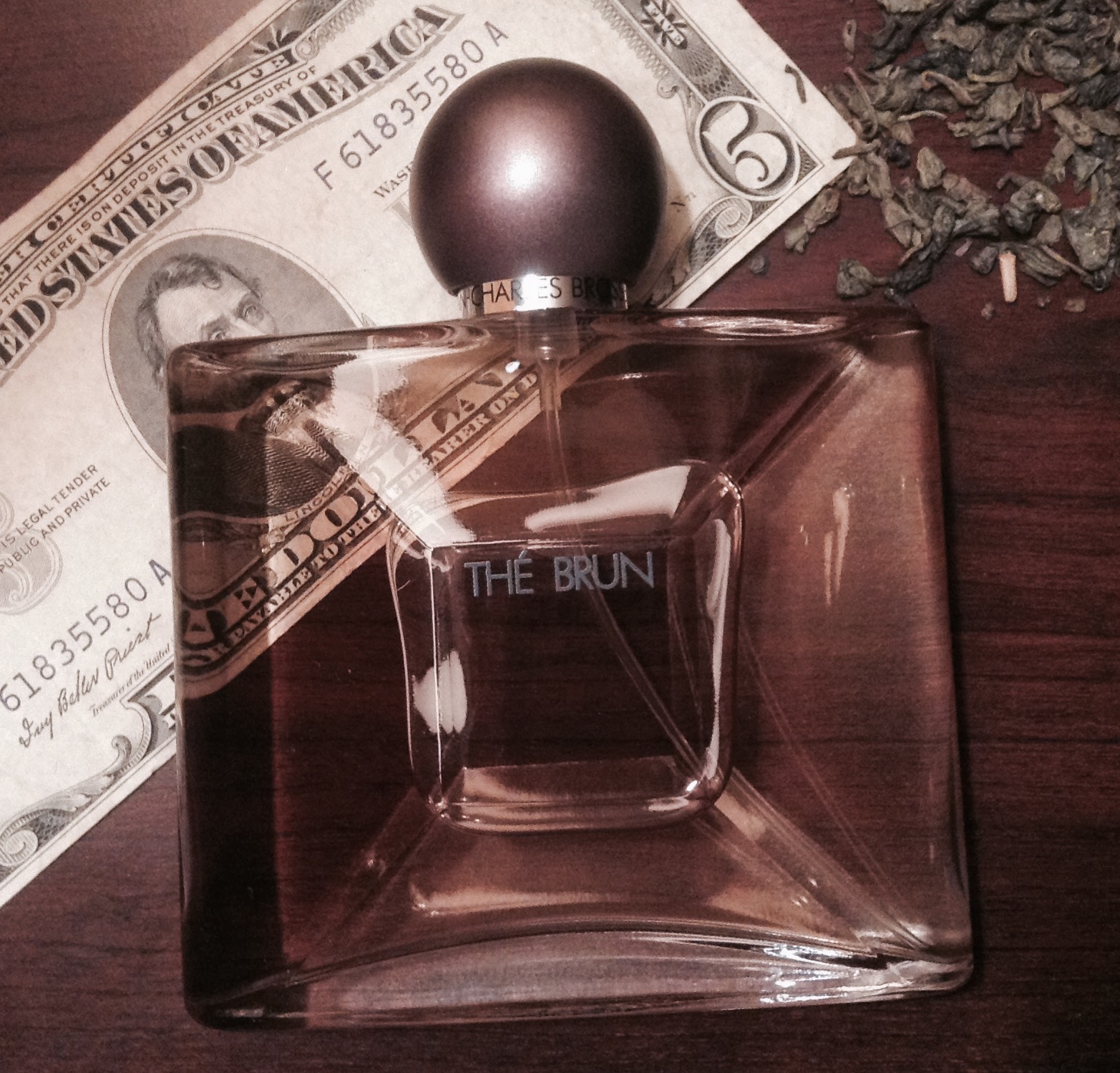
Thé Brun (Jean-Charles Brosseau)


In 2005, Pierre Bourdon created this now-forgotten tea fragrance for the somewhat obscure firm of Jean-Charles Brosseau. Thé Brun is an oddity, a Bourdon creation that flew under the radar, and never landed. It has attracted a bit of attention in the past few years via basenotes threads such as this one, with speculation that Bourdon is the nose behind Creed's Aventus, and that he "tested" the Aventus concept five years earlier in JC Brosseau's scent.

To my nose, no such "test" occurred. Thé Brun's note pyramid lists pineapple, but I get none from any stage of the fragrance. If the idea is that Bourdon rehearsed Aventus' "smoky" accord in Brosseau's frag, then it was by accident, because the smokiness in Thé Brun smells like an extension of its sweet, milk-and-sugar black tea drydown. The scent evolution is as follows: a trite fougere top note of cheap and unnecessary lavender, rapidly followed by a cloud of campfire smoke, which coalesces into a bitter, somewhat smoky Lapsang souchong note.

In Aventus the smokiness is papery, birch-like, reminiscent of American bills, and it lasts forever. Here, the smoke communicates a specific kind of aromatic Chinese tea, and is more complex. The Lapsang trails off after an hour, leaving a hyper-realistic British Colony mug tea in its wake. It smells like cheap English Afternoon tea, a commonplace beverage you might sip on your lunch break. It is recognizable, mellow, and pleasant when used judicously.

What does Thé Brun signify to the culture? Newsflash: Bourdon was obviously making charming niche scents for down-market brands while also allegedly creating upscale niche for Creed and Frederic Malle. He may have authored Aventus, but I wouldn't point to this frag as proof of that. There's no tea in Aventus. Thé Brun, on the other hand, is 100% about tea. When I sniff its atomizer, it smells like a cup of Twinnings. Truth in advertising! By the way, its minimalist gem-cut bottle is a nice touch.

12/11/19

A Few Words For Dan Mish


I discovered Dan "Mickers" Mish's channel in late 2011 or early 2012, very early in my fragrance journey, and he was one of the first reviewers I watched. With his infectious positivity and memorable chuckle, Dan always came across as a genuinely good person, with a great sense of humor, and nary a mean hair on his head. He was always entertaining to watch, and his channel became a sort of "institution" on YouTube. In short, he was one of the good guys that kept fans coming back.

I appreciated Dan's love of Creed's Green Irish Tweed as the mark of a man with good taste. Dan was more than just a snappy personality; he had a good nose. Near the end, Dan pointed out that he got a sort of "evergreen" note (I'm paraphrasing) out of Old Spice. At first I didn't understand what he meant, but after revisiting the current formula, his impression "clicked" with mine, and one of the woodier spice notes, maybe the clove, struck me, for the first time ever, as "piney." The ability to notice and recognize subtle notes is what the better noses do by nature, and Dan did it daily.

It saddened me to learn of Dan's passing, particularly because he was so young and had a family. He will be missed and remembered fondly as a man who did everything he could to share his love of scent with the world. For that, the world is a better place, and I owe him my thanks. It's safe to say that if I hadn't watched his channel prior to starting my blog, I may never have undertaken the task of writing about fragrances. He was an inspiration and a gift to the community, and I am forever thankful for him.


12/31/18

I'm Still On a Break, But I Had To Talk About The Awesomeness of Barbasol "Canned Goo"


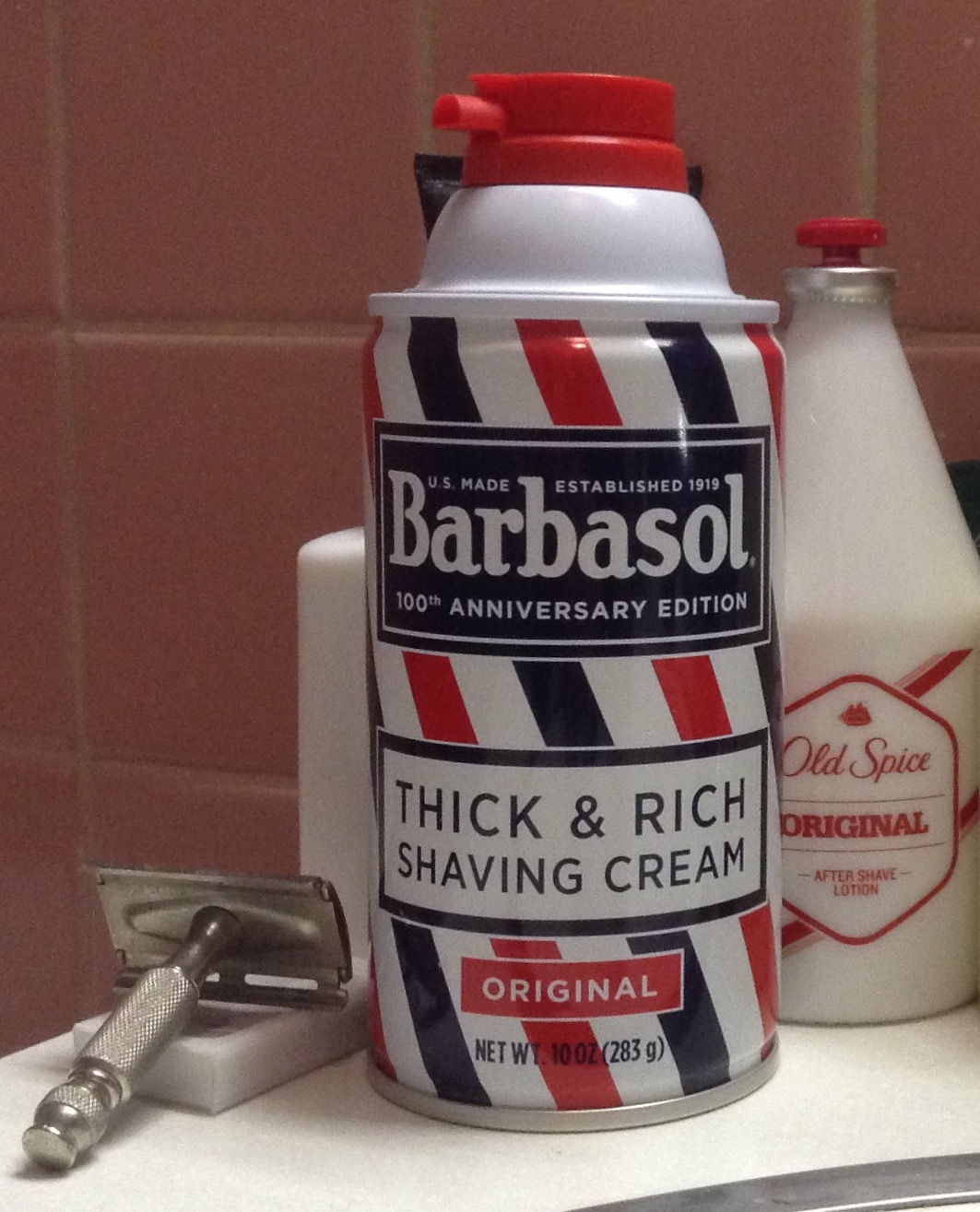
I would be remiss to not mention this, especially at the end of the Year of Barbershop. It came to my attention that Barbasol issued a 100th anniversary can, which is essentially the original graphic design from 1919, a lovely striped barber pole look. It's simple, eye catching, and the retro approach even carries over to the copy on the back, which touts Barbasol's "thick, rich lather."

I love this kind of stuff. Pepsi recently reissued their 1980s graphic design, and that looked awesome, and now Barbasol has successfully appealed to appreciators of retro Americana with their celebratory can. I hope they keep it on shelves at least until June, because I want to stash two or three of these around the house.

I also happened across a can of the mythical "Yellow Barbasol" - the skin conditioner version that was very recently replaced by "Purple Barbasol." If you frequent Badger & Blade, you're familiar with the countless threads about Yellow Barbasol. For some reason Barbasol distributes its color-coded variants unevenly across North America. Everywhere you go, you can find the original "Red" version, and it seems that "Green Barbasol" is also everywhere (that's the aloe infusion, which is my favorite). But nobody can find "Yellow Barbasol," for reasons that have never been clear. Stores don't stock it, and Amazon charges a small fortune for it.

There used to be "Blue Barbasol" with menthol, which if I'm not mistaken was called "Arctic Chill." That was discontinued a few years ago, and I'm sure I used a can or two, but can't remember what it was like. "Blue" has been replaced with "Teal Barbasol," now with both menthol (cool) and caffeine (not cool). I'm not a fan of the new caffeine trend in hair and barber products. Yes, caffeine constricts blood vessels and prevents swelling and irritation, but those of us with caffeine sensitivity are forced to buy Gillette's menthol aftershave, which I believe is decaf. Bummer.

Perhaps the second-rarest Barbasol is "Orange," which is the "Sensitive Skin" formula, full of precious herbs and woods to soothe inflamed cheeks. But I've seen the orange stuff on shelves. I've never seen the yellow label. Until the other day, when I spotted it in an IGA grocery store in a backwoods town in central Connecticut. This stuff was impossible to find when it was still in production, and now it's discontinued, and I find it. Life is weird. Probably shoulda bought three cans.

So what is "Yellow Barbasol" like? It's excellent. This is the formula with Lanolin oil, which is a natural skin conditioner. Yellow smells like a lighter version of the original Barbasol, sort of an Old Spicy scent, but it's not the smell that makes it great. It's the slickness. Let me address the slickness of Barbasol for a moment.

Many forums are inhabited by men who deride Barbasol as being "canned goo," a product they will never allow into their shave den. They turn their noses up at shaving foam, favoring expensive shave soaps instead. I understand their point of view, but I'm not especially interested in spending thirty bucks on a decent puck of shave soap, and then spending forty-five minutes preparing and cleaning my shave mug and badger brush at six in the morning.

Enter Barbasol. Canned foam is fast. Canned foam is easy to use. Canned foam requires zero cleaning. Canned foam works. But there's a trick: you have to mix it with water. Countless posts abound of men complaining that Barbasol lacks slickness, Barbasol is drying, Barbasol clogs razors. Barbasol lacks slickness in its virgin state. You're supposed to use one part Barbasol to two parts water. The result is a stable sheen of fairly slick foam that actually handles a DE razor quite well.

Barbasol has never clogged any of my razors. It rinses quickly and almost too easily. You know what does clog my razor? Cremo clogs it to death, and Cremo is three times the price. Not only did Cremo clog my razor, it also clogged by drain. I had to spend two hours disassembling my bathroom sink and cleaning Cremo gunk out of its pipes. Cremo is crap.

Four years of using Barbasol in that same sink yielded zero clogs, and when I watch it dissolve in water, I'm not surprised. And as for its drying qualities, yes, the original formula does dehydrate skin a bit. I need a moisturizer after shaving with it, especially in the winter. But so what? It's like $1.50 a can. For that kind of money, I don't expect perfection. I expect functionality and convenience. When something works correctly and doesn't cause any serious problems, it's successfully functional and convenient, and therefore worthy of use.

The Yellow Barbasol formula doesn't dry my skin, and I noticed its moisturizing qualities carried on for a few hours after my shave. It's also very easy to use, allowing the razor to glide freely across my face, perhaps a touch better than any of the other colors in the Barbasol line. Is the yellow label worthy of high praise? Should it be sought after as the stuff of legend by wetshavers everywhere? In my opinion, yes. This is good stuff. If you enjoy shaving, you should have a can of this.

I've used other foams. Noxema has a decent canned foam that I have no complaints about. Gillette has good foams, and I think they still make their lemon-lime foam, which is pretty good. But Barbasol has always had the extra old-school cool factor. I'm not a huge fan of their latest logo redesign, but lately most drugstore brands have been sucking in that department, so why should Barbsol be left out? They should make the 1919 anniversary can their regular design, and just change the color of the stripes for each version. I think if they did that, they'd destroy the competition.

Okay, now I'm taking a break. Happy New Year, everyone. See you guys in 2020.


12/8/18

Taking A Break


Ancient Greek perfume bottle

When I started this blog in 2011, my circumstances were very different. I was living at home with my parents, employed part-time, and adrift in a lake of financial insecurities and relationship problems. Fragrance was an escape, and blogging was a useful creative outlet for those days when there was little else to do.

In the subsequent seven years, my life has changed dramatically. I'm now over-employed, working a full time job with an additional stipend attached to its salary, I own a house, my financial outlook has improved significantly, and I've managed to make friends with my ex. But fragrance and fragrance blogging are no longer escapes for me, at least not in the way they were.

I've seen a fair few fragrance blogs die in the last ten years (I've been reading them since 2008), and what always surprises me is the finality of their demises. There was a very good blog called Pere de Pierre that very suddenly died and was cremated altogether - you can't even visit the URL anymore - and it was ended with a post, titled "Perfume is Boring." That's just one example - there were at least ten or fifteen other blogs that met similar fates, often without warning. It's as though their authors just died. One day they're posting something interesting to read, and the next, there's nothing. And that nothing stretches on for days, then weeks, then months, and finally years, and at that point you know the blog is finished.

This will not happen on From Pyrgos. This blog will not die. I will not forget that I am its author, nor will I abandon the URL. I will not delete the blog, or let it be labeled "dead" by anyone who wishes to replace it.

However, I'm entering a stage in life right now where I'm not as interested in shouldering the persistent cost of maintaining the blog. It takes money to buy fragrance, and to keep reviewing new and interesting things, and I'm getting tired of spending that money. I've recently grown interested in saving and diversifying my wealth. I'm looking carefully at investing in the stock market. I'm considering buying some gold coins from the mint. I need to contribute to my 401K. And I'm looking to put together a few stacks of hundreds, maybe save a few grand in cash.

Do I think perfume is boring? Absolutely not. It's always interesting. At some point in the next year, I'll purchase something, and it'll probably be something expensive. When that happens, I'll take note of it as something to write about. But meanwhile, I'm officially taking a year off. I know that doing this will reduce my page views and subscriber count significantly, but that's no longer a concern of mine. Hopefully faithful readers will return in the future. Consider this the last blog post you will read here until 2020, unless something cataclysmic happens in the news (and I hope it never does). I'm signing off for now. Keep smelling awesome.

Bryan

11/24/18

The Razor's Hedge: Why I Play It Safe and Stick With Two Types of Blades (and The One I Prefer)


When it comes to pre and post-shave ablutions, my shave game is flexible to a fault - I have a dozen aftershaves and several soaps I use on a regular basis to "condition" my skin for optimal shaving. The key to wet shaving isn't to have the best "technique," or the most expensive and exotic gear. It's actually about familiarity, and keying in on what you know.

I often wonder at the dudes who make videos about their "first time" using a straight razor, or any razor. I also shake my head at the ones with collections of fifty razors and two or three dozen different blades. I get the enthusiasm, I totally understand the "collector's mentality," and it's no mystery that wet shaving is an addictive practice. After doing it for ten years, I can never see a return to an electric razor. There's just no way it's ever happening.

In my experience with wetshaving, choosing a razor from a customized, velvet-lined drawer, and fumbling through a mound of razor packets isn't how I want to "mix it up," and lend variety to the morning. Aftershaves are safe for that, but razors? Not so much. With blades, getting adventurous ends in pizza face. I see no reason to have a razor collection, or to get gung-ho over a "shave den" stacked with paraphernalia. But then again, I learned to wet shave with Feather DE blades in a Feather razor. My only paraphernalia were band aids and tissue paper.

Trust me on this: there's nothing harder to use than a Feather DE, even one with a closed comb. It can slice through a gourd like hot butter, and mine had a stunted top, with way more blade exposed than your average three piece DE. Ten months into a regular routine, and I was still skewering my cheeks, but you know what? I learned. When I switched to Gillette and Astra blades, it was like going from Chess to Checkers. Suddenly the focus on precision shifted to a focus on handling, on wrist action, on easy angles, and as my fear of slicing flesh diminished, my eagerness to practice various strokes increased. I developed a sense of pressure sensitivity and grain patterns, with every knick and slit aiding the process of mapping out my face and neck. Now all I had to do was accelerate the process and become more efficient with my time.

I probably struggled through a dozen different blades before my Feather razor broke (shoddy craftsmanship, surprisingly), which forced me to seek out something similar, but better. Enter my trusty 1960s vintage Gillette Travel Tech, a notoriously easy daily shaver with a very simple three piece, closed comb design, and much better unibody molding that will likely last me the rest of my life. With that razor, it suddenly got much easier to settle into a blade. For a couple of years I used Derby Extras exclusively, and though I was aware of their crappy reputation, I wasn't dissatisfied with their performance. They're Turkish blades, known for being a bit duller than average, and even perhaps a bit of an underperformer in the closeness department. But for my three or four-day stubble, they work fine.

Occasionally I'll notice with Derbys that my skin gets a bit chaffed. Not sliced, not knicked, but chaffed, like someone rubbed sandpaper across my cheeks. This is a result of their dullness. Duller blades are a trade-off, as are sharp blades. When the edge is too mild, the shave might be safer, but the wrist does a subconscious trick, and sends the blade angle closer to ninety degrees than it would if the follicles were shorn with more ease. The end result is skin well shorn, with little visible irritation, but with more long-term, delayed irritation, which is a dramatically negative sensation. After a few shaves like that, I develop redness, patches of rash-like irritation that linger for weeks, which aren't easily assuaged by menthol or balms.

When a Derby shave goes well, it's usually because (A), I softened my hairs prior, or (B), I allowed for an extra day or two of growth. Hard to say why, but when my hairs are longer, Derbys work better. They cut closer, and rarely leave irritation. In these cases, I'm happy to follow up with some Old Spice, particularly Indian OS, or Pinaud Virgin Island Bay Rum, mainly because I can afford the burn. A perfect shave happens maybe once out of every five shaves, and in that case it's almost like I never touched my face with metal at all. It's the aftershave that reminds me.

Still, shaving with just one blade (and following it with just one aftershave, for that matter) is a bad idea. My skin has a mind of its own, and it "learns" what I'm doing. After a month or two of the same routine, it suddenly doesn't matter how carefully I go about things - my skin will begin to rebel. I'm not sure why this happens. My best guess is that its chemistry adapts, and begins to institutionalize against external conditions, which is to say that it registers a uniform treatment despite changing weather, humidity, seasons, etc., and thus has adverse reactions.

When this happens, I'm reminded that it's time to change things up a little, although not by much. When I'm repeatedly reaching for Skin Bracer or Osage Rub, it's time to reevaluate what I'm doing. My second razor of choice is Astra Superior Platinum, which is a more well regarded blade in the community. ASPs are sharper than Derbys, are better made (straighter lines, fewer defects, a good Russian blade), and are arguably more versatile. Astras are more agile after two or three days growth, but they're a blade of precision customization. They're easy to use, but easier if you have the right kind of razor. The Gillette is perfect, it has a fairly narrow comb with just enough metal exposed, perfect balance, and no aggressive stroke risk, unless you're a real novice who thinks he has to karate chop his jowls apart.

The plus side to Astras is their quality - overall, these are well made and effective blades. It's hard to find fault with how the factory is churning them out. Derbys are also decently made, but occasionally (maybe in one out of ten shaves) I get one with an uneven edge, the slightest depression in the metal, or a slightly crooked edging, and that can add to whatever irritation I'm at risk for. This risk is lessened when I use Astras - I can't think of a single time I've encountered a noticeable defect, although I do notice that they warp easier than Derbys.

Warping blades isn't a "thing" per say, but it is for me. That's because I tend to leave a blade in the razor for a day or two after using it, or put it in the razor a day before the shave, thinking I'm going to use it sooner. By the time I get to it, the metal has bent ever so slightly under the pressure of the three piece Gillette, and that can be no big deal, or it can yield some surprises, depending on hair length. I've had instances where Astras were warped a little too flush to the comb plate, rendering its cutting power virtually useless. It's something to watch out for.

Which blade do I prefer? If I had to choose, I'd say I prefer the Astras. I like Derbys, and still use them, and probably always will use them, but Astras are a better default, and in the last year or so, I've switched from using Derby to using Astra as my default blade. I'll never return to Gillette or Feather, although I certainly wouldn't object to the occasional Gillette in a pinch (they're overrated in my opinion), and Feathers are, well, Feathers. No use mincing words. The blade has already minced them for me.

The toggle between the two blades keeps my skin from getting too institutionalized into a learned routine, and for every six or seven Astra shaves, I can get a couple of Derby shaves in, and find little to no irritation in that pattern.

If you're a novice, just starting out in the world of wet shaving, and you've chosen your first DE razor, my advice is this: try the sharpest blade first. This might be something like a Feather, Gillette Seven O'Clock SharpEdge, or Wilkinson Sword for you, or it could be another brand, depending on where you live, but if it has a reputation for being aggressive and tough to use, all the better. You'll develop a sense of the physicality of shaving, and the feedback you get with your styptic will be a postgame rundown of what went wrong. It'll be a few months of ugliness and pain (your face will persistently resemble a Papa John's stuffed crust pepperoni pie), but when you feel like you've mastered the hardest blade, you'll have earned the way to more comfortable blades, and you'll have developed, on a subconscious level, a set of skills for minimizing the nefarious pitfalls of duller blades.

Why not start with milder blades, you ask? Sure, go ahead. But the issues with milder blades are exactly like what I've described with my Derbys - they're sneakier, latent, harder to correct if you're new and don't know the angles - literally. My experience with post-shave pain has consistently been that delayed razor burn, rashes, and chronic irritation are far worse than getting cut by a super sharp blade. Cuts and knicks hurt like hell, but the pain fades fast, and styptic takes care of the rest. So really, start with the hard stuff, and then work your way to something friendlier. You won't regret it.


11/14/18

"Outdated" vs. "Dated" Fragrances


Is the telephone outdated? Not in the least.

In a recent basenotes thread, the OP pondered Habit Rouge, and wondered if fragrances of its ilk are truly "dated." The general consensus was that fragrance appreciation is mostly subjective, and the conceptualization of something "dated" could apply within this broad framework, if one looks closely enough at it.

As I perused the responses, I noticed that no one made the rather important distinction between "dated" and "outdated." This tends to happen frequently whenever I discuss classic fragrances, especially masculines. Recently a faithful and valued reader challenged my attribution of the word "dated" to Zino, and wrote at great length that by today's niche-friendly standards, something like Zino is merely ahead of its time. I concur wholeheartedly, but admit that describing something as lovely as Zino in such a succinct way can lead to misinterpretations of my words, and my definitions.

There is also a greater danger. If fragrance appreciation is to be considered entirely subjective, then definitions become meaningless, and we begin to head down the road of misunderstanding how perfume fits into the endless narrative of our history. Take telephones, for example. Can we view the telephone from a purely subjective standpoint and say that whatever charms your average landline telephone hold are whatever you make of them? Or can we objectively identify a difference between contemporary cell phones and antique rotary dials?

If you ask me whether telephones are "outdated," my answer would be surface-level negative. Smart phones are technically telephones, and therefore the concept of the telephone isn't "outdated," because we still need telephones, and still use them. But ask me if a Northern Electric Company candlestick telephone, like the one on my desk, is "outdated," and you'll get a much different answer.

The same applies to fragrances. Zino is "dated." It smells like a direct ancestor of Brut, adjusted to suit 1980s fashions. It also smells like a fragrance that spawned a zillion other fragrances, which means it has its own lineage. (It's similar to people that way.) The fact that contemporary niche frags, which are full of ambery, woody, animalic, tobacco-inspired, "smoky" notes, smell right at home next to Zino, speaks to a return to the sensibilities that introduced this template in the first place, which also makes contemporary niche frags susceptible to being labeled as "dated."

But it is these very contemporary niche frags that insulate Zino from being "outdated." Like I said, Zino is related to Brut, but is an updated, improved, and ultimately more successful iteration of that which Brut represents: the quintessential ambery fougere. Nothing has superseded Zino in excellence, but many have imitated and expanded upon it. So if Zino is "dated" but not "outdated," what does that make Brut? Wait for it . . . . Wait for it . . .

Yeah, Brut is "outdated." Make no mistake, it's still relevant, it's still wonderful, it's still fun to wear, and it's still entirely wearable, and it even garners sincere compliments from women (I got one not long ago), but if we refer to Brut, we are referring to a fragrance that has been eclipsed and contextualized firmly within its time period, the mid 1960s. Another fragrance that is "outdated" is Jovan Musk for Men. One can enjoy MfM, one can love MfM, one can wear MfM til the cows come home, but in the end, it represents a time when sweet, somewhat acrid and animalic musks were all the rage. Fortunately, they are no longer the rage.

Now, if you were to present me with something cast from the Musk for Men mould, perhaps something like Ungaro Pour L'Homme II, and tell me II is "outdated" by whatever standard you hold, that's fine, but I would vehemently disagree. Despite its being rich with synthetic musks (not the least of which is a hearty dollop of Civetone), and cast in the bourbon-barreled style of the late 1980s, I would merely refer to it as "dated," and even go so far as to suggest that it's barely that.

Ungaro Pour L'Homme II represents that rarest of rarities in the masculine canon - an endpoint to a specific evolution. The species in question? Guerlain's Jicky (in the abstract); Pierre Cardin Pour Monsieur (for practical discussion). From Jovan Sex Appeal, we trace a handful of similar ambery fougerientals, until we reach the sleekest, most efficient, and most impressive creation, with the biggest budget, and with the biggest contemporary designer brand behind God's curtain (Chanel). Though it smells of a bygone era, and elicits nostalgia, II is still viable as a contemporary creation by dint of its never being surpassed.

And so I say to those who fear these terms, fear not. Greatness, cultural relevance, and lineage all factor into how these things are defined. We can inhale Mitsouko and consider it "dated," a thing of postwar decadence, but we can also consider it eminently viable as a contemporary fragrance (although this is arguable). We can do the same with something like Zino, probably with greater ease, despite its age, simply by considering what Zino is - a great fragrance. And Habit Rouge can also sustain the ironic considerations of those who appreciate its time period, without needing to relive its time while wearing it.


10/25/18

Unplanned Obsolescence: Do Millennials Lack the Attention Span For Perfume?


A suitable replacement for any Creed.


I recently read an article by Sarah Wu on Glamour.com, entitled "I Replaced My $215 Perfume With This $6 Body Wash," and it intrigued me.

Sarah writes:
"Twenty seconds into trying on my first perfume (the classic, spicy Paloma Piccaso), I got bored and proceeded to add a few generous spritzes of Bath & Body Works Cucumber Melon . . . I wear something different almost every day, flitting between bottles as often as my mood changes (aided largely by magazine testers, blogger swaps, and free samples from department stores)."
When I read this, I had to rub my eyes and reread it twice before believing what was actually on my screen. Paloma Piccaso couldn't even hold her attention for twenty seconds? Twenty seconds??

It surprised me for two reasons, the first being that it suggests our attention spans have become so poor that we can't even maintain interest in our own personal fragrance, which presumably has ever-changing top, middle, and basenotes. It also reminded me of my ex, who was given to "layering" perfumes, and randomly spraying new ones, often blending cheap body mists with pricier fare.

It now makes sense why she did that: she was bored. In the age of iPhones and apps, social media immersion, and the Internet of Things, we are officially becoming the insipid children of tomorrow, in an age when everyone, in chronic fits of technological withdrawal, seeks stimuli so forced, detached, and fleeting, that worldly pleasures no longer satisfy even brief moments of exhaustion.

Sarah apparently fell in love with Grand Soir by Maison Francis Kurkdjian, but when it was confiscated at an airport on her way to a country where it was unavailable, she discovered Dove Cream Oil Intensive Body Lotion, and felt that the soft, vanilla skin scent of that stuff was an excellent substitute.

This is a very strange thing to say. This isn't the same as someone saying their interest in niche perfume has been diverted to a greater interest in cheap drugstore lotions. It's not like saying that well-crafted perfumes are no longer your taste. It isn't even saying that a lifestyle change necessitated such a bizarre substitution; in the age of the interenet, we no longer need to worry about sourcing products, as any online merchant can ship them directly to us.

No, what Ms. Wu is saying is that she enjoyed the ambiance of the Dove cream enough to not miss, or even long for, Grand Soir. She is essentially saying that she doesn't see the need to ever purchase Grand Soir again, thanks to Dove. Now, if she had said this in an intellectual vacuum, where this topic alone was addressed, I would understand. But with the paragraph quoted above preceding her story, I can't help but think that Sarah Wu can't sustain interest in a luxury perfume, and thus prefers an almost undetectable skin scent lotion, upon which she can parade a myriad of different scents.

If I ever said I'd replace my Green Irish Tweed with Nivea Men aftershave lotion, because it's green and fresh enough to always make me smile, I'd ask you to take me to the emergency room.

Sarah's article fills me with despair. On her embarrassingly pathetic twenty second trajectory, we are headed for a different world, with a different kind of perfume. Instead of having perfumes as individual scents with legible drydowns, the future will bring us perfumes marketed as chameleons, strange creatures that are labeled as being "3-in-1" scents, each drydown phase so disparate from the others that they will save wearers the trouble of layering, or changing scents mid-day. It is conceivable that the young woman of tomorrow will purchase something like a "summer mélange mist," with top drydown of lime and coconut, middle drydown of watermelon and sea salt, and base drydown of lemon, grapefruit, and cherry blossom.

Each drydown will happen abruptly, spaced out by two hours, and in the course of six hours, the young lady will have worn the equivalent of three distinct perfumes, after only applying one. The old rules of citrus and aromatic top notes burning off and leaving a sturdy base of woody florals and musks will no longer apply, as new (and some not so new) advancements in technology will enable perfumers to attach formerly transient accords to late phases of wear. And instead of each drydown phase assembling into one beautiful composition, their transitions will intentionally diverge in character and tonality, stark enough to leave no trace of a single preceding note.

While this may sound like a good idea to some, I fear it would mark the beginning of a dire age. Imagine a world where people have so little attention and patience that they can't even bear the thought of wearing one perfume all day? What else would they have no time for? Reading a book? Watching a movie? Having a conversation? Eating a meal at the dinner table? Answering childrens' questions about life? Having a single original thought?

I keep waiting for the day when it will become obvious that technology is synonymous with progress, but after a lifetime, I'm still waiting.


10/12/18

Creed Is Releasing Yet Another Aventus Flanker. Is This a Good Idea?


Oh, It's You Again.

Apparently Creed has decided, against its better judgment, that one Aventus isn't enough. The world desperately needs another. They came to this conclusion two years after the release of the first Aventus flanker, the clumsily-named Aventus For Her. And by the way, Aventus isn't the only Creed to get flanked - Love in White has LiW For Summer, in case it gets lonely. There are probably one or two other Creed flankers that I just haven't noticed, so if you happen to know them, please mention them in your comments below.

The thing is this: Creed is supposed to be a niche brand. I know there aren't hard and fast rules for marketing niche frags. It's not like the words "Thou shalt not flank" are etched in marble on the sidewalks of the Upper East Side. It's a free market. You can do as you please, and let the shareholders judge for themselves. But in a world where every designer label feels the need to flank incessantly, a world where Thierry Mugler's obsession with flanking has infected Chanel, Dior, YSL, Prada, and many others, eventually the question is raised: should a niche brand make flankers?

How does it look, exactly? I see Aventus, and I see Creed created another industry-changing behemoth, in the tradition of Green Irish Tweed and Millesime Imperial. At some point, a legacy designer will get smart and create a nearly identical clone of Aventus, in much the same way Davidoff and Armani did with Olivier's aforementioned perfumes, which is all the flanking a truly great fragrance needs. Creed should be setting an example for other niche brands by firmly reiterating their erudite approach to creative output as the ever-chic and simple "one-and-done."

Why riff off your own work? What more can you add to something done right the first time? Then there's the question of whether it's worthy of your brand's pedigree. Creed is supposed to be top shelf. We're talking $500 bottles here. Why should I see them on that level if they're following a designer trend, and making flankers? Brands at $90 per bottle issue flankers. Brands at $45 on the grey market issue flankers. Brands you buy in boredom at Marshalls and Walgreens for $16 issue flankers. Brands that make you choose between their perfumes and paying your mortgage should not be peddling cynical, money-grabbing flankers.

How do people perceive your brand when you start hedging your bets after critical letdowns? I perceive nervousness, with a dusting of panic. Creed got spooked by the underwhelming reception for Viking (and the rather intensely polarized reaction to Royal Mayfair), lost the belly to chance it with something new, and decided to play it safe by releasing a variation of a sure thing. An understandable strategy, but not the best look. It's embarrassing, especially for Creed, and anyone with half a brain considers it a clue to how devastating Viking was to their bottom line. The combined efforts of keeping Viking on shelves and releasing Aventus Cologne right after seem more like vain attempts to save face than smart business.

I think Creed has done excellent work in the past, and hope they continue releasing incredible perfumes in the future. But I'm really hoping they don't go all lowbrow on us and start making flankers, and then flankers for flankers. Aventus Cologne might smell great, and might be a limited edition, which would be preferable to a permanent entry in the line. But then again, it might smell like another disappointment. And after Viking, I doubt Creed wants more perplexed and dissatisfied customers.


10/7/18

Lomani Pour Homme, A Review of the Latest Reformulation (Parfums Parour)


New and Improved Package, New and 'Improved' Contents

I don't know when it happened, but sometime in the last three years, Parfums Parour reformulated Lomani Pour Homme, and significantly changed its packaging. I reviewed this fragrance many years ago on basenotes and Badger & Blade, and pointed out that its "fresh" dihydromyrcenol and slightly fruity top notes were more a progenitor to Cool Water than anything else, but here on this blog I aligned my opinion more with its being on the Drakkar Noir axis.

At this point, in late 2018, the Year of the Barbershop, I found myself wondering if Lomani PH was worth revisiting. Again, to recap prior opinions, I found its structure classically fougère, but also remarkably cheap in both concept and execution. It smelled like the perfumer put dihydromyrcenol through an olfactory amplifier, and had dialed its synthetic facets to eleven in the top and early drydown stages, but then ran out of money. To close out the show, Parfums Parour settled on a very lonely tree moss note in the base, which made Lomani smell like a handful of stale wood chips after ninety minutes of wear. In short, it was one of the worst fougères I'd ever smelled.

I think this reformulation is a good opportunity for me to point out the key differences between oak moss and tree moss. Some fragrances benefit more from tree moss than oak moss, and some are the opposite. Two examples are Z-14 and Lomani Pour Homme. Z-14 belongs in the former camp; Lomani belongs in the latter.

Tree moss is dry, and aids in streamlining woody accords. It works beautifully in Z-14, among dry woods and woody citrus. Oak moss is much more diffusive, and amplifies any "fresh" chemical in its vicinity. It works like iso E Super, as a fixative and texturizing agent. Good fougeres marry aromatics to coumarin, and benefit from oak moss. Tree moss flattens aromatics and coumarin, leaving a one-dimensional drydown (Lomani circa 2010), but oak moss activates the aromatic connectivity between top and base, allowing crisp herbal notes to powder into a pleasantly clean shaving foam effect.

Thus the reformulation of Lomani PH is a less successful fougere than its earlier iteration from several years back, and for one reason alone: they replaced the tree moss with some kind of fake moss. Lomani PH is arguably the cheapest fougere you can buy, now yours for literally $6.98 if you can catch Fragrancenet's 30% discount offer. That's actually cheaper than Pinaud Clubman.

That means you can be utterly broke, and still possess a modern aromatic barbershop fougere in Lomani PH, which I also still consider an unheralded entry in the Drakkar Noir axis of barbershop ferns. Will you smell sophisticated? No, you will smell like you shaved, and applied some mixture of aftershave and witch hazel.

Lomani PH is a celebration of synthetic barbershop chemicals. They even colored it the same as Barbacide. P-Parour isn't going for broke here. They're just putting out the most basic Reagan era fougere imaginable on a shoestring budget. The hilarious thing is that they tout its "new look" on the box with a red imprint (something no classy brand does), and yet the box and bottle are almost identical to their former selves. The box is still drab grey with 1980s font; the bottle is still clear glass with an elliptical cap. Except now it has a silver plastic atomizer, and silver shoulders separating cap from bottle. Great. It looks better than it did, but not by much.

I often read about how Lomani is such a great clone of Drakkar Noir. I'm not sure it's "great." Drakkar's use of dihydromyrcenol is clever, taking its freshness and using it to amplify pine, wood, leather, and lavender. Lomani has a hint of apple-like fruitiness, a hint of soapy lavender, a very vague hint of pine. Yet nothing materializes into an accord. Instead it smells like dihydromyrcenol is an ingredient in a shave soap from a dollar store. It smells good for the money, and you got a superb deal. But how much of a deal is a crappy fougère that only cost you $9? 

What more needs to be said?


9/29/18

Is Caesars Man Worth Big Bucks On Ebay?


Well, it's happening again. Instead of using their heads and basing their pricing of a discontinued masculine frag on the rate of inflation, merchants are pulling insane prices straight out of their asses. I saw this thread on basenotes, which rightly asks why prices for Caesars Man cologne have skyrocketed, and once again, I have no answers.

When a cheap and readily available frag is discontinued, merchants ought to follow a simple formula for post-market pricing. Instead of basing the price on what it was last sold for, you base it on its price when first released, and adjust for inflation. This is how you find a fair price. Let's assume Caesars Man was sold for $25 back in 1988. It's a resort brand, a popular casino, and thus a relatively specialized release. For the time, $25 would be considered pricy, but not "luxe." I think it's a reasonable guess that they wanted at least this much for 4 ounces of it.

Now adjust for inflation. Twenty-five dollars in 1988 adjusts to $54 in 2018. There's your discontinued Caesars Man price. Bottles ought to now sell for $54.48, to be precise. So why am I seeing them on eBay for $229? Why are they pricing this cheapie at Creed price points? Where are these numbers coming from? The average merchant wants $145 on eBay, and some are asking $150 and $170. At least one wants an insane $238, with shipping. Is this fragrance even remotely worth this sort of coin? Of course not.

I've only ever sampled it at discount stores like Marshalls and TJ Maxx, and I can tell you it's a blatant clone of Drakkar Noir. It's nice stuff, but nothing original. It's a cheap, old-school fougère. We should refrain from entertaining eBay fantasies about it being worth anything more than $60. It's just not original enough for big bucks. Not to mention it smells pretty synthetic. This isn't a "natural" version of Drakkar Noir. It's just another synthetic green fougère that guys have been buying for $9 at Marshalls for years.

In comparison, 3.3 oz bottles of Francesco Smalto Pour Homme are selling for $79 to $129, and that one is far more natural and distinctive. Also, it's been discontinued for much longer, and it was released a year before Caesars Man. I'm fairly sure FSPH was priced around $30 for the large bottle in 1987, which makes its inflation value $68 today. You can get a 1.7 oz bottle for less than that ($54), which is a little high, but not ridiculous - I would think that size would have sold for half that much back in the day.

Lomani Pour Homme, which is a decent alternative, is still available for $8 on several sites. It's a perfectly reasonable fougère in the Drakkar Noir style, with perky green top notes and a shave-creamy mid, but it dries down to a hollow and overly simple moss note, and thus isn't something I kept in my collection. And of course, you can still buy Drakkar Noir for around $40, and get the original scent without any embellishment, so why even bother with cheap clones?

If there's one thing that makes no sense in the fragrance world, it's seeking out cheap clones of a scent that's cheap to begin with. Looking to make crazy bank on something like Caesars Man suggests people are using customer ignorance for cost calibration, and I find that practice despicable.