1/7/17

Pacino For Men (Cindy Chahed)


Good luck finding a 100 ml bottle.

Linear fragrances are perhaps the most difficult kind for perfumers to pull off. Done wrong, and they smell functional, like furniture polish, or Febreeze. With skill and a little luck, a limited palette can actually work beautifully, like fire engine red, or Yves Klein blue. When I first encountered Pacino for Men, my initial thought was that it would be another rich tapestry of old-school masculine hues, from the deep umber of smoked tobacco, to the burled browns of rosewood, with wisps of artemisia and pine to round off the edges. Boy, was I wrong! The house of Cindy Chahed surprised me.

The only information I can glean about it comes from this site, which I think is an impartial but unusually informative retail outlet. According to the (somewhat contradictory) information found there, the brand was founded in October of 1996, and closed soon after, almost three years exactly, in August of 1999. I guess they weren't moving units fast enough. Apparently Cindy never made anything more than minis, which may have contributed to her demise, although I think a brand exclusively dedicated to minis is an interesting idea, retailing solely from airports to frequent flyers. Pacino was apparently released in 1996, but I have no corroboration on that.

Pacino smells like an apple orgasm. Come to Connecticut in October and visit Lyman Orchards. Tread its rows upon rows of trees in bloom, and inhale the dry, sweet, woody kiss of the autumn air. Stop to grab one of thousands of wine-like dessert fruits, steal a bite, and savor the fresh flavor in your cheeks as it mingles with the crisp air in your lungs. That's the opening of Pacino. It's basically a medley of apples with a touch of pink grapefruit, and a drop of French lavender for extra dimensionality. I fully expected it to darken and get all pre-A*Men oriental on me, but instead it simply mellowed out, becoming warmer and a little sweeter. The apples have been picked and barreled, and their fruitiness radiates from pillows of cedarwood and hay.

It remains this way for the life of the scent, a full five hours, before fading to a skin essence more suggestive of dusty wood than pomaceous fruits. All told, this is a very good fragrance. Its sweetness never smells like candy; its freshness retains definition and clarity without becoming cold and grey. It's like someone took an X-Acto knife to Creed's Spice and Wood, excised its apple top note, threw in a few other cultivars, a little extra woodiness, and named it after a famous American actor. It's crisp, nearly edible, fairly natural (although not extraordinarily so), quite simple, and pleasant to wear. If you're an apple lover, a fan of scents like Boss Bottled, Cool Water, Nicole Miller for Men, and you happen across this stuff, I highly recommend it.


1/1/17

Why You Can't Trust Internet Reviews When Judging The Quality Of A Reformulation


Only the bottle has remained the same.


My main message in this post is short and sweet: Don't trust what I say.

It seems counterintuitive for me, a perfume blogger, to say this, but when you plug it into my larger message, I hope it makes more sense. That is, don't trust what I say alone, not without smelling things for yourself first. Use me as a rough guide, a vague starting point, the nexus of all your concern and enthusiasm for a certain fragrance. But do not consider me the authority, the voice of infallible knowledge. My sense of smell, my tastes, and my understanding of the fragrance world do not necessarily comport with your sensibilities. I am here to guide you, to inform you when possible, and to provide educated insights into the basic mechanics of how certain scents work (or don't work).

Perfume bloggers are tools. In my case, my personality conveys this explicitly. But as useful tools for gaining knowledge, we're small cogs in a big machine. Halston Z14 is an example of why this is true for all internet fragrance reviewers, including supposedly erudite noses like Luca Turin and Chandler Burr.

Z14 gets a bum rap. It turns 42 this year. That's a long time for a fragrance to be in production, and still widely available across the world. Roy Halston's original formula was released courtesy of Michael Edwards, who helped to engineer its place not just on store shelves, but in the pantheon of famous masculines, a realm where compositions endure the test of time. Yet Z14 has fallen on harder times in the noses of fragrance enthusiasts, many of whom consider it a mere shadow of its former self.

The narrative is that vintage Z14 is far superior to current Z14. I recently purchased my fifth bottle of Z14, a formula that dates to at least 2011, judging from its gift set packaging. I paid twelve dollars for eight ounces, cologne and aftershave. I would have passed on it, but my other 2011 aftershave actually spoiled. One day I went to use it and found that its oils had begun separating out of the alcohol. The liquid resembled olive oil vinegarette salad dressing. It was probably still ok to use, but I opted to toss the remaining ounce and just keep my eyes peeled for a replacement.

I also have a more recent formula, what some consider the "Big Red" formula. This version cropped up in 2014, and it continues to generate complaints. It supposedly has a massive, unbalanced cinnamon note, but to my nose the cinnamon is pretty much identical to all prior formulas I've tried. My perception is in stark contrast to some others, though. And that's the point of this post: to show you that the disparity in perceptions makes trusting any one reviewer on the internet silly.

Consider this review from Fragrantica of two "vintage" Z14s, and one "current" Z. Note how this person's opinions vary:

wesleyhclark: "My first take is that the [French issue] vintage stuff smells like serious perfumery. There's a note that I don't think I've encountered in that form yet. It's deep and strong. A dirty leathery smell, perhaps? It's bolder. Compared to it the current stuff dries in a less complicated, somewhat more modern fashion - cinnamon and cypress . . . But here's the weird thing! I tried some vintage Z-14 in Richmond, VA and it's different yet. It's certainly not current and it isn't this French mix, either. It has an initial oakmoss blast that is absent from both."

He uses the descriptors "dirty," "leathery," "cinnamon and cypress." He also notes excessive oakmoss in one of the vintages, which is apparently not as prominent in the other two versions.

Now look at how different the tone is for this person's perceptions of old and new Z:

Bigsly: "Reformulated version (recent with a lot of cinnamon up front): Well, if you hate cinnamon forget this. There's something else with it, which reminds me of what I've encountered in scents listing tree moss as a note or ingredient. Whatever it is (tree moss, leather, a touch of galbanum), it sort of hardens up the cinnamon and gives it a bit of a dry and chalky/powdery quality. This dominates for an hour or so, and then the earlier version of Z-14 begins to shine through, with more lavender than I prefer. However, here the lavender never gets too strong. After a couple more hours the lavender recedes and blends into the mix. At this point it is at its best, unless of course you really enjoy the initial strong cinnamon."

So while the first reviewer notes the presence of cinnamon without emphasizing it, the second finds it especially noteworthy, and doesn't mention any "cypress" element at all. Reviewer one says "dirty," and reviewer two goes into some detail about lavender, which is usually never "dirty." Also, while the first considers the current stuff "modern," the second refrains from such a vague descriptor, instead opting to be vague about what he perceives to be a "trend" in scents with treemoss. Fine to read if you have plenty of experience with fragrances, but it's like wandering into a Black Forest of opinions for anyone new to fragrance reviews.

If I were new to Z14, and I read these two reviews, I'd be very confused. These are two guys who are reviewing multiple bottles of what is supposedly the same fragrance, from roughly the same time periods, and their reviews are quite different. Adding to the confusion is the suggestion by the first review that two bottles of vintage Z14 smelled different! If I were a total newbie, this would probably elude me. But if I were someone with at least a year or two of experience in reading reviews and trying classic fragrances, I might consider this to be a "clue" of sorts. I'll come back to this in a bit. Let's move on to reviewers three and four, both referring to "vintage":

ericrico: "The opening of citrus with integrated herbs and fresh-ground cinnamon takes me back to my youth."

kmarich: "I discovered a vintage splash for under $10. USDs . . . It has a smokey, hazy richness that made me feel warm.

So which is it? If I'm in the market for vintage, should I expect to smell like a Middle Eastern salad, or a campfire? These reviews seem to be for different scents. But if I connect them to the first reviewer's notes on two vintages (probably from different years), I begin to sense that maybe Z14 just smells different from bottle to bottle, regardless of what the manufacturer's "formula" was. Maybe this is an "unreliable performer." Maybe with Z14 there's no way to know exactly what it will smell like until you smell it yourself, simply because every bottle is a little different.

If I approach Z14 with this attitude, then I can comb through the reviews and find this last one to be consistent with my theory:

Aiona: "It smells like celery seed to me, even though I see no celery seed in the notes listed above. It's distinctive. Not a cool aquatic. Not really a gourmand, despite the celery seed. Just a nice greenish scent."

Very interesting. To her, Z14 is "Just a nice greenish scent." You could find a parallel in this description with the "oakmoss blast" description found earlier. But you have to know that oakmoss, while often "green" in nature, doesn't always smell "green" in fragrances. It can smell nondescript, bitter, powdery even. Vintage Canoe is loaded with it, but few consider Canoe "green."

But most notable in this last review is the description of celery seed, which is commonly attributed to Caron's Yatagan. This is a biting, extremely bitter, pithy, woody note. It does not exist in Z14, which is generally a smooth, ambery citrus and cypress blend. Yet this is what the reviewer describes, and if you don't know anything about the fragrance, you'll be left wondering who to believe here. Does it have lavender and oakmoss and cinnamon, or is it like Yatagan?

I chose Z14 for this exercise because of the divergence of opinions across the boards, and also because there's the added monkey wrench of Z14 being a very "batch specific," "bottle-variable" fragrance. As the years churn on, and my experience with this fragrance continues, I have to wonder if Z's formulation history crudely mimics Grey Flannel's. Perhaps when licensing changed hands, the standards of production varied inconsistently from year to year, or even from batch to batch.

Maybe this is a fragrance where nobody is really "wrong" in their perceptions.

I would argue, from a strictly personal standpoint, that this is not the case. Although the oldest bottle I've tried, which dated to 2007 or 2008 (possibly a year or two older) had a markedly different composition, and a noticeable vetiver note that I have not smelled in any subsequent bottle, the overall feel of the composition, all notes accounted for, conveyed the same basic smell as the more recent versions I've owned and worn.

Every other bottle was either subtly different - to the point of really splitting hairs - or identical. I could get into concentration issues here, but I'll skip it to save time. (Concentration isn't that much of an issue with Z anyway.)

But as I said, I am but one voice. There are 42 years of fragrance to comb through with Z14, and that's a lot of material for study. If you're not interested in getting overly technical and picky about which kind of moss is in your Halston, just going to the nearest drugstore and buying the latest of whatever is in stock will be good enough for you, especially if you have no prior experience with this scent.

But if you're a stickler for material quality, complexity, depth, longevity, naturalism, dynamism, and whatever moss philosophy you adhere to, then clearly you need to eschew Internet reviews and do your own legwork.

I would warn you though, especially if you are the latter type of person, to use caution in how you write about whatever "vintage" you choose. If you disregard any potential concern for spoilage in perfumes, and think that perfumes last forever, you might mention that as soon as possible. That way I will know to avoid taking your review seriously, as will those who agree with my view that perfumes past the twenty year mark are not reliable expressions of their namesakes.


12/29/16

Socal for Men (Hollister)


After a year of reviewing cheap wetshaver ferns, it seems fitting that I close out 2016 with one more opinion on the same sort of thing, this time courtesy of The Hollister Company.

People talk about "iconic" masculines, the fragrances that shaped entire genres of scent, stuff like Acqua di Selva, Brut, Z14, Cool Water, Fahrenheit, A*Men, etc. And when the conversation steers into wetshaver waters, classics like Old Spice and Aqua Velva (and if you're European, Tabac) are always mentioned. But far less discussed is the eternally underrated great grandfather of semi-sweet, proto-gourmand fougeres: Skin Bracer.

In previous decades, fragrances were influenced largely by Old Spice and Tabac, with the "fresh" scents attributed to the long arm of Aqua Velva, but in the last ten years or so men have experienced an undeclared revival of Skin Bracer, and it's been quite a surprising journey for me. For instance, I never expected to smell Skin Bracer in Cool Water Night Dive. Nor did I reckon for it in Playboy VIP, or the somewhat older Cotton Club by Jeanne Arthes. Man.Aubusson Intense and Joop! Homme Wild were weird ones for the aftershave thing also, evoking memories of granddad after a shave, despite all their efforts to seem "cool" and "modern." Are perfume companies banking on something other than a great formula here?

I think they're counting on the fact that young guys have little to no interest in things from the past. This is a sad reality in America; "Millennials" are people who hold themselves and their generation's interests in the highest esteem, to the point where Katy Perry's songs are "oldies." I often wonder what would happen if I drove down to Yale, walked up to a random guy on campus, and handed him a copy of Crosby, Stills & Nash's debut vinyl. He'd probably have a nervous breakdown right there on the sidewalk. Youngsters have no interest in understanding how prior generations lived.

They're not interested in knowing what music from the fifties, sixties, and seventies sounds like. You know, music from when people actually played instruments AND sang at the same time. And old movies aren't on their thumb drives, either. Humphrey who? Oh, Madonna copied Marilyn Monroe? None of these twits own a real suit; most own but one tie.

So it's not hard to understand why perfumers believe they can get away with this. Out of ideas? Fuck it, just dredge up some forgotten oldie. Sure, anyone over forty knows what it is, but the rest won't have a clue. Skin Bracer used to be in every bathroom, and now it's on the bottom shelf at Rite Aid, buried under mountains of Axe body spray. But tweak it, stretch its proportions here and there, and give it a new name by a new brand, and boom! New fragrance. Every asshole with a tattoo sleeve and gym membership must have a bottle.

Hollister's Socal for Men is basically a retread of Skin Bracer, although unlike many of the others mentioned in this post, it has whiskers of its own; it was released in 2007. Unfortunately it smells less complex than its drugstore progenitor, and most of the others. It's even inferior to Man.Aubusson Intense, which takes skill. It's bland in comparison, and a bit plasticky and "blobby" in its evolution, but it ticks all the right boxes: fresh, clean, lavender, powder, sweet, tonka, vanilla.

Needless to say, spending $50 for a bottle of this is insane. If you want a good variation of this theme, Cotton Club is still the best way to go, and it costs a third of what Hollister is asking. I still think the best bet is to just drop five bucks on seven ounces of Skin Bracer, but what do I know? I'm old. I'm in my mid thirties (gasp!). My younger brother just turned 30, and he likes Socal. He wouldn't be caught dead wearing Skin Bracer. Go figure.


12/26/16

"You Smell Like Powder"


"And so do you."

I work with a young woman who greets me, on many mornings, with a backhanded compliment, saying with a laugh, "You smell like powder." Now, it should be noted that many masculine fragrances do in fact smell like powder, and that I own and occasionally wear a few of them. If I were to wear Royal Copenhagen, and she were to tell me that I smelled like powder, I would say she has an astute sniffer. Ditto for Tabac, Old Spice, Caron's Third Man, Brut, Canoe, KL Homme, Lagerfeld Classic, and Rive Gauche Pour Homme.

But she rarely mentions the powder thing when I wear those scents. (Granted, some I rarely wear.) No, she mentions the powder thing every single time I wear Grey Flannel. That's right, Grey Flannel. Green, mossy, flowery, earthy, woody, dark, somber Grey Flannel. The greenest old school masculine I've ever encountered. And it doesn't matter if I'm wearing vintage or new; her reaction is always the same. It actually makes her laugh: "Bryan, you're wearing baby powder again."

That this girl should associate Grey Flannel, even Jacqueline Cochran Grey Flannel, in all its Green Irish Tweedy glory, with baby powder, is simply a testament to how differently our minds interpret things. And is she wrong? I've always felt that GIT has a bit of a talc-like powder element in its far drydown, and I've also noted a mild powder element in Grey Flannel's heart, so her comments aren't obviously "wrong."

However, I rarely think of Grey Flannel as being a "powdery" scent. If I want powder, I don't reach for anything Beene. I reach for any of the others mentioned here. I reach for Grey Flannel when I want dry, green, floral, mossy. I wear it thinking "soapy" and "woody" and "bitter" and "fresh." Galbanum has a powdery aspect to it, and this burst of hazy greenness greets me every time, but it is soon followed by rich citrus esters, and the brisk snap of violet leaf. So what's up with this powder thing?

There's a simple lesson here. No matter how well you think you know a fragrance, or how well you understand its effect on you, your interpretation of what you perceive upon smelling something will not be the same as someone else's. The other person will likely have a slightly different interpretation of what you're wearing, or an entirely different take altogether. If it's the latter, then this turns your perception upside down completely. Until I began working with Ms. Powder Nose, I always thought of Grey Flannel as "green."

Now I can't help but think of powder, specifically baby powder.

But it gets better. One day I wore Mitsouko to work, and again, the powder comment. "You always smell like powder!"

Does anyone think Mitsouko smells powdery? I don't. Of course, as with all scents, there may be an element of powder in the fragrance, and this is usually where the florals are. But to completely identify Mitsouko with "powder" is very strange.

Perceptions vary, and in the case of this person, I can only say that she apparently perceives many synthetic compositions as being powdery, or of having prominent powdery qualities, regardless of whether the fragrance is generally thought of that way. Grey Flannel and Mitsouko are two frags that I generally consider "mossy." But who am I to argue with her?


12/10/16

What NES Classic & Hatchimals Teaches Us About Buying Vintage Perfume On EBay


A little while ago, a friend and coworker came to the office excited about something. Just the day before, Nintendo did the unthinkable and rereleased their original 8-bit system with 30 pre-loaded games, including all the major megahits of the late eighties and nineties. It retails for about sixty dollars from most of the big box stores (Walmart, Target, Toys-R-Us, etc.), and in their usual fashion, Nintendo has strategically issued a very limited quantity, letting stores stock an average of ten systems at a time.

The catch is that these systems are being throttled out to the public just two weeks before Christmas, making them the most sought-after gift of the season, second only to Hatchimals. Yes, that's right, Hatchimals, a weird, gimmicky, oddball toy that children and parents across the country must, absolutely must, must, must have. Last week a Hatchimal was retailing for $50. Earlier this week their prices went up, and now you'll pay anywhere from seventy to eighty dollars for one, if you're lucky enough to find it in a store. Most buyers aren't that lucky, and are forced to buy their Hatchimal from eBay.

Which brings us back to eBay, a wonderful place where every predatory seller and gullible buyer can convene and engage in the 21st century's idea of open commerce. If you search for an NES Classic Edition system on eBay, you will find a few, most priced at $250, and some for $300. Think about that for a second. An 8 bit video game system - an 8 bit system - with only 30 available games, is being sold for $300. This system lost currency twenty-five years ago, when Nintendo 64 finally invaded every thirteen year-old's living room and unseated the little grey king.

If you search for a Hatchimal, the $70 store prices disappear, and you can say hello to $95, $115, and even one $5,000 item, none of which are any different from what Toys-R-Us had in stock mere days ago. The craze for these weird little stuffed animals is intense, and competition for them is fierce. What is less clear is whether the craze will even last until Christmas, or if this is a rare case of a holiday hot ticket item that supernovas into a black hole of disgusted parents who gave up and got little Sammy or Susie a Cabbage Patch Kid instead.

My sense is that the lofty prices for these two items on eBay signify a desperation on the part of the buyer, and a veritable goldmine for the seller. My buddy at work has stood frozen and exhausted in eight lines in front of as many stores, huddled next to his girlfriend in a tent for six to eight hours straight, amidst ten or fifteen other wackos, waiting for the moment the store opens its doors and hands the first few people their ticket to buy a Nintendo. So far he has made $850 selling eight systems, basically doubling his money.

In recent years I've gone on and on about the ridiculous prices for discontinued and vintage perfumes on eBay, pointing out that many of these fragrances are being billed as somehow "desirable," despite being taken off the commercial market or simply being reformulated and kept in the game. You could spend eighty dollars on a new bottle of Polo from CVS, or you could hop on eBay and consider buying a vintage bottle of Polo priced at $300 by seller bad_doggy! The choice is yours.

Despite how absurd the choice is, I have been told repeatedly that the reasons for the $300 bottle of Polo, and for any similarly priced vintage fragrance that saw perhaps a little popularity in prior decades, are abundant and self-evident: they have "fan bases," they are examples of supply and demand, they are products that never deteriorate in chemical quality, and thus appreciate in worth, etc. Of course none of these reasons actually address why someone like bad_doggy! might think their price is reasonable.

They touch on subjective interpretations of the state of Polo cologne, and how the public interprets its worth, but fail to find a causal connection for why anyone would attempt to sell a bottle for four times the current asking price of the very same fragrance, or for why anyone would be crazy enough to buy it. To date, I have still not read a cogent argument for why I should consider a vintage bottle of any fragrance to be worth anything more than its original price, adjusted for inflation.

A 4 oz bottle of Polo cologne in 1978 was probably priced at about $35. Adjusted for inflation, that makes bad_doggy!'s bottle worth $129. Where does he get the other $171 from? Not only is his bottle of cologne probably a bit skunked from age, but it is in no measurable way superior, in packaging or practicality, to the $80 bottle at CVS down the street. You can't even argue that his vintage is rare; I have seen at least a dozen other such bottles on eBay over the last five years. (All of them were priced at over $200.)

What I see with the Nintendo and Hatchimal phenomenon is how inflated prices on eBay are actually formulated. The Nintendo is currently in very high demand, but there are almost none of them available, making supply egregiously low. The physics of commerce suggests this is the reason their prices are astronomical at the moment. But there' a little wrinkle, a crucial wrinkle, to that theory. NES classic will be available in wider distribution in January, after Christmas. Prices will remain fairly static for them in stores. If you're desperate for an NES Classic, why not wait until January?

The Hatchimal situation is a bit less contentious than the Nintendo deal, because supply is slightly better, and resale prices are a bit more reasonable, especially at $90. But again, this is just a crappy toy. A carbon egg with stress lines that is gently crushed by a weak robotic beak from within. Kids may love it, but it's not high tech, it's not particularly rewarding (it only hatches once), and why would anyone think $5,000 is a reasonable price?

Well, maybe because the item is being sold by a self-described war veteran with a tall tale about how catastrophe has struck, and he must raise the money to save his house. In other words, we are supposed to believe a total stranger on the Internet, and spend a gazillion times more than the retail asking price, out of the goodness of our discerning hearts. After all, the vet's story must be true. Nobody lies on the Internet, and certainly not on eBay!

In the case of Nintendo and Hatchimals, we see that supply is limited, and demand is high. In both cases, especially with the Nintendo system, there are people like my friend who see a golden opportunity to cash in by braving the elements, buying the product at the store, and reselling it on eBay for four or five times its retail price. This constitutes a trend where buyers are only buying to sell. In this regard, I see how the Nintendo phenomenon mirrors the vintage perfume situation.

Many vintages are "chronic" list items on eBay. Despite how rare they supposedly are, we always see bottles being listed, with prices that usually do not reflect their actual supply. There are currently 18 bottles of vintage Patou Pour Homme EDT listed, with prices ranging from $80 (for a mini) to $1,998 (for 3 ounces). Patou is supposedly "rare." This supposedly justifies its prices.

Contrast this to Davidoff Cool Water, a fragrance far more sought after, particularly in vintage form. A current search reveals there are no bottles of vintage Cool Water available, yet the Macy's in my city has a bottle accidentally in stock for $75. I have a bottle of late vintage on my bookshelf. I probably couldn't get any more than fifty dollars for it.

So why is a fragrance as dated and heavy and downright anachronistic as Patou Pour Homme enjoying $800 - $2,000 prices, while the far more historically significant Cool Water remains in the commercial doldrums? Why is it that I have to peruse eighteen listings, all of them with contradictory prices, when I search for Patou, yet the truly rare Cool Water gets zero buzz?

It's the Nintendo situation. People aren't really buying Patou PH to wear it. I don't care how rich you are, if you see there are 18 bottles of vintage Patou on eBay, and all are priced over $400, you're going to wait a little longer still to buy one if you intend to actually wear and enjoy it. Some day, you think to yourself, someone will wave the white flag and take a loss. They will take a loss, because almost all the sellers bought Patou for the same reason people are braving wild overnight lines in front of big box stores to buy NES Classic: to resell it.

The difference is that buying Patou PH to resell means you have to raise its already astronomical price to an even higher plateau of absurdity, and then say a prayer that you aren't out $800 in vain, that there really is someone greedy enough to spend $1,900 on your bottle. There is currently an $820 bottle from Germany that I have seen a few times before. I saw it last year for $650, and the year before for around $500. Clearly this bottle will never be worn by anyone. It simply trades hands between sellers, and will continue to do so until someone realizes they fucked up and spent too much on a fragrance mislabeled as "rare."

The difference is also that those buying the NES system on eBay for $299 aren't going to resell it. This price is its ceiling. The prices are contingent on the holidays, buyers know that the window of opportunity is limited, and thus far more competitive than the market for Patou is. Yet Nintendo is around the same age as Patou, far more dynamic in its cultural value, and still far cheaper than the fragrance.

The situation with eBay Hatchimals is simply demonstrative of how "dirty" the Internet is for gullible buyers. For every reasonably priced Hatchimal, there is one with a few dollars too many tacked onto the tag. There are sob stories from fake war vets, unsubstantiated "rare edition" listings, and any other iteration of "scam" that exists. When you stop to consider just how unremarkable the toy is, you realize that spending anything beyond retail for it is a poor investment.

So what is the lesson here? It's not complicated, and easy to remember: eBay is for bullshit artists and people who lack patience and wisdom. If you buy that $300 bottle of Polo, I don't know what else to tell you, other than that there's a Hatchimal with your name on it, and an NES Classic that I'd love to sell you.


11/25/16

Pi (Givenchy)


"A Little Further Than Infiniti." Far Out, Man!


To understand Pi, it helps to be more than a mathematician; you have to remember the nineties, and what cultural changes occurred after the 1980s. Following the conservative Reagan era, when masculine fragrances were either loud "cigar box" ferns and orientals, or loud "musky" compositions with borderline femme floral elements, and downright funereal moss notes (as found in Antaeus and Tsar), people were attracted to fresher, friendlier ideas.

Ferns became sweet and playful (Cool Water, Aqua Quorum, Polo Sport), chypres were hybridized and sunnier than ever (Red for Men, Acqua di Gio, Green Valley), and orientals were divested of unnecessary accords, stripped and compacted and simplified, until only the basics of "amber" and "vanilla" were left. Fragrances like Pasha, Angel, and Givenchy's now Classic Pi were the result. Interested in "fresh" orientals? Try Cartier's idea. Want something "gourmand?" Here's an overdose of Ethyl Maltol and some cheap patchouli, ala Mugler. Need a more traditional citrus-amber fragrance? Pi was the way to go. It is essentially a basic mandarin orange and toasted vanilla accord, and little else. There's a smidgen of cedar and synthetic musk in the base, and that's about it. It smells rich, smooth, almost edible, very warm, and oddly "fresh." It's a nineties frag to the hilt. I hear Gin Blossoms and Sheryl Crow songs whenever I spray it.

But there is perhaps one other aspect to Pi that goes a little deeper than just writing it off as a dull nineties scent. The decade was in many ways a throwback to the seventies. Big cars were momentarily back in style, the economy enjoyed a brief but luminous revival, thanks to the Dot-Com Boom, the President was plagued by scandals that had nothing to do with his political policies, and which threatened to undermine his office, and recent wars had caused an undercurrent of social discomfort and political dissent not felt since Vietnam. Perfume was fresh and sweet, but it was also loud, and very raucous in character, even conservatively speaking. Mugler and CK and yes, Givenchy, were putting noise into the air, competing with grunge music and Nicolas Cage movies to see which could be more obnoxious.

I was a teenager in the nineties, and remember it well. So to me, Pi smells not like a conservative gourmand, but like a boisterous vanilla crossover feminine, geared toward guys with Ceasar haircuts and subwoofed Iroc Zs. There's nothing demure about how one dimensional and fatuous this fragrance is. You can't wear more than two sprays and expect reactions to differ from the snickers and half-assed compliments elicited by Joop! Homme. In its original formula, Pi filled rooms, preceded wearers by ten minutes, and made coffee houses smell like whore houses. Is it an exciting fragrance? No, not by a long shot. But is there more to it than meets the casual nose? You bet. It's the Brut of the nineties, but it was never offered at Brut's price-point, fitting for the inflated ethos of 1998.

I'm not a wearer of Pi, and I don't personally know anyone who wears it, but the stuff is still being made, and still selling, so there must be stragglers from my generation keeping it alive. It wouldn't surprise me if it won over a few next-gen fans as well. Meanwhile, wearing KL Homme, with its crisp balsamic citrus top and warm, vanillic base, it feels like the twelve year interval between Lagerfeld's oriental and Givenchy's gourmand was lost entirely, and I want it back.


11/23/16

Virgin Island Bay Rum (Pinaud) & Why Old Spice Is Not A Bay Rum

A good bay rum is an olfactory sketch of two main notes, with a third note "bridging" them; bay is meant to be immediately noticeable, followed closely by a warm, sweet "rum" effect, with subtle spice connecting the two. Typically the spice is an amalgamation of several spices, be it a cinnamon and clove hybrid, or clove and nutmeg, black pepper and pink pepper, etc. Just as frequently, the spice note stands alone. The most common in popular bay rums is clove.

Eugenol is a miracle drug. Perfumers can take the dullest vanilla composition and give it teeth using but a hint of it. Too much conjures associations with a dentist's chair; too little impresses as merely a weird, camphorous aftertaste. But when it's dosed just right, clove is the height of manliness. Its woody-fresh bite can marry feuding accords like nothing else. Consider the bracing beauty of Z14's lemon aldehydes attempting a peace agreement with its cinnamon, vetiver, and oakmoss foundation, without the unambiguously stark eugenol underlying the citrus. And just as it can act as a savior, clove can also ruin the fun. Remember Copper Skies? What an awful composition.

Pinaud's Virgin Island Bay Rum is a popular cologne with several decades of accolades from several generations of "manly" guys under its belt. It is incredibly cheap ($7 for a 12 oz bottle), and readily available at almost every online retailer, although good luck finding it in your average brick and mortar pharmacy. Its spare plastic bottle and wan, tricolor label are easy to miss, but the liquid within is a bit harder to overlook. VIBR smells charmingly piquant and almost drinkable, with lively "rummy" notes layered under vague citrus, and what is without exaggeration the closest one can get to clove overdose without crossing the dentist's threshold.

That said, I must assert a measure of caution to those considering this fragrance. It's technically an aftershave, but in this case that means they merely added a skin toner to a cologne. You can expect four to five hours of longevity, with subtle but noticeable sillage. For the first hour, you'll enjoy a brisk and linear breeze of boozy clove, very old-fashioned, but undeniably charming. As you near the ninety-minute point, you'll begin to realize that aside from the alcoholic eugenol, there isn't much to play with. There's a very flat, almost stale wafer effect, which eventually settles into a gingerbread cookie. And two hours in, you will understand: Pinaud's VIBR doesn't have any actual bay in it at all. It's just a Christmassy barrage of clove over a cheap gourmand amber.

Now, every so often I visit wetshaver boards and encounter comments about Old Spice that go like this:

"Such a great bay rum. I love this better than my other bay rums!"

Or I'll read:

"A real shame P&G reformulated this. Now it's just a lame bay rum scent."

Comments like this really bug me, because Old Spice is not a bay rum. It has no bay, and It has zero rum. Furthermore, Old Spice's reformulation is actually less like bay rum than its previous formulas, for the simple fact that the massive clove note in the American version exists primarily to darken the fluffy orientalism of its relatively loud orange citrus and vanilla accords. Old Spice is doing other things with clove, things that have a lot in common with contemporaries like Habit Rouge and Royal Copenhagen, and nothing in common with homemade stews of bay leaves soaking in Captain Morgan's. Shulton's formula had an airy transience that I guess one could associate with bay rum aftershaves, but here the association is strictly subjective.

I would argue that Pinaud's bay rum isn't really a bay rum, either. After all, it lacks a bay note. But at least it nods to classical bay rum with its potent rum note. And that massive clove note is just the direction they decided to take the scent. Why they didn't bother with the bay is beyond me, but I would guess it was just too difficult to manage on Pinaud's paltry formula budget. I personally don't consider it a bay rum, but more of a spiced rum cologne with what is perhaps an unintentionally edible facet that makes it a little too "nice guy" for my taste. Don't go by me though, because I'm not really into this sort of thing. If I'm wearing spice, I want it to say "Old" on the bottle.

11/19/16

The Incanto Charms Problem: Why Cheap Gourmands Usually Don't Work


Coca-Cola Can Do It. Why Can't You?


In 2006 the house of Salvatore Ferragamo released a little inexpensive gourmand feminine called Incanto Charms. The fragrance features a fruity, saccharine opening, followed by an Ethyl Maltol bomb with abstract hints of cheap jasmine. The one and only time I wore it, I was immediately self conscious, wondering if my girlfriend would dump me for smelling like a preteen girl. It's not that IC smells "bad," because in all honesty, this is the sort of composition that young girls love, and it's relatively inoffensive, wafting in gentle clouds of nondescript "sweet." But as a fragrance, considered objectively and without any predetermined contexts, it's as dull and forgettable as a Ken Burns movie.

It raised the question as to whether or not the noses at Ferragamo were just lazy, or if their boring gourmand was part of a larger problem. With other gourmands by Paris Hilton, Beyonce, Coty (non-prestige), and Mugler in the mix, I realized that perfumers are largely missing the point of making someone smell "edible." They're operating in a vacuum, informed only by their communal accomplishments in a pseudo niche realm, and they never stop to ask themselves if they should try a little reverse engineering instead. After all, many gourmands on discounter shelves are being one-upped by something as ubiquitous as Coca-Cola, a mass market soda brand. That's shameful.

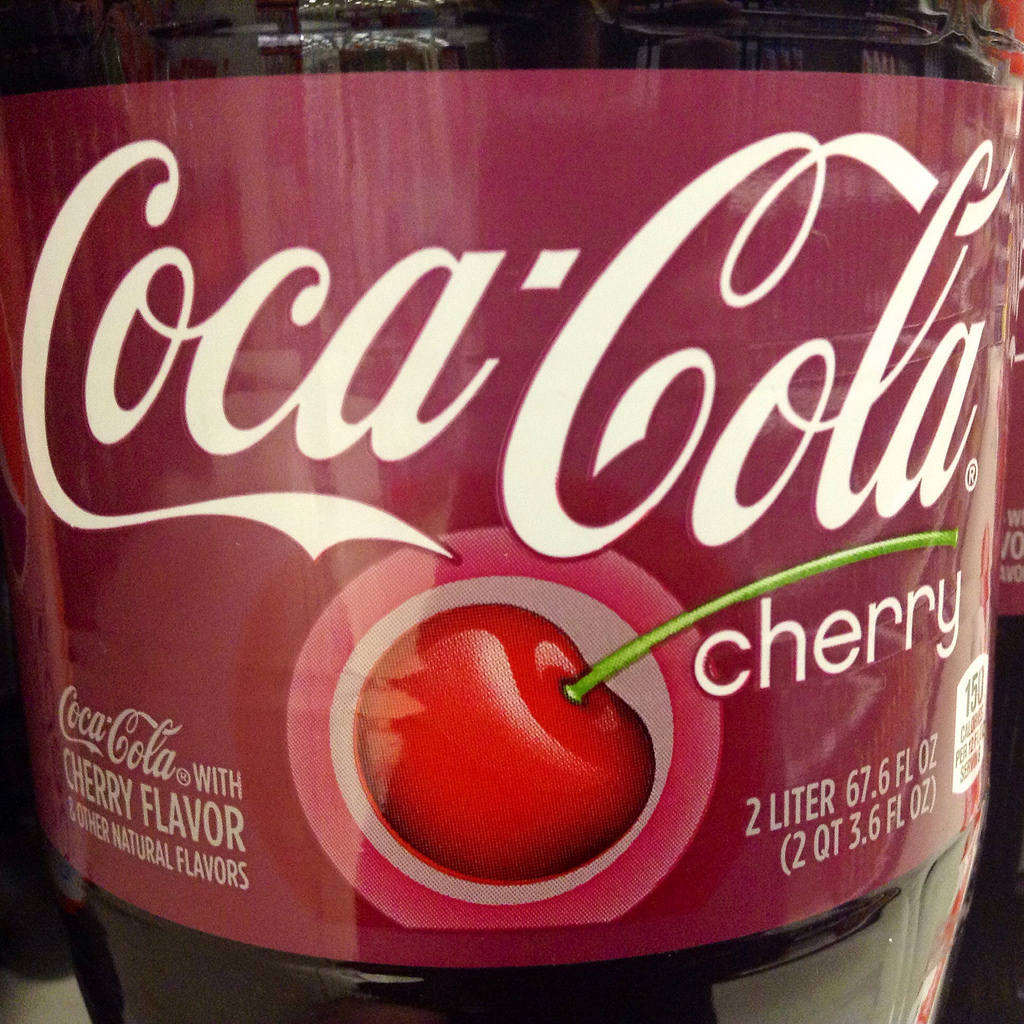
I often wonder if perfumers ever think seriously about the link between scent and flavor. Why, for example, hasn't anyone ever made a perfume that smells like Coke, or any of its flavors? Soda reviewer Patrick O'Keefe, creator of the prolific soda review site "Soda Tasting," once said that if Coke made an air freshener of Cherry Coke, he would buy it and use it all the time. Given that this guy has taste tested hundreds of sodas, his sentiment is quite an endorsement. (Vanilla Coke is perhaps the only soda that he awarded with five stars.) This got me curious about Cherry Coke, so I went and bought a few cans and tried it. I hadn't had it in twenty years, and my return to it was a surprise. This stuff is excellent.

When we think about soda, we think two things: "cheap," and "sweet." Sodas are usually just a few cents per can when purchased in bulk, and their flavors are generally disgusting, nondescript, and forgettable, much like the myriad of bargain gourmands being foisted on people here in the States. But Coca-Cola is the exception. Unlike their competitors, the Coke brand has paid extra careful attention to perfecting what they do, rather than just shoving HFCS and one or two fake flavors into a syrup. Cherry Coke has the potential to taste like Dimetapp and sugar cubes, but it actually tastes great. The cola is gentle and crisp, and complemented beautifully by an even-handed and well blended fruity cherry accent that leaves a clean aftertaste. The brains behind it all must have spent a year or two laboring over a way to make fruit cola taste elegant, and they succeeded.

Vanilla Coke is even better. It could have been glorified cream soda, but no. They spent time and money on this flavor. The vanilla isn't candy-like. It's actually fresh, with a brightness that works incredibly well against the cola backdrop. It's so rich and smooth and appealing that it's worth poisoning your pancreas to drink it. It helps that Coke's original formula is a masterpiece, the veritable champagne of colas, full of subtle cola, coca, cinnamon, nutmeg, orange flower, and vanilla notes. If ever there was a crime against the genre of gourmands, it's the neglectful stance the perfume industry has taken in not giving Coke its due. These sodas, in all their simple beauty, should be cloned into wearable art. It wouldn't be too difficult for a decent nose to achieve, and I'd wager millions of teens would fawn over such frags.

Instead, we have Incanto Charms. But hey, at least I don't encounter shelves of Incanto Charms at the grocery store.


11/15/16

Bamboo Eau De Toilette (Gucci)


Perhaps the "Alt-Right" has a point after all; it's frightening to think that political correctness has neutered Italian bravado into the stuff of pallid white florals. Yet when I smell Bamboo EDT, a pallid white floral is pretty much the long and short of it. Yes, it's well balanced. Yes, yes, yes, I know, I know, it's well made, I get that. Every synthetic analog of fruit and floral is modestly rendered against a wan, woody, chemical background, all fogged up with white musk. It's a fragrance that smells pleasantly uninteresting on a woman when you're both crunching the company numbers, but which suddenly becomes intoxicating after hours, when fragrance is the only thing she has on. But that's not really a convincing argument for it. A great frag deserves higher praise.

The truth is that beautiful women don't need great perfumes. And by "beautiful women," I mean whatever women you're into. (Beauty is subjective, and honestly, I'm not being "PC" when I say that.) When a man digs a girl, the last thing he's worried about is the pedigree of her fragrance. She could be wearing her husband's Brut, and if a guy thinks she's sexy, he'll assume she's wearing "girl stuff," and his hormones will just block out the rest as they zero in on the score. Men aren't sophisticated when it comes to sex. We're not complex machines when it comes to spreading our genes. Our brains go into autopilot, our senses search out pheromonal stimuli - the invisible, musky smells secreted through skin, hair, mucous membranes - and our "conscious" noses, always eager to identify burnt toast and spoiled milk, take the night off.

Still, it would be nice to return to the days when women wore foghorn frags to dampen the essences of their competitors. Loud perfumes, often commissioned (without irony) by men, played into women's unending interest in the other women around them. Whether to arouse innocent, friendly small talk between office girls on a luncheon, or catty disapproval, with backhanded comments whispered snidely behind unsuspectig backs, feminine "powerhouse" fragrances like Paris, Poison, Chanel No 5, and Gucci's own Rush were patterned for sapphic and tribalistic mores. Women wore perfumes so loud and garish that sharing an elevator with them meant you stopped on whatever floor had the Tylenol. And even though I knew they weren't wearing them for me, I thought their olfactory egotism was charming.

Bamboo EDT just reminds me of everything we've lost.


10/23/16

Dior Homme Eau (Dior)

I never understood the appeal of the original Dior Homme. Its powdery and bittersweet iris pastiche never felt convincingly dimensional, lacked the fundamental warmth of classical orientals and chypres, and Dior created flankers for it, which seemed akin to flanking liver and onions with tripe. If ever there was a challenging, "stand-alone" composition, it's Dior Homme. Although I'm not sure what makes it popular, I appreciate it as a mature, competently crafted work that I do envision as acceptable fare to a funeral, or perhaps a brit milah. It says plainly, "I'm not smiling today."

I approached the "Eau" flanker with trepidation, but I needn't have, because it's lovely, a crisp, Mediterranean interpretation of the original. Where the first employed a strange, almost waxy iris note, Dior Homme Eau lets the heaviness go to the breeze, allowing iris' inherently cool and powdery freshness to shine. It still evokes the makeup counter at Dillard's, yet also brings me to the beach with splashes of pert citrus, smelling at once nondescript and unfamiliar. Here the alien strangeness of its progenitor touches down on friendlier terrain, yielding a fragrance not as challenging as the original, but quite interesting in its own right, and much easier to wear.

The unusual "lipstick" aspect of this line is not an outlier in masculine fragrance, or fragrance in general, with parts of Mitsouko and Miglin's Pheromone for Men employing a similar quality during various stages of their drydowns. Refined chypres aim to soften their balance of otherwise harsh components (bergamot, oakmoss, labdanum) via sweet florals, precious woods, and musks. What sets Eau apart is its ability to meld an ambitiously classical and dated chypre idea with an unexciting and contemporary woody-amber drydown, while always smelling cheerful and original. A solid effort from Demachy.


10/16/16

The Musky Orientals Of The Nineties


I have been wearing Witness by Jacques Bogart lately, and just wanted to comment on a few things that have come to mind.

This fragrance smells more and more like Balenciaga Pour Homme to me. Its central chord of artemisia, woods, fruity esters, and musk are almost identical to Balenciaga, with the main difference being that these notes are sweeter and less animalic in Bogart's scent. (It also contains noticeable cinnamon, which is absent from Balenciaga.) There are heady terpenes in Witness that evoke pine, juniper, and evergreen woods, and in this regard it resembles Aubusson Pour Homme, another musky gem from the same era. And though it generally smells different, Bogart's Furyo contains a louder, civet-laden version of Balenciaga's and Witness' musk. Can you guess what connects them?

I read a very interesting review of Balenciaga PH on Fragrantica the other day, posted by member "Michel Vaillant," which, if true, explains everything in one sentence:

"As far as I know, the house of Balenciaga was owned by the Bogart Group at the launch of this fragrance in 1990."

When I read that, it made sense. These spicy beauties were a very distinct style between 1989 and 1994, but their stylistic roots can be traced back to Kouros in 1981, YSL's epic fougere and landmark masculine musk bomb. Whenever people dismiss the importance of tracing fragrance genealogy, I nod to Kouros. From Bourdon's scent springs a generation of "powerhouses" and classical late 20th century masculines, but without this historical context people get confused. From Kouros to Witness, one follows the breadcrumbs to Giorgio, Zino, Boss No. 1, Dali Pour Homme, Lapidus PH, Sung Homme, Ungaro Pour L'Homme, Ungaro Pour L'Homme II, Balenciaga PH, and Joint. Witness is one of Kouros' logical end points.

In any case, I'm wearing it again today. Jacques Bogart is one of perfumery's most underrated houses, and Witness and Furyo are among the best in my collection.