4/22/23

Hearts & Daggers for Men (Ed Hardy)


Ed Hardy fragrances are weird. I get the whole tattoo artist brand legacy, and thus the godawful packaging and "edgy" names, but the question remains as to who they're for. Love & Luck comes sheathed in a canister that looks like it was designed by a seventh grader, yet under the cheese is an unadorned column of glass containing a very good woody-floral musk, the sort of thing that appeals to adults with excellent taste. 

Hearts & Daggers holds similar intrigue as something by the same perfumer, Oliver Gillotin, and of course the packaging is bilious. What I've read online has me believing that even the best fragrance writers are overthinking this scent. Many say it's a bizarre aquatic with cocktail accords of martini and olives alongside a pear-flavored umbrella drink, but I don't think it's quite that complicated. H&D was released in 2010, only a few years after 2007's Chrome Legend, in which Chrisophe Raynaud and Olivier Pescheux famously veiled a jasmine bouquet under a bevy of aldehydes and salinated musks. They used congeners of Muscenone and Habanolide to abstract its feminine core, and it smells like the same trick is used in H&D, except here the chemicals overlay a pear note. While pear isn't quite as compelling as jasmine, it's still interesting to smell an inexpensive salty musk accord that can elucidate on the various facets of something ostensibly familiar and simple. Sometimes I get whiffs of the juicy sweetness of the fruit, while in others I get drier and woodier nuances. Why Gillotin stopped at pear and didn't include a few other fruits is beyond me, but I imagine the budget was his main constraint. 

I do think he misjudged the degree to which Raynaud and Pescheux imbued Legend with its sea-spray effect, because it feels like H&D is the 8-bit version of Azzaro's 64-bit display. But when the prickly saltiness recedes, the story of Hearts & Daggers rests on one clear little thing: pear. It's $12 for a large bottle of this, but for a similar frag done much better, you might as well pay a few bucks more and get Legend. 

4/17/23

Gravitas (Naughton & Wilson)


Dan Naughton is a YouTuber and fragrance enthusiast, and I've been watching his videos since 2018. He shares my love of old-school masculines, the fragrances of the seventies, eighties, and early nineties that are rife with rich woody and musky notes. It shouldn't be a surprise then that his first collaboration with Scottish fragrance entrepreneur Scott Wilson and Master Perfumer John Stephen (of Czech & Speake fame) yielded something that smells like it was formulated in 1980. That it hit shelves in 2020 is, in a word, amazing. 

Gravitas Pour Homme (no women's version, btw) isn't a complex fragrance, but what it does, it does well. The first hour of wear is strongly reminiscent of Le 3e Homme (1985), only it smells more natural than Caron's current fragrance. In lieu of jasmine, John Stephen paired a very heady lavender with a fruity-musky accord, and the spring-like bracken effect is sweet, powdery, wet-shavery. When the sunny opening subsides, the lavender grows sturdier and woodier, and a patchouli and sandalwood duo imbue it with a familiar cigar-box feel. It sort of veers into Ungaro Pour L'Homme II territory by this point, as it hums along for another five or six hours before fading into a mildly animalic musk. It feels a bit hum-drum at times, but the quality of materials is high enough for me to bear some admiration here. Gravitas smells good, like a square-jawed and reliable man. 

I find it positively bewildering that they aren't shouting from the rooftops about it on Basenotes. This is exactly what the riff-raff there have been wishing would return to the world: an old-school masculine made of quality materials. Here it is boys, in its unadorned glory, IFRA be damned. I'm also more than a little confused by the reviews. Way Off-Scenter calls it "a minor variation on the familiar post-Cool Water/Green Irish Tweed ambroxan-flavored fougere genre," which Gravitas is the antithesis of. StylinLA says "it just died" on him - I get seven hours. But whatever. This is a good fragrance, it isn't over-priced, and I'm glad that Naughton, Wilson, and Stephen made it so. 

4/16/23

Guess Man (Guess)


Guess is one of those generic discount designer brands that is easy for enthusiasts to ignore, simply by virtue of its commercialized ubiquity. A day doesn't go by that I don't see at least a handful of Guess fragrances marked for clearance somewhere. But it raises the question, do they deserve to be overlooked? Or are they diamonds in the rough? 

I want to think Guess Man went straight to discounters upon its release in 2006, but technically I'd be wrong. It spent at least a couple of years on tester counters at Macy's, priced at $65 a bottle, but probably sold poorly. Then Guess opened the distribution channels to places like Ross and Burlington Coat Factory, and wham! Well, maybe not, but it sold much better at twenty bucks. People are eager for the next big thing, but don't want to be culpable for financing it. Guess Man smells of the 2000s zeitgeist of woody-fresh synthetic masculines, in the most timely of windowed, silver-plastic packages, but also harkens back to the eighties and nineties with its aggressively woody intro and nitrile-driven dry-down. The fragrance packs a little punch at the start, with bright orange zest and herbal aromatics closely mated to a decently sturdy artemisia, which aligns it more with things like Caron Yatagan (1978), AD Classic (1980), and Smalto (1998) than with the gym-bro aquatics and ozonics of its time. Quite the welcome surprise. 

It takes about an hour for its big top to settle down, and for a standard-issue lavender, violet leaf, and cedar accord to step in and carry the next few hours into oblivion, but this green-woody affair is just cool and smooth enough to remind me of Dunhill Fresh, and (by proxy) Fahrenheit. This cheapy isn't bad at all, and is worth a sniff for lovers of transitional 2000s classics. Who would've Guessed? 

4/13/23

Cologne de Feu (Bortnikoff)

Bortnikoff calls this an "Extrait de Cologne," which suggests a high concentration, but to my nose it simply reads as an eau de toilette, so let's go with that instead. On its website, the brand lists this fragrance alongside Cologne de la Terre, and both share similar labeling and packaging, so I think they're meant to go together. I'll have to try Cologne de la Terre another time, because I really enjoyed Cologne de Feu. 

It's difficult to find a citrus fragrance that lasts. For that, you need to hit up something by Thierry Wasser or Calice Becker, perfumers who understand that the freshness of citrus can be extended indefinitely using the right blend of synthetics. Cologne de Feu smells like something by Wasser, in that it draws out a spritely grapefruit and blood orange accord, which would typically be gone after fifteen minutes, and gets it to last several hours. Intermingled with the citruses are soft florals, mostly a burnished rose, some raspberry tartness, and a bit of woody musk. It's simple, but plays out as a congruent accord that smells clear and fresh and performs with alacrity. 

Is it worth $230? People get annoyed by how often I bring up price. Well, perfume is a game of cards, and you lose money if your hand is short. Bortnikoff asks a lot, but gives you a lot. This is an elegant fragrance in a beautiful bottle, so it's competent. Still, this sort of dusky-sweet citrus can be had in something like L'Homme Idéal Cologne by Guerlain ($100, Wasser) or Borsari's Acqua Classica ($35). But for a quality grapefruit at a luxe level, Cologne de Feu is certainly something to consider. 

4/10/23

Casamorati 1888 Mefisto (Xerjoff)


I've spent the last five years reading about Mefisto by Xerjoff, but only recently got around to wearing it. The Italian niche house of Xerjoff is the brainchild of Sergio Momo, and his fragrances are stratospherically priced, which had me expecting something of consummate European quality. After all, if I'm spending three hundred dollars on a perfume, it should smell amazing. This should be the Silver Mountain Water clone to end all clones. 

Mefisto is a disappointment. Its plaudits online must be by people who look down on the "bargain" Arabian clones for SMW, because if they'd tried things like Al Wisam Day by Rasasi, Silver Shade by Ajmal, or Club de Nuit Sillage by Armaf, they wouldn't care about Mefisto. You can buy six bottles of AW Day for the price of one Mefisto, and the differences between them are negligible. Mefisto opens with citrus notes that don't really read as citrus, but rather like a metallic-fruity musk. (Silver Shade's bergamot and lime notes smell way more natural.) A floral ensemble of lavender, iris, and rose develops, and carries the scent for a good seven or eight hours, before it fades into a white musk. Again, this is done elsewhere for much less, and Xerjoff's scent is surprisingly loud and synthetic. 

The most glaring issue with Mefisto is the red-berry "froot" note in its heart, which all the aforementioned clones share. It's forgivable in something that costs ten bucks an ounce, but raises eyebrows at Xerjoff prices. SMW's blackcurrant note isn't a neon sweetness, but an inky bitterness, and it plays off the sour Creed ambergris base. It's SMW's main appeal. Sadly, Xerjoff's version doesn't even attempt to replicate it, and instead resorts to the same cheap berry chem found in all the other clones. Just another reason to avoid spending Creed money on anything other than a Creed. 

4/7/23

Club de Nuit Intense for Women (Armaf)


Photograph by Muschio Di Quercia

I've reached the point with Arabian perfumery where I'm not sure I should even bother to look into what the fragrances are clones of anymore. There's so much cloning, copying, and stealing going on that I've lost interest in tracing the comparisons and commenting on them. Armaf is notorious for cloning designer fragrances, and Club de Nuit Intense for Women is supposedly a clone of Tom Ford's Noir de Noir, so they went right for the top tier of designer here. It doesn't matter, because CdNI for Women smells pricy, comfortable, and very Arabian, with or without its internet-driven Tom Ford association. 

It opens with a bright rose and hyacinth accord, very floral, but it rapidly darkens from pink, to red, to purple, the petals of a deeply woody and dark rose. Flanking the blossoms are patchouli, cedar, oud, and the patchouli drives the resinous embellishments. This Armaf is initially loud, but it softens in the first hour and wears close thereafter. I'm impressed with the floral element, and I enjoy how it seems to melt into the earthier components of the heart, but what really wins me is how everything gauzes into a discreet vanilla in the base. The notes all harmonize with its radiance, with a rosy sweetness to the end. It's quite civilized for a rose/oud combo, and draws you into its friendly glow. 

CdNI for Women is touted as being a feminine Armaf that men can wear, and I agree. However, it comes in two concentrations, eau de parfum and cologne (as a body spray), and the latter might be more feasible for guys. So if the blast of florals and patchouli feels a little too loud and girly in EDP form, it might be of interest to try the cologne version and see if that wears easier. I find the quality of CdNI for Women to be great for the money, and the sort of Arabian composition that has gone full-circle from Dubai to New York Fashion Week, back to Dubai again. It just feels very modern and Middle Eastern to me. 

4/1/23

Silver Blue (Mancera)

The bitter truth about perfume since 1972 is that there are only a few truly original ideas that have been bottled and sold to men. Everything else is a riff on one or another of that handful of groundbreakers, be it Paco Rabanne Pour Homme (1973), Grey Flannel (1975), Azzaro Pour Homme (1978), Drakkar Noir (1982), Green Irish Tweed (1985), Cool Water (1988), Fahrenheit (1988), Eternity for Men (1989), Acqua di Giò (1996), A*Men (1996), or Aventus (2010). Every masculine of the last decade is at least a vague copy of one of these, and every other one is blatantly so. This makes reviewing masculines an exercise in tedium, only elevated to interest by how utterly shameless its subjects are. 

Released in 2019 as a Selfridges exclusive, Silver Blue is a branch off the A*Men tree of nineties-era subversive masculines. There isn't a "natural" note to be found in its glacé quasi-gourmand composition, although its synthetics are pellucid and seamless, and it took my nose all of three seconds to discern its familiar blend of almost-mint aldehydes, buttery caramel, and earthy patchouli. It smells dissonant yet congruent, the exact thing that made Angel and its flankers so compelling in the age before smart phones. Its mishmash of burnt sugars over indigestible woody resins lifts the banality of perfume candy into a higher realm of contrasts. Successful perfumes harness contrasts: Caron Pour un Homme's strident lavender pulses gorgeously against its cushy vanilla backdrop; peach nectar glistens through an oakmoss gloaming in Mitsouko; Silver Blue's caramel smiles sweetly through a bitter bushel of patchouli and woods. It's a subtle but pleasant way of creating nonchalant freshness, and it's very nice.

I'm 41 years old, and I remember the nineties well. A*Men (the silvery-blue star) was the expensive and very weird sorta-niche gourmand frag with an intense rubbery tar note boldly contrasting with caramel, chocolate, and coffee. Conversely, Silver Blue offers a relatively timid contrast without full commitment, and its constituent parts aren't vibrant enough to make up for the lack of daring necessary to make this sort of thing fly. It did win me a couple of compliments, so it's undeniably persuasive, but I still prefer A*Men. Anything that attempts to emulate the Mugler effect needs to go hard, or go home. 

3/17/23

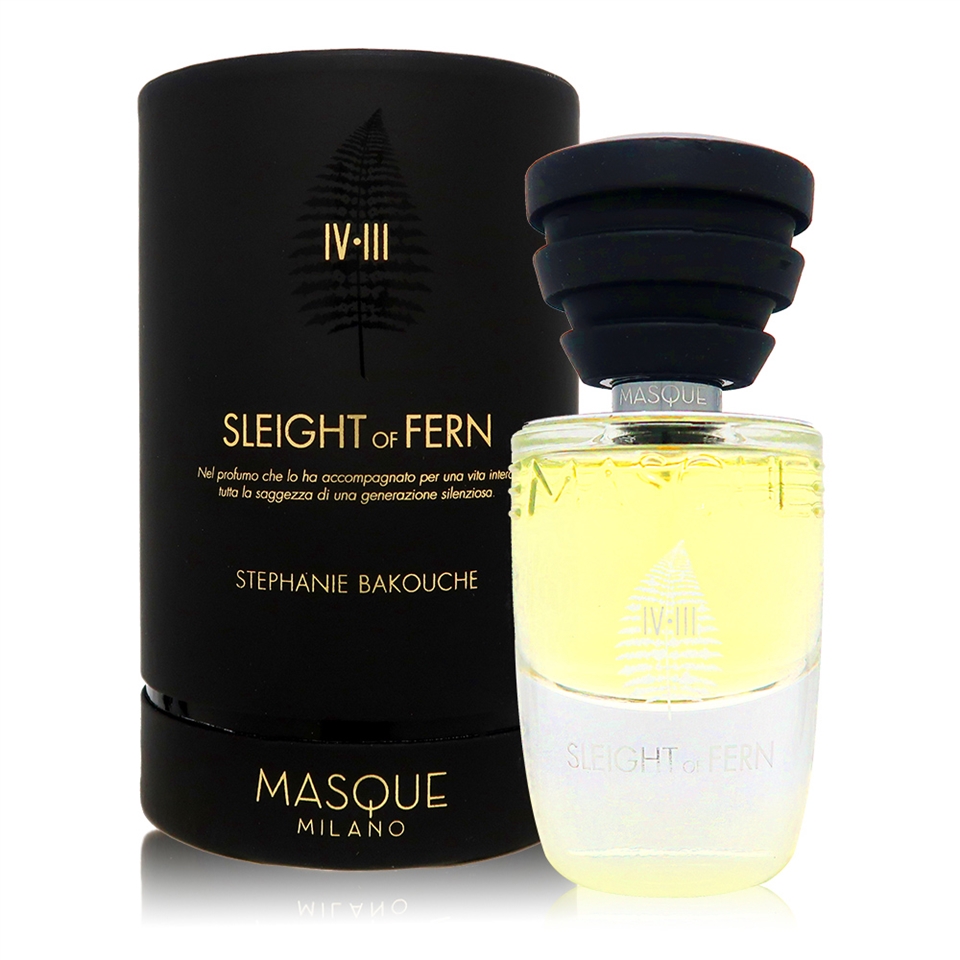
Sleight of Fern (Masque Milano)


Stéphanie Bakouche is a marquee name in the fragrance industry, having worked for Givaudan and Takasago, as well as Parfums MDCI. In 2006, she established herself with Invasion Barbare, a postmodern relativist fougère that is as sleek and powerful as a small block aluminum engine. Its Germanic lines of unswerving aldehydes, bergamot, lavender, violet leaf, cardamom, thyme, cedar, vanilla, and white musk are anything but barbaric - they're really rather conventional and boring. That said, the fragrance is technically quite good, with each note and accord neatly arranged to convey a sense of sanguine masculinity. Brut for the rich. 

Stéphanie must have taken the criticisms of her work to heart, because her 2022 release for Masque Milano makes a statement that Invasion Barbare did not. Sleight of Fern opens with a barrage of medicinal anisic and green-geranium notes, carried along sinus-piercing bergamot, all lending the accord the desiccated effect of garrigue, with nuances of rosemary, juniper, and thyme bleeding through. This all gives way to a surprisingly burly lavender, with robust accents of patchouli, rosewood, a super-piquant coriander, ambergris, cedar, and civet, along with several other Kouros-like musks. Virile and a touch old-school, Masque Milano's fougère smells at various points like Davidoff's Zino (1986), Trumper's Wild Fern (1877), and, quite amusingly, Invasion Barbare. 

This presents a quandary for me, the humble reviewer. I enjoy Sleight of Fern, and I think it smells the way a fougère should: properly animalic, yet also herbal and soapy. But looking at my collection, I find I have fougères from yesteryear that satisfy this itch for far less money. Red for Men (1991, $14), Vermeil for Men (1995, $17), Wild Fern ($60), Lapidus Pour Homme (1987, $15), all accomplish in degrees the same result as this expensive niche offering. Kouros achieves the woody-musky effect better than all of them. But if you enjoy the subtle nuances of this sort of thing, and don't mind the price, Sleight of Fern is a pleasant option that is, quite frankly, a damn sight better than Invasion Barbare. 

3/15/23

Curve for Men (Liz Claiborne)


I attended high school from the fall of 1996 to the spring of 2000, so I managed to graduate in the final year of the twentieth century. I would have tossed my cap in 1999, but my folks held me back a year. This made me a little older than everyone in my class, from first grade onward. It also led to an odd bifurcation of my teenage experience; my personal sensibilities were sometimes aligned with those of my peers, and other times not so much. My taste in perfume was unoriginal (i.e., aspirational), and I gravitated to my French teacher's Chanel, but many of my friends liked Claiborne - and I understand why.

Curve for Men was released in 1996, freshman year, and contrary to what some of the talk on the interwebs suggests, it wasn't exactly "cheap" that year. I recall seeing it exclusively at Macy's and J.C. Penney: $45 for a 2.5 oz bottle, $65 for a 4.2 oz. These were standard Connecticut prices, but if you toured the malls of the Eastern Seaboard in the late nineties, you would be hard-pressed to find Curve for much less. Liz Claiborne was still very much alive and in the game, and although she had adopted the same mass-market strategy as brands like Pierre Cardin and Michel Germain, the newness and cultural success of fruit-fueled Curve kept it on the pricier side until the early 2000s. 

I mention this because the quality of the original Curve and its first unofficial flanker, Claiborne Sport (1997), is strikingly good. Jean-Claude Delville borrowed some of CK Eternity's pyramid and used the same heart accord of lavender, citrus, and sandalwood, but filtered it through Lisa Frank-like tones of neon greens, a drop of sweet pineapple, and dewy ginger. Accompanying the requisite dihydromyrcenol and violet leaf in the mid are very nineties notes of ginseng and soapy black pepper. Is it cheap in 2023? Yes. Does it smell good? Yep, and like its sport variant, it's still worth every penny. To wear the true nineties formula, look for Claiborne Sport on eBay. My vintage bottle is verrry potent. 

3/13/23

Greenley (Parfums de Marly)


This perfume went through some name changes before Parfums de Marly settled on Greenley. Its original title was "Sutton," and you can still find pictures of boxes with that label from late 2019 and early 2020. The story goes that another company had something that went by "Sutton" (gee, wonder which one it could be?), and it politely asked PdM to reconsider. Then they road-tested "Epsom," which is an odd one, although there's virtually no evidence of this to be found online, so I don't know how true it is. Eventually they went with the color of the packaging, the safest (and lamest) choice. 

My take on Greenley is that it faces a few insurmountable challenges. Its main problem is that it inhabits the Creed price bracket at $355 for 75 ml, and Creed does green better than every other niche brand in existence. Want something fresh, green, clean? Original Vetiver. Want something manly with a perfect grassy/green apple accord? Green Irish Tweed. Looking for an edgier fruity-green? Silver Mountain Water. These frags are expensive, but they're expensive for a reason: they smell miles better than anything in the designer realm, and they're made with top-tier synthetics. For Greenley to stack up, it needs to match or surpass the Creed standard by using equivalently good materials in an equally-great composition. Unfortunately, it falls short. Like, $300 short.

Greenley smells remarkably close to Banana Republic's Grassland, and I suspect the latter is a straight-up clone. Both fragrances are directly predicated on a familiar cast of sweet-green violet-leaf-and-ginger things popularized by Green Valley (1999, another Creed). Both open with a translucent mélange of green apple and citrus, both pop and fizz their way into serene grassy-woody handsoap hearts, and both end up on simple bases of Cashmeran and white musk. Greenley's apple is perkier and its heart is pinier, but it's undeniably a waste of cash. For soapy-green, get Grassland instead. 

3/11/23

Valaya (Parfums de Marly)


Having ventured into fragrance writing in the early twenty-tens, I quickly became immersed in a sea of criticism aimed at the house of Creed. The brand was relentlessly mocked for its supposed historical inaccuracies, questionable claims about its elite clientele, and its army of "swivel-eyed" chads who swore by their "panty-droppers."

Yet, to my mind, Parfums de Marly feels far more geared toward the chad demographic than Creed ever was. I can't scroll through my YouTube subscriptions without stumbling upon a slew of men extolling the virtues of the latest PdM fragrance. It even sparks considerable female-driven content; if I hear one more woman rave about how sexy Layton is, I'm buying a one-way ticket to Međugorje and taking a vow of chastity.

That said, Valaya is a name as beautiful as the bottle it graces, a fragrance crafted by the accomplished perfumer Quentin Bisch. With the evidence mounting that PdM is here to stay, it's time to delve in. The brand's website gushes: "Fresh top notes of bergamot, mandarin, and sweet white peach lead to a blend of white flowers, settling on musk and ambrofix sensual base notes." This description leads me to expect a swoody-floral musk, and at $177 per ounce, I want those floral notes to shine. And they do—sort of.

The copy holds true when it comes to the top notes: a burst of warm citrus, followed by a hint of peach, rosy, transparent, expertly done. In our post-Covid world, where so many noses have been compromised, perfumers have resorted to powerful ambers and musks—notes detectable even by the most damaged of olfactory senses. Thankfully, I’ve never had Covid, so my nose remains sharp. It embraces the initial notes of Valaya before noting their rapid transition to a radiant, intensely powdery white musk, which carries echoes of the fruity opening but cloaks them in a soft, almost arid veil of freshness. I think it's Ambrofix, a Givaudan material touted as the best substitute for ambergris.

The muskiness is multifaceted, with hints of amber, vanilla, and white florals, including an orange blossom accord elevated by a silvery, muguet-like quality. There’s elegance to Valaya, though I find that it "flattens" around ninety minutes in, evolving into a linear, dryer-sheet amber for the remainder of its impressive ten-hour wear. Stylistically, it calls to mind CK One, that iconic citrus-floral, still available for around eight bucks an ounce.