Showing posts sorted by relevance for query oscar for men. Sort by date Show all posts

2/18/13

Oscar for Men (Oscar de la Renta)

A few months ago I did a review of a citrus chypre by Richard Herpin for Brooks Brothers called New York Gentleman, a decent fragrance that benefits from a few good raw materials, but falls far short of greatness due to a lack of complexity, and the unfortunate incorporation of cheap musk in its base. It's kind of hard to lambast New York Gentleman outright because comparatives are not only superior to it, but to most other masculines as well. To say that Eau Sauvage beats NYG is pretty much a foregone conclusion. But I spent a few weeks wondering whether another fragrance could step into NYG's shoes and do exactly what it does, using the exact same citrus-aromatic flourishes, except the way it should have been done by Herpin - i.e., without shortcuts. 

Then I came across Oscar de la Renta's second masculine fragrance, simply called Oscar for Men, and realized I'd found a match. In every way, Oscar is very similar to NYG, but it's much more complex, exhibits higher-quality raw materials from start to finish, and unsurprisingly smells more masculine and "outdoorsy." If I were a stuck-up prat, I'd call it an "aficionado's fragrance," but since it doesn't take an aficionado to appreciate anything that smells good, I'll settle for just calling it flat-out excellent.

Of course, this eau de toilette is not to be confused with Oscar de la Renta's first masculine, the infamous and much-loved Pour Lui. That 1980 release is a strong, macho, leathery-green machine that takes no prisoners and crashes head-on into the eighties powerhouse aesthetic. For an in-depth take on Pour Lui, see the terrific review on Pour Monsieur. Oscar for Men is also reviewed there, and I concur entirely with Shamu1's spot-on assessment of it. This is a beautiful fragrance, and quality-wise I put it in the same league as Edmond Roudnitska's citrus-chypres and fresh-fern masterworks.

Oscar for Men sits at a place equidistant from Cacharel Pour L'Homme and Marc Jacobs Bang. Like those fragrances, Oscar is a citrus-woody aromatic, but brace yourself: I move to officially label it a citrus chypre, due to a hesperidic presentation in its top notes, followed by a peppery, floral sweetness in the heart, and a mossy-woody base. Whether or not oakmoss or treemoss is used is a bit of a mystery, as Oscar's packaging offers what appears to be an abbreviated ingredients list (IFRA compliant it's not), but I feel there's at least a little treemoss in there. 

Labdanum is also not obviously present, but the way Oscar's pine and cedar notes play against each other fills its heart with an earthy, slightly skanky sweetness that reminds me of the funky edge to Eau Sauvage. Also similar to ES is Oscar's Italianate bergamot and elemi resin, very bitter and fresh-green. These aspects of Oscar make its classification seem easy enough, and it only gets easier as it develops on skin.

The real key to Oscar's success is its complexity, and how each note is intentionally used for the purpose of keeping its movements smooth and congruent. Brooks Brothers NYG was constructed on what I believe was a very tight formula budget, and for some reason Herpin decided that blowing the bulk of his cash on top-shelf bergamot extracts and a minuscule quantity of high-grade vetiver oil would make up for a distinct absence of anything else. Its movement is clunky; NYG opens with a very fruity-fresh burst of citrus that sustains itself for an inordinately long time, thanks to synthetics, and then abruptly shifts into vetiver, with the two stages held together by a discreet musk note. 

From that mid-stage vetiver, things go downhill, and the base is little more than a laundry-fresh washout, very chemical and "clean cotton-T." There isn't much in the way of floral or earthy notes to lend depth or complexity, aside from a bit of peppery carnation. But not to fear - Oscar shows us how it's done. Its citrus, mostly bergamot, is crisp, fruity, fresh, but soft, and transient relative to NYG's (expect three minutes from it). Almost immediately the elemi resin is apparent, with a sweet piney freshness that rapidly leads to a distinct pine and black pepper accord. An hour later the evergreen notes adopt a woodier tone, and a very dry nutmeg note is detectable. Bristling behind it is cedar and subtle musk.

The opening accord of citrus and elemi is smoothly conjoined by cool clove. The heart and base accords of pine, black pepper, and cedar are quietly brushed together with nutmeg and musk. Each note works in harmony with its neighbor, and together they form one brilliant and shimmering accord of chypre-green freshness. But there's more to Oscar's beauty than meets the nose at first sniff - upon subsequent wearings, it becomes evident that its lemony-bergamot intro is underpinned by a soft jasmine-like floral effect, perhaps via hedione, or even a smidgen of calone. 

A brisk lavender note also comes forward in the final minute or so of the top accord, and helps the citrus segue into peppery resins. How the nose behind Oscar for Men managed to get that pepper note to last for seven hours at a stretch is anyone's guess. The same synthetics that are used with Brooks Brothers' citrus, and the pepper in Marc Jacob's Bang, are perhaps employed here, but Oscar is much richer and better blended than either of the others. This really is a piece of manliness that imparts sophistication.

Oscar for Men was released in 1999, but it doesn't resemble your typical fresh-sweet wuss-fests from that decade, and leans closer to the old-guard French proclivities of the sixties and seventies. If I were asked to do a blind sniff test of Oscar and Eau Sauvage, and then were asked which is older, I'd say they're the same age. How this passed me by in college I'll never know, but I'm glad to have a bottle now. It's also nice to know that three ounces of Oscar can be had for twenty dollars, which makes it a better value than the significantly more expensive Brooks Brothers. 

I can't tell you to eschew Eau Sauvage, Moustache, Diorella, Monsieur Balmain, YSL Pour Homme, or any of the other great twentieth century citrus compositions in favor of Oscar for Men, but I strongly recommend placing it among them in your collection, and awarding it "Best in Show" as a pristine example of how the standard set by its predecessors has been, despite the odds, deliberately and successfully adhered to.

11/1/22

No. 6 Cedarwood & Geranium and No. 7 Spiced Ginger & Rum (Goodfellow & Co)


Target has its own in-store brand of fragrances and toiletries called Goodfellow & Co, after the store's original name from over a century ago, Goodfellow Dry Goods. Usually store brands of anything are of spotty quality, and one would think perfumes are no exception, but in this case the two I've tried are actually pretty good!

I'm not sure I understand the system Target employs for their perfume line. Each fragrance is numbered, but I only see four fragrances, with two labeled No. 1 and No. 2, and two as No. 6 and No. 7. Where's numbers 3,4,5? Anyway, No. 6 is Cedarwood & Geranium, and it's basically a clone of Oscar de la Renta's Oscar for Men from 1999. There are some differences, mainly in the lack of citrus and jasmine notes in No. 6, which focuses more on geranium leaf. But the main similarity between these fragrances is their shared focus on pepper, in this case the peppery side of geranium. I only smell a hint of cedar in the top accord, along with some sage and lavender, and then Goodfellow' scent is pretty much a linear peppery geranium for five or six hours. Longevity is good, it's fairly loud, and it's not bad. If you already have Oscar for Men, you don't need Target's take, but if you missed out on it and want something that smells about 90% similar, here you go. 

No. 7 is called Spiced Ginger & Rum, and this is the weaker of the two projection-wise. Right at first spray, I have to push my nose into my skin to smell it. It opens with a watery ginger and citrus accord, and the ginger hangs around for about ten minutes. It gets just a touch spicy and a little warmer (and stronger) with time, and eventually a bay note appears, but to my nose there isn't much rum. There is, however, a clear birch note, with a synthetic oakmoss undergirding it. I think No. 7 is a type of bay rum idea, and the woody bay lends it a wet-shaver vibe that I find very attractive. I'm going to keep this one in mind for future reference. If I want a replacement for my Trumper Bay Rum, but something a little softer and more durable, Goodfellow & Co's Spiced Ginger & Rum is perfect for the job. It lasts about four hours before becoming very faint, and would follow Pinaud's Bay Rum perfectly on shave day. 

Many fragheads turn their noses up at commercial fragrances like these. When discussing them, basenotes member "Hednic" made the comment about Goodfellow & Co fragrances: 
"If they are a Target in house brand (not familiar with name) would be a pass for me."
This is the worst way to approach fragrances. Reader, let me give you advice: if you're looking for fragrances that you can wear every day and enjoy without worrying about breaking the bank on follow-up bottles, you should try as much as you can, wherever you can, from whoever is out there. Don't scoff at company brands and discount rack items simply because they're not high-end designer or niche. Don't ignore something because you're not familiar with it. Good items are out there. An open mind finds them. 

9/9/13

Jeffrey Dame Chats With From Pyrgos


Jeffrey Dame is not just a man. Jeffrey Dame is one of the great pillars of the fragrance industry. His prestigious career spans 34 years, and he has worked in various high-ranking and executive capacities for several of the world's largest fragrance brands. Since 1985, Jeffrey has served as Vice President of Marketing Men's Fragrances for Sanofi Beauty Products, Executive Director of Marketing for Aramis, Vice President of Sales and Marketing for Parlux Fragrances, President of the Five Star Fragrance Company, President and CEO of Hypoluxe, Inc., and is also the owner of Irma Shorell, Inc., with subsidiaries Madeleine Mono, Tuvaché Fragrances, and Long Lost Perfume. As you can see, the man really needs no introduction - you should already know who he is. He was kind enough to comment on a recent blog post here on From Pyrgos, and even kinder to grant me an interview, in which he answers some of my questions about the fragrance industry, the "art" of perfume-making, and the joy of bringing timeless classics back from the grave. He also helps to clarify some key points about how perfume formulas are selected, and why so many of them are repeatedly reformulated. So without further ado . . .

Jeffrey, I want to thank you again for your informative comment under my article about the corporate distribution history of Geoffrey Beene's Grey Flannel. This is one of my favorite fragrances, I've been wearing it for years, and contrary to what a lot of people might think, I believe it is the progenitor of a slew of popular masculines from the last thirty years, including Green Irish Tweed, Fahrenheit, and Cool Water. It was exciting to learn that you were part of GF's corporate history.

Grey Flannel was, and still is, a stand-alone scent, with a specific character. It leads, of course, directly to Fahrenheit. Grey Flannel occupies its own unique space, but for me the fragrance that was really ahead of its time was Geoffrey Beene's Bowling Green. If you smell Bowling Green today, it might seem in keeping with all the other fresh, herbaceous, ozonic scents out there, but back in the day Bowling Green was really ahead of its time.

You have had a long and accomplished career in the fragrance industry. From the beginning of 1982 to the end of 1984, you worked as the marketing manager for Caron. It looks like this was your entry into the industry. What was it like working for that legendary house?

My entry into the fragrance industry was actually in 1980, as a trainee in the Neiman-Marcus fragrance buying office in Dallas, Texas. At Neiman's that year we launched Oscar de la Renta Pour Lui, back in the glory days of fragrance introductions, and I will never forget it. The fragrance industry back in the seventies and eighties was filled with small, tiny perfume companies, just marvelous. The Parfums Caron Paris corporate office was a handful of people, under a dozen; in New York we were only five or six, plus the sales forces in the field. The Parfums Caron company at the time was based on Pour Un Homme, Royal Bain de Champagne, Bellodgia, Infini, and Fleurs de Rocaille, plus the boutiques with the urns and historical scents. But the real marketing and development effort at the time was on modernizing Parfums Caron with Nocturnes and Le 3eme Homme.

Many lament the recent reformulations of Caron fragrances. When you smell Caron fragrances these days, do you think to yourself, "How did things get this bad?" Or is Caron still synonymous with quality to you?

In regards to the current scent character of Caron, I have not reviewed anything recently, and need to find the time to take another look, although Caron will always be Caron. Thanks for the reminder. I need to go find some Bellodgia.

Anytime, I think everyone needs to be reminded to find some Bellodgia at some point in life! You told me that many of the classic masculines like Obsession, Polo, Lagerfeld, and Grey Flannel had their labels changed from "Cologne" to "Eau de Toilette" to make them marketable to parent companies in Europe. What was the reason for labeling them "Cologne" in the first place? Most of them were always in an EDT concentration, from what I remember.

All the major American fragrance brands for men made in the USA in the seventies and into the early eighties were made and marked as "colognes." No "eau de toilette" at all. You only saw the words "eau de toilette" on brands imported from Europe. Americans have always culturally referred to men's fragrance as cologne - this is just how the product was made and sold. Even to this day, Americans generally refer to men's cologne, and don't interpret it as "cologne" in the European sense. Back then all the sizes were two-ounce and four-ounce, the American standard.

You also told me that when a brand is bought and sold, the purchasing company usually inherits several years-worth of excess boxes and labels (presumably bottles also), which are used until they're used up, and in need of replacement. This is interesting, because there are many fragrance enthusiasts who actively seek "vintage" formulas, like I did with Grey Flannel, and they tend to take older packaging styles at face value whenever they find them. Rarely is the age of the fragrance questioned if the package it comes in looks old. Is it conceivable that maybe half of the "vintage" bottles of fragrance out there on Ebay and on swap lists actually contain newer, reformulated perfume? If so, are the people who claim to smell vast differences in quality between older and newer vintages kidding themselves?

There is really no way to know what percentage of vintage scents have mixed and matched old boxes and labels with various newer scent updates. Just know that packaging carries on for years. I will say that scent is a living thing, and the character of the smell changes over time. A scent made within the past year will be brighter in top notes, a scent 2-3 years old is mellower, as everything melds together. A scent 4-5 years old starts to lose character, and can often be turning bad. Anything over 5 years old is highly suspect for quality, and anything 8 years old is dreck and turned. Buying any fragrance on Ebay over 10 years old tells you nothing, as you either end up with fragrance which is completely unwearable, or even if it is wearable, bears no relation to the original scent when it was first made. Fragrance goes bad. Fewer brands were introduced back in the eighties and nineties, and if a brand aged too long in the warehouse, it was destroyed, and no longer sold (usually past 5 years). In today's modern perfumery world, so many brands are launched and pushed through the market that you end up with brands sitting around in secondary market wholesalers for years and years and years, and reaching the consumer in all sorts of poor states.

Would you say that the majority of reformulated "classic" masculines have been reformulated poorly? For example, things like Lagerfeld Cologne and Davidoff Cool Water were bought by Coty, and reformulated in ways that some felt were truly awful. Others feel that these new formulas are just fine. Are cost-cutting and IFRA regulations responsible for ruining a whole bunch of fragrances? Or is the perceived destruction of these classics mostly in people's heads?

In the industry as a whole, fragrance formulas are changed for three reasons:
1. For straight up cost savings in two manners: one is that the brand owner wants to reduce the cost of the scent, and asks the essential oil house to switch to lower-cost ingredients, and the other is that an ingredient in the original formula becomes scarce, and the essential oil house is forced to raise the oil cost. The brand owners find that unacceptable, and ask that ingredients be changed, and the price held.

2. For IFRA ingredient de-listings and restrictions.

3. To purposely modernize a classic.
What you really need to be aware of is the "Five Percent Change". A brand may have multiple owners over a period of decades, and thus a series of formula changes. If each scent reformulation was done with good intentions, the resulting update may be ninety-five percent accurate - good enough that one time. Then the next time it is changed, it is also ninety-five percent close - but based on the prior mod, not the original; and again five years later, ninety-five percent close. Over a period of thirty years, the scent is now seventy percent of the original character, because it has had a series of ninety-five percent changes.

In regards to ruining fragrances, these reformulations are what they are, and just need to be adapted to by the consumers. It's not going to change. The business machine is moving forward. These past three to four years have been particularly difficult with the significant IFRA changes, and you can look at this whole period, from 2010 - 2015, as kind of a starting point for new directions in scent. Young people today who are fifteen to twenty years old will start their fragrance journey with the scents of today. Their olfactive memory will be locked into this period, while aficionados can remember the old days. In theory, these new standards being implemented by IFRA are so sweeping that formulas created now will have a longer life-span, since they were created from approved ingredients. Niche scents can continue to provide uniqueness within a structured palette. It is what it is.

And here is a fun one for you, an experience I had several times, whenever I was involved in one company buying another, and brands would switch hands. More than a few times I changed a scent from another company's reformulation, back to its original formula, and had the consumers complain about it, because they had become acclimated to the reformulation.

That is hilarious. If only people knew what was really happening in those instances! This brings me to the next fragrance company - from 1996 to the end of '99, you were the president of Five Star Fragrances, a brand many enthusiasts associate with the word "reformulation," particularly when it comes to classics like Pierre Cardin Pour Monsieur and Royal Copenhagen. On basenotes and in the blogosphere, it's hard to find anyone with anything nice to say about Five Star reformulations, but I personally feel their versions smell fine. I own the current Five Star versions of Cardin and RC, and they're great. Do you have any thoughts on why Five Star gets a bad rap?

I actually founded Five Star Fragrances, and was president for its first four years. At that time we were using original formulas at high concentrations for Norell, Royal Secret, and Royal Copenhagen. This was fourteen years ago though, and I can't comment on the current state of the Five Star scents, as I have not smelled them in many years, and have no points of reference. Pierre Cardin was not part of the company when I was there.

Fair enough. You told me elsewhere that junior executives at fragrance firms are often the ones selecting "mods," or modifications of fragrances, which then officially become reformulations. Both you and your Givaudan rep were only 27 years-old when you agreed on a Grey Flannel mod for Sanofi, and that selection was made without telling anyone. You just picked what you liked, and that was it. Why is mod selection done by junior execs, and why so secretly?

There is nothing secret or secretive about it, it is the job of these people (and my job then) to do this. Understand, in fragrance companies there are all kinds of people with job assignments - sales people who sell, finance people who finance, operations people who ship, packaging people who make stuff, and marketing people who focus on the scent (or fragrance evaluators in the larger companies). Not everyone smells, and it was the job of myself and the Givaudan person that day to evaluate that scent. The Givaudan person had an internal team at their shop revise the scent due to ingredient restrictions. They brought it in to me for approval, we worked together to approve it, and picked the best one. I'm certain a memo was typed up, and all were advised of the change (there were no desktops then). Today at the larger companies there might be an entire team dedicated to adapting scents, and they may even have research studies and panels, but back then it was desk work, just as it is at the niche companies today. One or two people working on a scent. The people in charge of "keeping the flame" of the scent character are well-intentioned, and usually have very good, discerning, and accurate noses. Fragrance is glorious, but never forget it is a business with a series of small but important business decisions to be made.

I've been saying for a couple of years now that perfume is a form of commercial design, and not a proper fine art form. Chandler Burr has been stirring things up lately by insisting that some perfumes are fine art, and some perfumers are fine artists. On your forum Perfume of Life, you wrote: "In 33 years now of working in the perfume business on well over 50 perfume 'briefs,' all I ever heard the perfumers say to me was 'here, this smells good.' Many of the perfumers I know would prefer that the whole concept of aesthetics, conceptual origin, and top, middle, and base note descriptions would just go away, so they could just make scents people would enjoy in and of themselves, without the required 'extras.'" You even mention working with Jean-Claude Ellena in the mid nineties, just after his groundbreaking work for Bvlgari (Eau Parfumée au Thé Vert & Thé Vert Extreme), when he was based in H&R's studio in Manhattan. You consider him a "creative genius," but can I infer from your quote that you think of him (and his contemporaries) as being simply perfumers, and not fine artists?

I do think a good perfumer is an artist, but so is a good soccer player an artist. Some perfumers are better than others and have more of a creative vision, but I think people outside the actual fragrance creation process are over-thinking the issue on both sides. Most of the perfumers I have come to know over the years are positive people who enjoy creating perfume, and they are overjoyed if their creations find homes in brands, and end up on customers' skin. The scents are like children going out into the world. For myself, I'll have a vision in my head of a scent direction that I would like a brief to go in, and usually the perfumers will come back with submissions that are better than my original concept. I'll be blown away by one or two, and might ask for one, or at most two revisions, never more. Then out it goes for the consumer to enjoy. Nothing makes me happier.

I think the focus on the artistry of the scent creation and the resulting smell misses a key point - a fragrance is multifaceted. Yes, the wearers end up with scent on their skin, but the artistry of a fragrance is a complete brand experience. It is the relationship of the consumer with the brand maker, the beauty of the carton, bottle, and cap design, and the feel and shape of the finished product in hand. A great "artistic" scent composition placed in a poor brand design and an unappealing bottle accomplishes nothing, although a tiny cohort of people can review the scent character in a salon-type environment among themselves.

Sitting with perfumers makes you part of their creative process, especially when they hand you blotters and ask what you think of whatever is sprayed on them. Have you ever felt that your opinion directly swayed the creation of a perfume, in that your comments were taken seriously by the perfumer, and were interpreted in the final draft of a formula?

A client's comments are always taken seriously by the perfumer, and the client's changes are reflected in further mods. If a perfumer does not listen to their client, the perfumer does not sell any perfume. Certainly the perfumer can express their opinion, and their thoughts on the origin of a scent is great, but mostly the perfumer wants to win the brief, and will respond and change the formula as requested. An inflexible perfumer doesn't sell much perfume. Also note that today, direct access to the perfumers themselves is less common, and there are fragrance evaluators who act as intermediaries. For some of the largest of companies in the fragrance industry, for mainstream fragrance brands, the fragrance development departments have a library of pre-approved and pre-tested scent submissions on the shelf, ready to go. When briefs come in for new brands, submissions are pulled from shelves and assigned to these brands, and the perfumers find out after the fact that they "won" these particular briefs. There is nothing wrong with this, and the quality of the scents can still be excellent, but the idea that a perfumer explored the "heart and soul" of a fashion designer before creating the scent is less true today than in the past. With so many launches of new scents, there is just not enough time.

You are currently president and CEO of Hypoluxe, Inc. Your company oversees U.S. stocking and distribution of niche/artisinal brands M. Micallef, Parfums Rétro, and Biehl Parfumkunstwerke. These are generally considered to be niche products, and are very successful brands, but you also own Irma Shorell, Inc., which owns a stunning range called Long Lost Perfume. In this range are Crepe de Chine, Memoire Cherie, Sortilege, My Sin, Casaque, and more. These are very old and long-discontinued fragrances, recently resurrected by Irma Shorell. Their return is the ultimate feat of re-branding, re-formulating, and re-marketing. Tell me a little about what it was like to revive these classics, and reintroduce them into the contemporary fragrance market. Was it a challenge for the people at Irma Shorell to compare vintage samples to fresh ones while reformulating these classics?

The Long Lost Perfumes collection in Irma Shorell was introduced back in 1999, which makes fourteen years now of classic vintage scents for women. Recreating these scents... Sortilege, Crepe de Chine, Memoire Cherie, My Sin, Casaque, Ecusson, has always been a labor of love, and such a pleasure. I have several thousand women who are devoted to these scents, who are keeping me honest. The olfactive memory of these women, who are now in their fifties, sixties, and older, is outstanding. Even if they have not smelled the scent in decades, they know at once if the formula is accurate or not. I'm convinced there is fragrance imprinting on the brain with the first couple of fragrances a woman owns, all the way back to when she was a teenager, and the scent she wore with her first love, the scent she wore at her wedding. The locked-in olfactive memory comes back to them at once. Recreating the scents took quite a bit of work to get them right. Everyone talks today about scent reformulations, but reformulations have always gone on. So we had multiple formulas to choose from and compare to more recent versions, with some even going back decades, that were hand-written and frayed. In general, we have been able to use most of the [same] ingredients. It's just a matter of being willing to invest in costly ingredients, which results in a final oil cost that is six times higher than mainstream scents. At this point I know I have the formulas right for these scents, as we receive zero returns from the women who wear them.

I've been so focused for the past fourteen years on creating and maintaining these perfumes for the women who have always worn them, that I've not really made any efforts to reach out to modern and younger niche customers with these scents. There was a period of time around 2005, before niche exploded, when I would have young women in their thirties call me and ask to purchase some of these classic vintage scents, because they had heard how incredible they were. Without fail, these young women did not enjoy the scents, and had a hard time understanding them. They had been raised on Calvin Klein and Ralph Lauren, and had no olfactive range in their senses to interpret and enjoy complex classic scents from decades ago. There were no recognition points for their senses to grab hold of. Much has changed over the past few years in niche fragrance, and I believe there is now an opportunity to reintroduce these Long Lost Perfume scents to young women, because thanks to niche they have now been exposed to more variation, and have expanded their palate. And I have a few new outreach programs in the works.

Such as?

This past spring, 2013, I've just introduced a product of my own creation - Parfums Retro GRAND CUIR, which has been wonderfully received, and is selling very well exclusively at LuckyScent. With Parfums Retro, I've tried to take all that I have learned from classic perfumery (back to my Parfums Caron days, as you noted), and brought forth the best of these formulations with a modern approach, or as Ida Meister said in her Fragrantica review, "Classics rendered contemporary." Parfums Retro GRAND CUIR is for both men and women, but since it is a true leather scent, sales to date have trended more to men than women, although there are many women who know how to wear leather. There is little marketing "fluff" with Parfums Retro GRAND CUIR, just a gorgeous scent to wear and enjoy. The next scent up in Parfums Retro is a Sandalwood. I've completed the formula, and am just now working on establishing the best concentration level for the oils. Too low, and the full complexity does not come out. Too high, and a scent can harden and close down. There is always a best and most perfect concentration level.

These sound really exciting! Last question - In general, how do you feel about mainstream (non-niche) masculine perfumery of the last decade? Anything you'd like to see done differently?

Masculine fragrances today seem a little lost in the unrelenting deluge of new scents each month. On the one hand, you have new niche fragrances being introduced one after the other from over a hundred niche companies, but almost all of these niche scents are positioned for both men and women. And of course that works fine, but there's something missing without a true for-men-only scent. You need that extra masculine element, of scent focus and brand concept, to really capture my heart. I've always been deeply involved in men's scents. After my experience at Neiman-Marcus, but before Parfums Caron, I was training director for the German men's line Marbert Man, and later on was Director of Men's Fragrances for Geoffrey Beene and Perry Ellis, and after that Director of Marketing for Aramis. There have been great strides in men wearing scents since I was in those jobs, but mostly from the more knowledgeable man exploring niche scents, and the younger man wearing sexy body sprays. The man in the middle is still kind of plodding along, the same as always. His wife or girlfriend buys him his scent, and he wears it for special occasions. In another ten years, when the Body Spray Generation ages, I think things will improve. But for now, this is where we are.

I've been working on a new specific-to-men collection of fragrances for the past two years, and they are now complete. Techno-cologne, very modern and distinctive, very avant-garde with their statement, but quite wearable, and completely focused on modern ingredients. The collection will be previewed next month in October, and will start with five scents under the name PRIME COLOGNE MASCULINE. For someone like you, who appreciates a man's scent with character and attitude, you will love these. The collection encompasses: PRIME II Black Citrus, PRIME III New Musk, PRIME V Leather, PRIME VII Herb, PRIME XI Anti-Matter. And more is coming soon!

For mainstream, the diversity and range of scents for men has shortened greatly. For men, you used to have Obsession, Lagerfeld, and Pierre Cardin at one end, and at the other end was Polo, Grey Flannel, Pino Silvestri, Aramis, Devin, with maybe YSL Pour Homme in the middle. Each scent was like wearing a completely different outfit. Today, modern mainstream scents for men break into two distinct groups - "warm/fuzzy" and "clean/fresh". There's a hundred scents jammed into each group, and they are all very similar to each other, but with slight tweaks. It's as if all the men are wearing the same outfit, and only changed the belt. This distillation of scent character has forced me to really concentrate in terms of telling the scents apart, because the nuances are so small. Everything seems to be great and highly-wearable, but it is more brand-name driven, and many of these mainstream scents are interchangeable. For me, I'm happy as long as men are wearing fragrance. I'm not concerned with their perfume, as long as there is scent on their skin.

4/8/12

Green Tea Lavender (Elizabeth Arden)


EA Fragrances has plenty of money machines in its lineup, but none so popular as the Green Tea franchise, which has spawned nine or ten flankers since its introduction in 1999. The company, which is based in New York City, is responsible for some major American classics - Arden Men Sandalwood, Blue Grass, and Sunflowers among them. The range has precious few official masculines, but I've taken the progressive position of considering the Green Tea sprays to be unisex, and occasionally even blatantly masculine. In the case of Green Tea Lavender, they're definitely selling a gentleman's cologne.

I had a brief debate recently with an annoying basenoter on which gender can lay claim to lavender. My point was that lavender has always been a note used in traditional masculine perfumery; her position was that women enjoy lavender just as much. She mentioned Jicky, saying something akin to an Irish Spring soap ad, "Manly, yes, but I like it, too!" Evidently men used Jicky before women, and despite its feminine marketing nowadays, men still like it. Whether or not women actually wear and like Jicky seemed beside the point; marketing trumps statistics (kidding).

Lavender is currently more favored by men than women. It is a vital component of traditional fougères, which are generally just for men. Caldey Island Lavender is the brainchild of Caldey Abbey monks, who have an abundance of the purple stuff and see no reason to let it go to waste. They wear the soliflore and have it shipped out to the rest of the world, but you'll find men are its target audience if you peruse wetshaver sites. 

The inclusion of lavender in feminine perfumes often tends to sway the fragrance more toward the masculine - take Oscar de la Renta's famous feminine, Oscar. This fragrance is rather mis-marketed in my opinion. Sure, women can wear it well, but the boatloads of sandalwood and lavender comprising its top and heart notes make it something I'm completely comfortable wearing - in fact, I can wear it better.

The same goes for Green Tea Lavender. This fragrance opens with a very aromatic lavender note, very nicely rounded, save for a hint of opaque chemicals in its earliest stage. After ten minutes the synthetic twinge vanishes, leaving a purple mark on the familiar green tea note accompanying it. The remarkable thing about GT Lavender is that it never loses the lavender - the note accompanies the simple structure into the far drydown. Naturally this makes it seem more synthetic than its scent indicates, but it's no problem because it smells quite good. In fact, between this and the original Green Tea, Lavender is an improvement.

It also lends this simple "fresh" fragrance some much-needed structure. GT Lavender feels very loosely like a fougère instead of a sport scent. It also feels a touch more formal, and I could see wearing it to spring functions, like graduation ceremonies (not so with Green Tea). While the other flankers may waffle in character, GT Lavender holds a very confident and mature poise, imbuing the air around its wearer with a clean and dignified attitude. 

This version is available exclusively at Macy's and other department stores. I have yet to see it at discounters like Marshalls or TJ Maxx. But if you're the kind of person who only uses one cologne in the summer, then this is a worthy investment, especially if you like the original Green Tea. Go ahead guys, check it out. It'll fit right in with your fougères.

9/27/15

Is "Naturalism" In Perfume Valuable?


Nothing wrong with going natural in nature!


This question has come up numerous times over the years among those who enjoy fragrances at varying price points. The biophysicist Luca Turin considers "naturalism" in perfume to be a misidentified value, one that holds some interest from an aromatherapeutic angle, but has very little worth beyond that. Chandler Burr revels in finding accords that combine natural odors with blatantly synthetic constructs, even when the naturals are supposedly repulsive, like the scents of armpits and anuses. Intelligent people understand both Turin and Burr's points of view on this, although there are certainly morons at a sixth-grade reading (and writing) level who express difficulty with understanding these basic descriptive approaches.

Then there's the question of how well the common man perceives the transition between the "real" and the "fake," and how this bodes for his enjoyment. In my last post about Playboy's VIP for Men, I mention in not so many words that its old-school aftershave fern composition is largely synthetic in scope, yet still satisfying to me. I was glad to receive some comments by a man named John, who expressed his issue with enjoying truly "cheap" compositions:

"I find it really compelling the way a single, beautiful rendered piece of rendering (say, the hesperidic opening of Eau Sauvage) experientially anchors the abstraction that follows. At the moment, I'm a sucker for the slight-of-hand entailed by this transit from naturalism to abstraction. And I'm just not getting as much naturalism from the cheaper things I'm trying."

I understand his conundrum entirely. To him, the thrill of a scent resides with the movement from identifiable, recognizable notes into artistic, abstract, man-made accords. The more natural those top and early middle notes smell, the more enjoyable the transition, if such a thing actually moves into a successful place. Unfortunately, he doesn't get this thrill from super cheap fragrances like Brut and Skin Bracer. Neither do I.

However, is "naturalism" really that valuable? To me this is similar to how one refers to women. Some are "natural beauties" who don't need a single particle of makeup to convey their physical attractiveness, relying instead on healthy lifestyles and willing smiles to do the talking for them, while others are "average," and simply glam up nicely. Is one subset of women more beautiful than the other? Perhaps, but does it matter? True love doesn't stop at the surface.

There are perfumes like Garner James' Nature Boy that smell natural from top to bottom, with crystal clear notes that are blatantly representative of their material; they gracefully rope into a set of accords that maintain clarity on two levels, the singular and the collective. While the sandalwood, labdanum, and floral elements of Nature Boy maintain their identities and "separate," they simultaneously convey a new effect, a larger whole, without losing a shred of their natural feel. This is arguably the most difficult feat to accomplish in perfumery, and why Nature Boy is to date the most impressive perfume I've ever smelled.

Then there are fragrances like mb03 by Biehl Parfumkunstwerke that smell natural at first, but then transition into more synthetic and diffuse bases, and "waft" from time to time from skin. These little wafts are somewhat natural, and somewhat synthetic, retaining with clarity at least two of their initial naturals, but eventually rely on the synthetics to carry things forward. With a fragrance like mb03, which has generous amounts of pink pepper, patchouli, labdanum, incense, precious woods, and elemi resin, this works, even if the carrier is a relatively bland musk.

The majority of fragrance enthusiasts, those not wedded to making perfume a lifetime pursuit, encounter upper-shelf designer compositions like Eau Sauvage, and can be won over. This sort of fragrance falls just under the other two for me, because its naturalism is more limited, even in its top notes and early middle stages. While it certainly possesses a crisp citrus-woody opening of bright neroli, bergamot, and rosemary, very easily decipherable, a large dose of the synthetic Hedione is present, and remains prominent all the way to the far drydown. Eau Savage's naturalness is embellished from the start, and marks not so much a shift to more synthetics, but rather a rebalancing of more naturals and fewer synthetics to more synthetics and fewer naturals, a movement hinging on Hedione. The dihydromyrcenol overload of scents like Drakkar Noir and Cool Water are other examples of this type (for a Hedione bloodbath, Acqua di Gio).

Last but not least are the hoi polloi splashes like Brut and Skin Bracer. While there are noticeable traces of natural materials in the surprisingly busy opening salvo of Brut, replete with lavender, anise, mint, moss, and lemon aldehyde, they're already fairly tightly "fused" into one soapy, oily characteristic, which only grows more vague and synthetic with time. This is why most super-cheap masculines are often described as being "soapy." They resemble the vague cleanliness of fresh soap smells and not much else, from up close or afar. If you're someone who values that scintillating effect of many natural notes mingling together into a beautiful crowd of new ideas and accords, with fluctuating balancing acts and constant movement, Brut will disappoint.

However, as I've outlined here, there are at least four different types of perfumes out there, ranging from most to least natural and well-blended, which means that people have choice, and probably a wide range of reasons for those choices. If I enjoy Nature Boy, or similar scents (as far as naturalism goes, and not necessarily scent) like Annick Goutal's Duel, Polo Crest, Sunwater, or Oscar (feminine), I'm looking for both note clarity and compositional balance. But I may also enjoy Brut and Skin Bracer when I'm in the mood for simplicity and feeling "clean," with no frills. The first set accomplishes what I'm after beautifully, and so does the second set.

There are some outliers to these broad categories I've mentioned. They are fragrances that smell uniquely synthetic all the way through, yet also smell good. Take The Dreamer, for example. It's a tremendous fragrance, a delicious celebration of woody tobacco delicately blended with a lightly floral soapiness over a nondescript amber. A true postmodern oriental, if you will. It breaks all the rules, defies all the conventions I've listed above, and still comes out smelling great. How?

In order for a perfume to utilize completely synthetic notes and still smell coherent and wearable, it needs to emulate synthetic materials, using the same compositional principles that more traditional compositions employ. So while it is entirely synthetic in material, structure, and scope, The Dreamer uses these synthetics in much the same way Nature Boy uses naturals. Instead of natural tobacco leaf, The Dreamer contains the wry sweetness of treated cigarette tobacco, which is the smoker's equivalent of cured supermarket Black Forest ham. Instead of natural lavender oil, a super sheer, ultra-soapy lavender essence is used. This is meant to convey lavender soap, not actual lavender. You get this gist, and perhaps with an open mind you also recognize that this is a conceptual fragrance, very boldly executed.

People seek this sort of thing all the time. Often they're not aware that synthetic notes are what they seek, and don't notice any correlation between them and the emotions they elicit. One person on Fragrantica, "Manny44," clearly enjoys synthetic compositions, namely scents that employ synthetic materials to deliberately mimic synthetic aromas, but doesn't particularly enjoy certain "natural" compositions, where the opposite approach is at least partially used. For example, he has this to say about The Dreamer:

"GodDAMNNNN this smells good. Worried this would smell dated but it is not in the least dated . . . Rose, Geranium, Fir, Sage, just a touch of sharp vetiver-on top of the 'can't go wrong' base of Lavender and Tobacco. These all make Dreamer a multifaceted scent that women and men love. A Fall and Spring masterpiece I hereby nominate for the Hall of Fame."

But this was his reaction to Tom Ford's Grey Vetiver:

"I don't hate this cologne but I don't like it either. Bit too earthy for me. Something in the spice notes here that is too old-school masculine in the way that a strong oakmoss note can be."

His sentiments sum up what I've been saying perfectly - tastes vary, and so too does the value of "naturalism" in perfume.

10/10/13

Epic Man (Amouage)


Epic Man is little more than a "woody-fresh" masculine with a surprisingly lackluster drydown arch, especially when one considers the supposedly high-quality materials Amouage uses. One reviewer on Fragrantica writes of Epic:
"Amouage have been known to imitate French style. God knows they have made a few ten-course perfumes. Epic man is their five-course meal. It is the perfect middle ground between opulent and edited."
That's a good way to put it, but I think the editing is a little choppy. I don't smell the tea note that is supposedly in there, nor do I get a concise oud note (although oud is definitely there). I do smell quite a bit of fresh frankincense, which in its own way is rather nice, but Epic Man isn't about incense. I'm not sure what it's about, to be honest. It's one of the few Amouages that smells a bit cheap. It begins with a surprisingly unpleasant arrangement of camphoraceous notes, a weird accord of pink pepper, incense, caraway, mace, and geranium. It's very bright, and instantly reminds me of Vick's VapoRub. I don't know about you, but I'm pretty sure the smell of Vick's belongs in a jar of Vick's, and not in a perfume.

The drydown blends patchouli, saffron, the usual resins (myrrh, olibanum, elemi) with accents of mace, sandalwood, and cedar. To my nose, the drydown consists mostly of saffron, patchouli, and elemi, with just the faintest touch of sandalwood, and hangover hiccups of that nasty top accord. I read there's castoreum in Epic Man. I don't smell it. I do in earlier incarnations of Dali PH (fortunately not in its latest reformulation) and Chanel Antaeus, and in the end I don't care for castoreum. But perhaps castoreum could lift the composition above and beyond the ordinary, which is what Epic's drydown is: painfully, painfully ordinary. It's all very generic, old-school "men's cologne" at the four-hour stage, and from there I get patchouli, a smudge of precious woods (basically a disassembled woody amber), and the final peppery tang of elemi. 

If you like elemi resin, you'll find Oscar for Men to be a more rewarding experience. It costs about $15 at Marshalls, and actually smells quite natural and easy-going. If you want a no-frills "fresh" masculine, I can think of thirty fragrances that smell better, and at least five that surpass Epic on every count.

7/23/25

Book Review: Chandler Burr's Year in the Fragrance Industry (Cough!) 17 Years Later


Summer reading: It was either this or The Emperor of Scent, and since I’m a little weary of Luca Turin and Burr’s sycophantic worship of him, I went with this. Why am I reviewing it nearly two decades after publication? Don’t ask. I get to things when I can. With my schedule, I’m lucky to get to them at all.

First, a quick personal note on Mr. Burr. He followed this blog from 2012 to 2015. During that time, I’d published some carefully crafted pieces refuting his thesis on perfume as an art form. I disagreed with him loudly, even posted a photo of him (captioned “this guy”), and suddenly I was on his radar. Burr is famously litigious, and I suspect he followed me not out of interest, but to see if I’d give him a reason to sue. That didn’t pan out. My interest in him evaporated around the same time The New York Times’s did, and he unfollowed. In 2025, I doubt he remembers I exist.

Still, it left a bad taste. The idea that some elitist doofus making six figures in Manhattan doing fuck knows what thinks he can rattle me by appearing in my subscriber list is laughable. It didn’t intimidate me. I still think he’s an elitist doofus. And in my opinion, the Times is better off without him. I don’t know Burr personally, but he reads like someone who believes his own hype, and I find it strange that people like him make so much noise for a short period of time, only to vanish when the public collectively shrugs. 

Which brings me to The Perfect Scent: A Year Inside the Perfume Industry in Paris and New York. Against all odds, it was a terrific read. I can’t remember the last time I tore through a book this fast. Started it last week, finished it today, epilogue pending. 

So, what is this book? It’s a dual narrative set in 2005–2006. One track follows Jean-Claude Ellena’s entry into his new role as in-house perfumer for Hermès, culminating in his creation of Un Jardin sur le Nil (A Garden on the Nile). The other follows Sarah Jessica Parker’s involvement in launching her first celebuscent, Lovely. Oddly, the book made me want to smell Lovely, so I bought it, but just as oddly didn’t do the same for Un Jardin sur le Nil. Of the two arcs, Parker’s is more compelling, though less developed. Burr gives far more oxygen to Ellena.

On the Ellena side: the prose is smooth but laced with French dialogue and its translations, clearly meant to signal worldliness. There’s no reason to pepper an American English book with French unless you're trying to show off. It’s annoying. That said, Ellena’s story is unintentionally funny. Three Hermès execs basically drag him to Egypt to stand by the Nile and magically become inspired to make a perfume that had already been named A Garden on the Nile. You can’t make this stuff up.

Does it work? Read the book. I’ll just say Ellena’s story aligns with his style: introverted, minimalist, and paradoxically dull. Watercolor perfumery is only as interesting as the materials used, and Ellena refuses to use more than 30. The result is often thin. Even Turin only gives Un Jardin sur le Nil three stars and skirts criticism, probably to avoid litigation (kidding, sort of). Is Ellena overrated? Maybe. But he also made Terre d’Hermès, which I consider one of the greats.

The SJP storyline had more promise. It shows the full industry pipeline, from a celebrity knocking on every corporate door, getting rejected across the board, then finally landing a meeting at Coty. I was surprised by how snobby the industry was. Parker was at peak fame, Sex and the City was huge, and everyone agreed she was incredibly nice. Burr confirms this but also paints her as a bit naïve, which made the read interesting. His day spent with her, meant to “pick her brain” (but really to boost his cultural cachet), was some of his best writing. No pointless French. Just clean, vivid narrative. Her creative process for Lovely was worth the page time.

Burr also breaks down the economics of the industry well. I appreciated the section on “The List” of top sellers -- it clarified a lot. He explains how fragrance houses like IFF and Givaudan actually function. He covers margins, supply chains, in-house vs. freelance perfumers. There were a few moments where I actually said, “Finally. That makes sense.” If you’re in the perfume world and have questions, this book answers many of them.

Now, the real criticism: Burr contradicts himself, just like his idol Turin. These guys love to moan about how perfumers are unappreciated artists slaving away in obscurity, and then, on the next page, they trash the very work these “artists” produce. Turin does it constantly in The Guide, panning most of Pierre Bourdon’s work while making a handful of exceptions. Cool Water and Kouros are brilliant, but Joop! Homme is “floor cleaner”? EROLFA is “thoroughly nasty”? Burr is even worse. Every mainstream masculine pre-1995 is either gasoline or Raid. He ridicules dihydromyrcenol like it's the olfactory equivalent of wearing sweatpants to work. He trashes the entire Hugo Boss line, including Number One, which is still one of the best fresh masculines around.

The common denominator? Price. If it costs under $0.50 per milliliter, it’s garbage. If it’s over $2 per milliliter, it’s a masterpiece. That’s not criticism, that’s classism disguised as connoisseurship. Burr loves to praise perfumers as underappreciated geniuses, then drags their work if it isn’t expensive or niche. Pick a lane.

His descriptions of molecules are bizarre. Everything smells like someone’s ass, armpit, or crotch. It all reads like a monologue from a sex comedy. “Nutty breath.” “Ammonia-like penis.” It’s gross, gratuitous, and not helpful. I’m pretty open-minded, but this was just off-putting. Burr might be the last person I’d ask to describe how something smells.

He also has a weird vendetta against lavender. He calls it cliché and says perfumers should stop using it. This is simply idiotic. Lavender has been foundational to perfumery for centuries, especially in masculines. Lavender is cliché? Tell that to Antonio Gardoni. 

And more to the point: Burr unintentionally undermines his own thesis that perfumery is an art form. He shows, in vivid detail, how artless the process actually is. Ellena is flown to Egypt to cruise the Nile for inspiration and ends up settling on a mango accord. Mango trees are native in over 90 countries. You don’t need to visit Egypt for mango. It is only associated with the Nile in Ellena's scent because Hermès printed “A Garden on the Nile” on the label. If this is art, then Paris Hilton for Men is Egyptian modernism. I'd argue Hilton has the better mango scent, but I'll have to smell the Hermès first. Turin left Paris Hilton for Men out of The Guide, even after reluctantly giving Un Jardin sur le Nil three stars. Burr side-eyes Hilton’s perfumes in his book, without mentioning her signature masculine. Funny how that works.

The SJP storyline is even more damning to the “perfume is art” claim. Real artists don’t need corporate meetings, market research, or celebrity handlers to decide what to make. Burr never really engages with the perfumers who actually created Lovely. He spends more time on the meetings than the making. The story just peters out. I finished that section not even knowing what Parker thought of the finished scent. That’s a problem.

And finally, the epilogue-to-the-epilogue. Burr wraps things up with a check-in on Ellena and SJP’s perfume career. Then we get a bloated “thank you” section where he thanks everyone short of the Dalai Lama. It reads like an Oscar speech. Unnecessary. You don’t end a nonfiction book with a victory lap. One page, tops. Keep it tight.


7/9/18

Recognizing Faces (Part Two): How Youtube and Fragrance Guides Compete For Relevance While Leaving Classic Masculines In The Dust


'TV Static Screenshot 2' by Justin March at www.justinmarch.com

Luca Turin and Tania Sanchez have authored a new 2018 perfume guide, and having read the preview, I can say that it's as good as their first book. Meanwhile on Youtube, "MrSmelly1977" has offered a list of his "Top 5 Discontinued Fragrances." I won't ruin his video for you by revealing which frags he's listed, but hint, hint: a few are masculines by largely forgotten brands, frags that were on shelves over twenty years ago.

I have a few complaints, though. Let me preface them by telling you a little about myself. Look, I'm not a sensible guy. I have a very unusual habit. I tend to pick favorites in life, and then return to them in lieu of trying new things. This extends to many interests, especially fragrances and movies. With film, it's quite maddening to people. They'll ask me what I want to watch. They'll have extensive libraries of movies from the last five or ten years, they'll ask if I've seen any of them, and I'll say, "No, but why don't we watch Lovers Like Us?" Which is something I've seen about fifty times.

Turin and Sanchez's new guide is a little like my friends' movie collections. It's chock full of new. Which means it's chock full of fragrances I have no desire to try. If I did try a few dozen of them, I'd probably wind up buying a bottle of Lapidus Pour Homme afterward. These frags boast all the latest special effects in olfactory technology. Many are "smoky," or "oud," or esoteric picks from established lines like Acqua di Parma or Guerlain. Yet Sanchez writes of department stores, "the luxury floor has been having a hard time." Really? Doesn't look that way to me. Reference the ever-growing catalogue of Acqua di Parma and Guerlain. As usual, there's a logical disconnect between what I see and what they write in their book. Sure, the grey market has stumped Creed, Caron, and Guerlain (you can get Mitsouko far cheaper on Fragrancenet), but that hasn't really hurt them, unless the "La Petite Robe Noir" line is indicative of "a hard time."

An interesting thing that T&S do is discuss the historical arc of perfumery as a type of evolution, as if perfumes are biological species that have either gone extinct, or evolved into something new. The implication is that many (or most) twentieth century fragrances have failed to evolve, have been overtaken by newer and bolder predators, and have gone the way of the dinosaurs. Is this analogy fair? Have Lacoste's and Bogart's eponymous masculines been killed off and fossilized by brands like Maison Violet and Aedes de Venustas? If so, why? More to the point, why in all these years has nobody published an incisive historical analysis of the most interesting kind of perfume, the postwar masculine?

According to Sanchez, new frags don't have complex, enduring drydowns, and don't possess the complexity of bygone classics, yet many attempt to replicate the same smoky, spicy, woody, and musky scent profiles of their predecessors. Doesn't that make them inferior? Doesn't that make the superlative craftsmanship of a $10 fragrance like Halston Z14 more interesting than a $165 fragrance by Le Galion? I'm not sure why I should bother with any of these new niche scents. By omitting any expression of love for classic masculines, yet showing a lukewarm interest in frags that attempt to replicate them, I wonder if Turin and Sanchez wrote the wrong kind of guide.

My main complaint is that very few of the fragrances in the new guide are things I've ever heard of before. Turin is turgid about his love for "smoky" fragrances, "spicy" fragrances, things rich in "drydowns" and "soft, balsamic-salicylate" accords, which is all fine and well. But there's an irony here. Despite his proclivity for rich, woody, floral, and smoky frags, Turin appears to have little interest in reviewing classic twentieth century masculines from the golden era of the 1950s to the 1980s, frags that actually smelled rich, woody, etc. Rather than discuss classic gems like Acqua di Selva, Pino Silvestre, the first Davidoff scent, Oscar de la Renta Pour Lui, Jaguar for Men, Sung Homme, and hundreds of others, he would rather ponder fragrances that often cost far more money for the same effect, and which hold little interest for me.

I'm not alone; many guys share my taste. We populate the fragrance boards and tirelessly explore vintage beauties, things like the Ungaro series, tobacco frags like Vermeil and Havana, fougeres like Tsar, the Aramis line, Boss, No. 1, and any Bogart scent released before 1995. We know many of these fragrances by heart, and we continue to wear them, yet we hunger for a respected author like Turin to acknowledge their mark in the annals of history, and "guide" us through his opinions of them. Many are still available, inexpensive, and well made. Many embody the same qualities as the scores of brand new niche frags reviewed in the new guide. Yet there is no love for any of them. They are considered "cigar box" by Turin, as he wrote of them ten years ago.

So instead of reading the guide, I turn to Youtube. Oh Christ, Youtube. As I mentioned earlier, guys like Chris at "Scent Land," Dan, and Lex Ellis are still talking about classic masculines. But they're not the majority. I mean, that's ok, I totally get it. Times have changed. It's not 1989 anymore. We're living in the post designer, post niche, postmodern era. Obscure Italian companies are buying up niche lines, and in a manner not unlike the mega designer conglomerates of yesteryear, they're distributing them under umbrella licenses across Europe and select parts of North America. These fragrances often cost around $180 a bottle, sometimes over $200, and in fewer cases over $300. Many are true niche, smelling of very specific notes with intensity and attention to detail, but many others are just smelling like rehashes of vintage greats, without oakmoss and coumarin to fix the drydowns into "beastmode" territory.

These fragrances are expensive, have little to no legacy beyond a one or two year existence, and they're often discontinued before any real loyalty for them can form. This doesn't stop Youtubers from going on and on about them. Problem is, none of these frags interest me. And the new designer stuff they're talking about? Really don't care either. I don't care about Alien Man. I don't care about Parfums de Marly. I don't care about Xerjoff. I've been spending the summer meditating on midcentury fresh fougeres like Acqua di Selva and Pino Silvestre, which I just bought a new bottle of (updated review pending). I've been spending the last three weeks obsessing over Italian barbershop fragrances like Silvestre by Victor. I'd love for Youtubers to devote hours to these kinds of frags on their channels, but almost no one bothers with them.

If you asked me who has more cache online, Turin and Sanchez or Youtubers, I'd have to give it to T&S. Despite floating in a lake of olfactory obscurity, they are talking about fragrances that resemble the classics I've written about here. The fact that these new fragrances are judged against a hulking skein of multicolored and endlessly layered historical threads is what draws readers by the millions to their guide.

Youtube comes in a distant second place. I'm not interested in dupes of new Creed frags. I'm not deeply invested in "Top Five" lists. Someone needs to stop and breathe, and pull out a bottle of something by Parfums Mavive, or Antonio Puig, and wax poetic about it for fifteen minutes, while exhaustively discussing the fragrance's history, and offering new information, things never before disseminated to the public. Someone needs to have a channel with researched content, worthy of NPR programming, a kind of documentary series. Someone needs to stop leaving classic masculines in the dust.


8/10/13

The Corporate Distribution History of Geoffrey Beene's Grey Flannel: From Epocha to EA Fragrances, 1977 - Present


There's a lot of material to cover here, so I'm not going to spend time on a prologue, except to say that much of what is assumed about the different vintages of Grey Flannel is wrong. While bloggers opine on finding "vintage bottles" and Youtubers upload "Grey Flannel Sucks" videos to humor Dan Mickers (love that guy), I went ahead and did some research on the commercial distribution history of Geoffrey Beene's beautiful violet leaf chypre. What I learned was very, very interesting.

The story starts in New York City, 1976. There are two dates given on the internet for when Grey Flannel was released - 1975 and '76, but most bloggers seem to believe it was '76, and indeed it won the FIFI that year, so I'll defer to the time when it was most likely that commercial units had appeared en masse in department stores, and cite the later date. If any reader remembers differently, please comment, and I will research further and possibly make a correction.

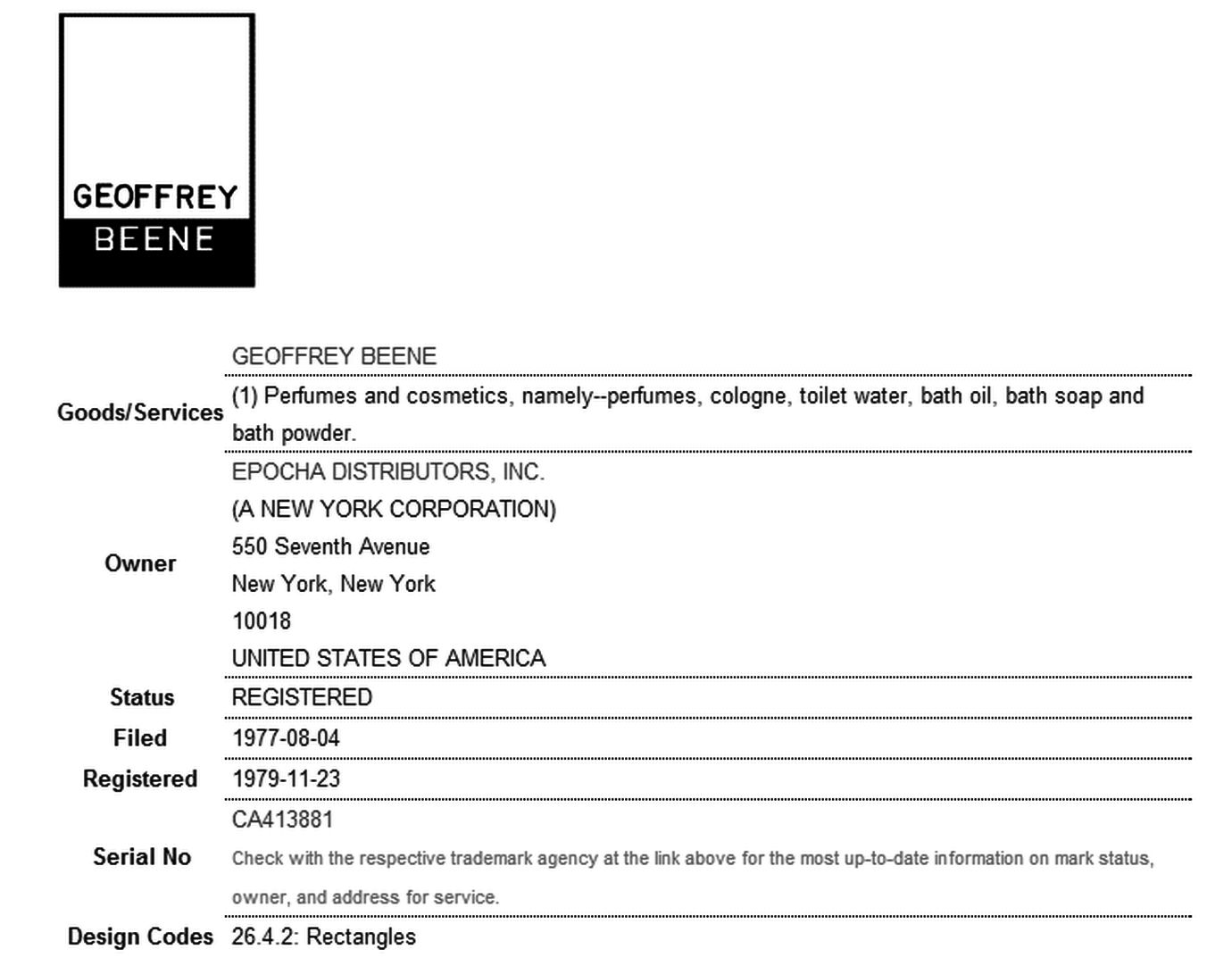
Geoffrey Beene's prestigious fashion brand was by this time a thirteen year success story, having garnered several awards and extended itself into the distribution of accessories and housewares. Licensing with a fragrance distributor was inevitable, and the first to file a trademark for Grey Flannel was Epocha Distributors, Inc., a company located on Seventh Avenue in New York City. Jeffrey Dame, former VP of marketing for Sanofi Beauty Products, revealed in a comment under this article that Epocha was Beene's own in-house design brand, so essentially Epocha is Geoffrey Beene. Epocha filing below, dated 1977:


This filing suggests that even though Grey Flannel was released in 1976, it was not widely marketed until the year after, when paperwork for distribution rights had entered the appropriate channels. It also corresponds with the resume of Denise DeBaun, current founder and president of DeBaun Development, Inc. According to Ms. DeBaun's employment history, she was Director of Brand Operations for Epocha Distributors from 1978 to 1980.


During this period, the Epocha sticker was placed on the bottom of all Grey Flannel bottles.


Bottle labels bore only the words "New York" under the fragrance name. Though not apparent in the picture below, the fragrance was also labeled with the word "Cologne" and not "Eau de Toilette" or "Eau de Toilette Spray Vaporasiteur."


Ms. DeBaun's updated resume, a snippet of which is shown below, might be a little more accurate about her starting date than the LinkedIn document, because it cites her employment record with Epocha as beginning in 1977, the same year that the company filed for trademark. Nevertheless, the LinkedIn resume above suggests that Epocha was taken over in 1980 by Jacqueline Cochran, Inc., resulting in the personnel shakeup that forced DeBaun out. She went on to work for Oscar de la Renta and Parfums Stern, Inc.


This raises the question, where did Jacqueline Cochran, Inc., come from exactly? While Ms. DeBaun's career was taking off in New York, a corporate reorganization was happening in New Jersey. American Cyanamid, owner of Shulton and Jacquelin Cochran Inc., allowed Cochran to take over Contemporary Fragrance Group, and with it the manufacturing and distribution rights to all fine fragrances by CFG under American Cyanamid. Amazingly, someone saved a newspaper page from the end of 1978, which documents the transition, and also notes that esteemed entrepreneur and art collector Carlo Bilotti, the president of Cochran, would continue to head Cochran's division as an enterprise separate from CFG.


This suggests that Jacqueline Cochran, Inc. was well positioned to begin manufacturing and distributing Grey Flannel when it purchased the Epocha license in 1980. Cochran's cosmetics enterprise had been operating since the 1930s, and had also been bought out by Shulton pretty early on. Cochran herself was a famous racing pilot with an entrepreneurial spirit, and her marriage to Atlas Corp. founder Floyd Odlum proved fruitful in moving units of makeup, lipstick, and perfume.

Jacqueline Cochran, Inc. owned and distributed Grey Flannel for most of the 1980s. This is important to note for vintage Grey Flannel enthusiasts, as most of the older bottles still in circulation are from the nineties. Bottles of fragrance, aftershave, and balms bearing the Epocha sticker date from 1977 to 1980. From 1981 onward, Epocha's sticker was replaced by Cochran's.


The next chapter in Grey Flannel's life is intriguing. By 1987 American Cyanamid had decided to sell Jacqueline Cochran, Inc., along with another subsidiary, La Prairie. According to an 1990 affidavit from the U.S. Second Circuit Court of Appeals, Cyanamid sold Cochran to Sanofi Inc., on March 30, 1987. The heading for what was presumably the last motion can be seen here:


The sale resulted in some legal issues for Sanofi. The affidavit contends that a man named Mario Ronzani wanted to buy La Prairie from Cyanamid, but was told that the corporation wanted to sell La Prairie and Jacqueline Cochran "in a single transaction." Ronzani was apparently disinterested in Cochran, and approached Sanofi to see if they would agree to a joint bid. Their communication, according to Ronzani, established that Sanofi was amenable to this idea because they were disinterested in La Prairie, but wanted Cochran and its holdings.

Ronzani claimed that Sanofi agreed to a joint bid, and thus entered into a bidding partnership with him. One party would get all the shares of one company, and the other party would get the shares of the other company. This is described in lines six and seven below (click on picture to enlarge):


Then Sanofi pulled the rug out from under Ronzani (see line eight below):


This appears to have angered Mr. Ronzani, and he filed the first of several complaints. The court struck down his main complaint, citing in legalese that Ronzani's agreement with Sanofi was invalid because he was not legally categorized as a legitimate "purchaser or seller of securities," as highlighted in lines eleven and twelve below:


Why am I bothering to tell you all of this? This legal wrangling over Sanofi's purchase may very well have delayed production of its newly-acquired product line. Note that on line twelve above, the cited court date of Ronzani's complaint dismissal is August 22, 1989, about two and a half years after Sanofi purchased American Cyanamid's holdings package. Because Sanofi bought a company and not just distribution rights, they did not have to file for trademark, and there is no record of Sanofi filing for Grey Flannel's trademark at that time. (There is a record of Sanofi owning the trademark, which can be found further on in this article.) Based on the affidavit, I think the earliest Sanofi could have begun producing and distributing Grey Flannel is 1988, assuming they ignored Ronzani's complaints and forged ahead with business as usual. It is possible that Cyanamid allowed production to continue during the transition, but I think that is unlikely, and doubt there are bottles of Grey Flannel from 1987.

From 1988 to 1995, all Grey Flannel bottles bore the sticker of Sanofi Beaute, Inc.

A Sanofi Grey Flannel gift set.


Sanofi's tenure as Grey Flannel's manufacturer and distributor ended in 1995. French Fragrances, Inc. bought from Sanofi Beaute the license to manufacture and distribute Grey Flannel in March of that year, and their first batches appeared in 1996. From 1996 to 2000, all Grey Flannel bottles bore the sticker of French Fragrances, Inc. By this time Grey Flannel bore both "New York" and "Paris" on its label. The word "Cologne" had also been replaced by "Eau de Toilette," although that change supposedly happened during the Sanofi years.


A French Fragrances bottle.

French Fragrances bought Elizabeth Arden from Unilever in 2000, and changed its company name to Elizabeth Arden, Inc. This is interesting because it basically means that EA Fragrances is the same company as French Fragrances. According to The New York Times, about 1,500 of Arden's employees were expected to transfer to French Fragrances, which suggests that a segment of Arden's Unilever people were laid off.

Of note also is the trademark filing by French Fragrances, which had already assumed the EA moniker. It seems that in July of 2004, EA cancelled its original Grey Flannel trademark, and also owned all of Grey Flannel's previous trademarks. Note that the French Fragrances trademark is not listed.


From 2000 to the present time, Grey Flannel bottles have held the EA Fragrances sticker, and their labels have gone from saying "Eau de Toilette" to "Eau de Toilette Spray Vaporisateur." They also still say "New York" and "Paris."


The label for the current formula of Grey Flannel.


Below is a basic timeline of each of the corporate distribution transitions that were made in Grey Flannel's 37 year history. Click on the image to enlarge:


And that brings us up to speed. How do any of these vintages of Grey Flannel smell? I'm only familiar with EA's version, but I have a bottle of Jacqueline Cochran's version coming in the mail, so I'll have an opportunity to compare it to the current stuff soon. Finding certain vintages of Grey Flannel becomes increasingly difficult the further back you go. It seems that the most readily available "vintage" version is French Fragrance's, before their acquisition of EA. You can sometimes spot a bottle by Sanofi on Ebay, but those are fewer and further between. There are usually no bottles of Jacqueline Cochran Grey Flannel on the internet, and you can forget about finding Epocha's vintage. I have yet to spot a bottle of the Epocha cologne, although rarely an auxiliary product, like the aftershave balm, will randomly appear (and very quickly disappear again).

There seems to be a widely-held notion that the Sanofi vintages of Grey Flannel are "eighties vintages," and while that may just barely be true (assuming Sanofi picked up production slipstream in 1987), Jacqueline Cochran's bottles definitely comprise the bulk of eighties vintage. I think the soonest Sanofi was able to get production underway would have been 1988, and given that the final legal motion by Ronzani took place in 1990, who knows for certain? Most of the Sanofi bottles are from the first half of the nineties, and all of the French Fragrances bottles are from the late nineties. EA Fragrance's tenure is already thirteen years old.

UPDATE

I received a comment from Jeffrey Dame of Hypoluxe, Inc., formerly of Sanofi Beauty Products, and he revealed some very interesting information regarding Grey Flannel. He was VP of marketing in the men's fragrance division of Sanofi, and he clarified some points about safety regs, and the various crossovers in batches and bottlings during each transition that Grey Flannel made. He also mentioned that Epocha was Beene's own in-house design brand (it's all in his comment below). I'm hoping I can persuade Jeffrey to participate in a brief interview, in which he can field some insider questions about his years at Caron, Sanofi, and the other top brands he has worked for. His stories and insights would be of immeasurable value to us all.