4/1/12

Angel EDP (Thierry Mugler)


Gourmands are, for lack of a better word, difficult. The "foody" exercise can be taken to such extremes that there are few companies capable of reining things in. It seems there is no limit to how obscenely a scent can mimic fruit, candy, sugar. Step into any Bath and Body Works, and you're immediately assaulted by the full range of gourmandom, with berries, caramels, vanillas, even whole pies (apple is especially popular) splashing you in the face with their cavity-inducing charms. I'm convinced that today's teenage girl would be lost without a wardrobe that makes her smell like a walking See's.

What started it all? I can't be bothered to find out. I do know that Thierry Mugler is largely to blame. Angel was one of the game-changing '90s perfumes that set all the dusty chypres and orientals aside to make room for sweetness, and lots of it. In 1991, just one year before Angel's release, the market was crowded with losing bids for the future of perfumery. Things like Lauder's Spellbound and Cardin's Choc weren't exactly inspiring, or inspired. Dior's Dune was popular, but oddball, its transcendence something only time could qualify. Instant breakthroughs were all but nonexistent.

Then came Mugler and Angel, his sugar bomb. Sweetness, quite suddenly, became all the vogue. I've smelled it on many people, but they've mostly been adult women well beyond their teenage years. I attribute this to the distinct tremor of patchouli that radiates from its saccharine core. In fact, for its first five minutes on skin, the patchouli pushes past the other fuzzier notes and makes its presence very well known. Eventually the sweet notes take over with honey, pink berry, vanilla, and white chocolate sweeping the earthiness aside, the olfactory equivalent of the dessert table in a Viennese hotel.

Mugler's fragrances are mostly unisex. There's nothing about them that pins them to one gender. The same can't be said about their fashion, however. Alien smells out of time and place with its egregiously synthetic bombast, while Womanity smells like something that would have been better left forgotten in some '70s porno. Angel managed to survive its zeitgeist and stay relevant in the 21st century, smelling just as new and wearable as it did twenty years ago. If that's not transcendence, I don't know what is.

3/25/12

Conundrum: Is Perfumery A Craft?


This week on basenotes there is a thread addressing the topic of whether or not perfumery is an art. It is a spirited debate that remained fair and genteel for the duration of my participation in it (I go by MOONB on basenotes). After two days of input, I have decided to step back and let other members hash it out. It seems to be a topic for which no minds can really be changed, and I have said all there is to say.

Let me distill some of the points in this thread down for you. One particular basenoter contended at length that perfumery is most certainly an art. He pointed to Hammam Bouquet - the original 1870s toilet water and the Penhaligon's scent - and likened its orientalism to a painting by Ingres called The Turkish Bath.

He wrote:
Isn't Penhaligon's Hammam Bouquet as powerful a statement olfactorily as Ingrès Turkish Bath is visually (=Hammam). Are they not enmeshed in the same cultural discourses and Victorian politics of sublimated desire? Isn't Jicky's masterful conceptual abstraction a breakthrough similar to the Nude Descending the Staircase?
Interesting questions. I tackled them both with the most concise answers I could provide:
I ask you: if Hammam Bouquet (the original 1870s scent that you refer to) is comparable to Ingres, then do you consider a fruit salad comparable to Cezanne's Still Life With Fruit Dish ??? And why would it be different from attempting to replicate the smell of Turkish bath oils? I can take the same fruits and concoct a dish that contains the same natural components that are represented in the Cezanne. And taste is related to scent, so I would think this comparison would seem apt to you(?) Jicky will always smell of its core components, but Nude Descending a Staircase will look differently to different people based on their orientation to the subject matter. And their perspectives will not necessarily be wrong, or right.

Conversely, if I told you I smelled oud in Jicky (even if I really do smell it), my interpretation is based on an error in my olfactory sense, and you would surely disagree if I told you there's oud in Jicky. If I told you the Nude is a woman - now you must consider why you do or do not disagree. There is a different access point for your perspective on the painting, versus your perspective on Jicky
It's an important conversation, contrary to what others on the interweb may think, because this question of whether perfumery is an art cuts to the core of what perfumery really is, and what its appropriate context and role in modern society should be. Definition is important here, to better understand that which we so love and write about.

So, considering the importance of definition in this debate, I'll include this exchange between myself and another basenoter (different from the above). He wrote:
Most say that film is an art, but we all know of an innumerable amount of examples that certainly don't feel like they should be called art (Gigli). It's definitely not a simple answer. I looked up the definition of perfumery, and quite a few use the word "art".
To which I replied:
Film making is a craft. Writing is a craft. Craft, like design, is different from (but similar to) fine art.
This prompted a response from the basenoter that I quoted first in this post:
Sorry, but you've utterly lost me. Film not an art? Drama? Poetry?
To which I said:
I think you're lost because you're having definition problems here. Movies are about writing. Writing is about crafting sentences. The difference is in what is acceptable - imagery and materials of traditional and non-traditional art can range far and wide (earth art, performance art), but writing has strict rules for coherence. There are radical styles in writing, as in art, but in the end there must be a subject, verb, noun, etc., to form a proper sentence. Then the sentences themselves must be arrayed appropriately to convey a limited degree of information. Big difference between this, and fine art.
Indeed, there certainly is a big difference between this, and fine art. My point attempts to illuminate what craft is. Craft is the adherence to strict guidelines, within which a personal expression is made, either for entertainment or functional purposes. Cabinet making is a craft. Writing is a craft. Film making is a craft. There are rules. There are specific guidelines. You are not allowed to stray too far out of any of them, lest you lose the impetus of craft making.

This applies very rigorously to film making. There is a misguided notion out there that any old sap can write a screen play, and turn it into a movie. I guess the viral spread of reality TV shows is to blame for this. The truth is that screenwriting is extremely standardized. There are very rigid rules as to how the words are allowed to go down on paper. Formatting is essential. Word choice is everything. Saying more with less is crucial.

One should ask, given an understanding of this, if the same standards apply to perfumery. Are the guidelines so rigid? Do famous perfumers have to adhere to these rules in order to create something that is legitimately perfume?

Simple answer (which is all I'll provide - I'm entertaining guests today): No. Not really.

Case in point: Molecule 01 by Escentric Molecules. The fragrance employs one note: ISO E-Super. There is no adherence to any structure, no conformity to any academic blueprint. The conventional idea of top notes, middle notes, base notes, goes out the window. 

If one were to suppose these conventions were the standard by which one could relate to perfume as a craft, then this fragrance, and indeed this entire fragrance line would disappoint. Furthermore, Molecule 01 provides insight into how far from craft perfumery truly is - by abandoning structure to a single aromachemical, Escentric Molecules proves that avant-gardism in perfumery involves providing less, not more. In other words, to think outside the box, one should just fold the box and not attempt olfactory experiments.

I rest my case.

3/22/12

Vintage (John Varvatos)


If you have a chance to visit Sephora and test fragrances, I suggest limiting yourself to three, for any more will likely fatigue your nose. Sephora deals in high-end designer scents (no niche) and designer scents tend to be rather funky, potent animals, longevity not withstanding. Naturally it's a good idea to go with a theme - try a few green scents, or a few leathers. Maybe a couple of tobacco frags. Stick to the theme so your nose gets attuned to one central note, be it fir, or grass, or vanilla, or musk. 

Diversity of similar experiences will illuminate compositional differences surrounding this one thing. In the end you'll find at least one thing you like, one thing you hate (or simply dislike), and one thing you're indifferent to. Try it, and see. It's human nature to matrix scatter-shot information into orientations, but only if one sticks to a theme. Trying a gourmand, then a leather, then a traditional fougere will only result in confusion, and a misguided sense of feeling indifferent, spoiled for choice.

The last time I went to Sephora I re-tried three scents that I've been pondering for a while now: Terre D'Hermes, Tom Ford for men, and Vintage. Of the three, I disliked Terre D'Hermes (review pending), liked Tom Ford, and was neutral on Vintage. Set against the bone dry ashtray of Terre D'Hermes, and the lemony violet leaf plushness of Tom Ford, Vintage was surprisingly "blah." The theme here was supposed to be tobacco, although I fudged it a bit with TdH, as there really isn't a tobacco note in there. There is an odd patchouli that resembles a dried, ready-to-crack tobacco leaf, however. Which couldn't be further from the potpourri-like pipe tobacco accord in John Varvatos' offering.

Vintage is surprisingly sweet, given its note pyramid, with the moist grapefruit and berry notes taking center stage in both the opening and the heart. Tobacco adds a temperate masculinity, and an hour after application a fir note accompanies the fruit and woods. It's a nice fragrance, albeit a little too sweet for me. The fruit notes mixed with green earthiness sends a strange vibe, like something pseudo-retro, the olfactory equivalent of an Arcade Fire song. Which is to say, derivative, unfocused, and unconvincing.

The whole thing would read better if it weren't so damn sweet. After two hours, I'm left with a fruity tobacco drydown, with fir and tonka pushing through the syrup. All well. I'm sure someone out there loves Vintage. That someone is simply not me.

3/21/12

Aramis (Estée Lauder)


As far as leathery chypres go, few compare to Aramis. It's one of the few leather frags that actually smells chapped to me. Its bitter citrus and powdery herbal components are expertly arranged around a hay-like coumarin. Yet I never really liked Aramis. This post attempts to explain why. (If you don't have time to read on, here's the summarization of everything below: I'm biased.)

Something about the way it opens is confrontational to me. The citrus barrage of the top notes is crisp and woody, but also blank, colorless, like a starched white shirt, and holds little intrigue beyond a desiccated offering of sage and vetiver. After a while a petrified accord of oakmoss and patchouli coalesces around a stony base of precious (petrified) wood, abstract gardenia, and more unhappy vetiver. Crisp, pungent, earthy, dry, sharp, masculine, and classic are descriptors that apply. There's no denying that it smells like something of the sixties, and its 1965 release date and conservative chypre structure suggest it is the Cabochard edit centerpiece of Chant's limited masculine oeuvre.

Unfortunately a personal association influences my feelings about Aramis. I went to high school with a guy who drove a rundown 1981 Cadillac Deville, chain-smoked Marlboros, and routinely drank Busch Lite on his father's boat, which was permanently parked in the driveway. He leered at girls, listened to grunge rap, and hawked a potent strain of weed to hopeless freshmen. He was a friend, but a bad friend, always trying to involve me in schemes that drew police attention. This walking bachelor party's signature scent was Aramis. Despite his debaucheries, he wore it with restraint. Not once did he emerge from a cologne haze like so many other Le Male-abusing morons. But for me Aramis suffers from guilt by association. It's not Aramis's fault. It's just how it is.

Memories are memories, and I can't help but remember my old buddy every time I sniff Aramis. Maybe I'm simply not man enough to wear it. But that shouldn't stop you from giving it a try. While you're at it, maybe try putting the boat in water, just once, and see if that does anything for it. 

3/17/12

Eau de Givenchy (Givenchy)


Spring is near. After what goes down as the mildest winter on record here in my neck of the woods, this fact meets with little fanfare. No one is expelling the sighs of relief one usually hears after a particularly brutal season. You know the kind - two solid months of nonstop snow, frigid rain, slush, icicles, 10°F days and -3°F nights. This week was 70°F two days in a row, and it's only the middle of March. Last week it was 50°F for a few days. Lately cold is anything under that. And snow? Haven't seen it since January. Well, there was that little snow squall toward the tail end of last month, when I think we may have seen a dusting here and there. But let's just say the winter of 2012 has been a godsend.

My issue is that this really takes the snap out of spring. We broke some temperature records here this week, yet nobody was marveling over the sun and heat. Usually you hear things like "can you believe this weather?" and "Shit, it's way too early for this," but instead there was only silence, broken by the occasional "nice day today." People aren't stunned by stunningly nice weather when it's been stunningly nice for weeks. But the problem isn't the presence of premature summer. The problem is the absence of coolness.

Coolness is what makes spring an interesting season to me. I tend to think of summer and winter as the "major" seasons; autumn and spring as "minor." They're transitional seasons, with markedly similar characteristics in stark contrast to their polar-opposite endpoints. October is about crisp, dry air. Spring is about cool, sometimes cold, humid air. Without the coolness, the rain, spring simply doesn't exist. If we go right from frigid winter to balmy Sundays, we've skipped a vital step in nature's ritual. With the truancy of spring's cold and wet, grey, bitter pallor, I'm a little disoriented. Even lost.

Fortunately there's a fragrance that captures the essence of fishing in the reeds on a foggy April morning. Eau de Givenchy is fresh, green, damp. It's coolness in a bottle. Released in 1980, ten years after the more classically-composed Givenchy III, but bearing some categorical similarities to its predecessor, EdG transports its wearer to the very soul of springtime without so much as lifting a dragonfly's wing. It conjures images of strong, dark, mythical femininity, average school girls whose inner beauty forces their skulls' plates to gradually realign into the countenances of ravishing women. 

Eau de Givenchy reminds me a bit of Jacomo's Silences in that it doesn't pander to common fruity floral trends, but rather rolls like cold water off mossy rocks and simply shimmers in a kaleidoscope of green, yellow, and white.


As a lover of green fragrances, I'm always excited when I find something that smells of dewey fields and unopened flowers. Eau de Givenchy comes pretty close to ticking off all of my "green" boxes. It opens with a brilliant and clean lemon, and swiftly transitions into an array of grassy notes and white florals, namely honeysuckle, muguet, and jasmine. Although strong hints of them abound, these florals never really take center stage, and as rapidly as they appear, are just as rapidly tinged with the same bitter green grassiness of the opening. Tuberose and oakmoss are present, but take a backseat to the greens. Eventually, as Eau de Givenchy settles, the contrast of green and floral finds a steady balance, leaving a very light, herbal skinscent in its wake.

I think this fragrance is almost perfect. I wish it were a little less floral, as those notes compromise the incredible greenness of the grass accords. It could also be a smidgen stronger in concentration, but we're talking an eau de cologne-style perfume here. Although marketed to women, I consider this to be utterly wearable as a man, and see some similarities to the equally scintillating Chevrefeuille Original by Creed. It certainly smells just as expensive, and it's just right for those April and May commutes. Wear it, and know the smell of winter's ghost.

3/13/12

Himalaya (Creed)

Creed's masculine Millésime range can be broken down into three tiers: the classics, the modern Millésimes, and the wet-shaver Millésimes. Some contend there's no stacking order, but I tend to think that the classics should be considered first; the wet-shavers ought to come last. The classics include Green Irish Tweed, Neroli Sauvage, Royal Delight, and Millésime Imperial. The wet-shaver Millésimes include Bois du Portugal and Tabarome Millésime. Tucked neatly between these categories are the modern Millésimes - Silver Mountain Water, Royal Water, Green Valley, Original Vetiver, Original Santal, EROLFA, Aventus, Virgin Island Water, Royal Oud, and last but not least, Himalaya.

Having tried almost everything in the modern range, I can say that they have impressed me and disappointed me in equal measure. Himalaya, however, was one of the impressive modern Millésimes, and I am not someone disposed to liking it. "Fresh" orientals aren't my bag. You can keep your 212 Sexy Men and Armani Attitude. If I want to go all brisk and spicy, I'll stick to the classics. The ever-available Joop! Homme will never let me down, nor will Obsession for Men. But Himalaya finds its place among respectable orientals, and holds its own with powerhouse chypres, items like Quorum and Yatagan. In fact, deep down in its icy heart, Himalaya is a 1980s monster man-frag.

Its opening is an explosion of pink pepper - actually verging on overdose for me, although not quite. Pink pepper is a good note, poo-pooed by plenty of snobby perfumistas as being the "note of the day" in men's frags (although not so much anymore), but still worthy of its overuse, particularly when one considers how frequently lavender and bergamot get overkilled in millions of fougères. Creed's use of this infamous ingredient is very naturalistic, and for the first five minutes Himalaya's wearer is surrounded in a hi-fidelity haze of fruity spice.

From the pepper, Himalaya transitions into a dry, grey, gunpowdery accord that I read as a mini fragrance-within-a-fragrance. Here's where this gets interesting. The greener and more natural elements seem to mimic the scent profile of Quorum by Puig - that's right, I said Quorum by Puig - and the richness of pine, olibanum, cyclamen, and perhaps a ghost of tobacco create the famous "gunpowder note" at Himalaya's core. If you just sniff casually, it smells a lot like gunpowder, or even just frozen rocks. But if you really delve into it, this accord reveals its many components. Eventually rich sandalwood, cedarwood, and ambergris notes develop into a fresh and warm base that lingers for a couple hours before fading away.

I'm not really sure why, but I almost think Himalaya smells rather old-mannish once the pink pepper burns off. However, its intense gunpowder note is pronounced enough that it saves the composition from seeming too staid and "gentlemanly." Had they been balanced differently, this scent's mixture of piney tobacco and traditional woods could have come across as a bit stodgy.

There's nothing stodgy about the packaging, though. Let me say this using exact language: Himalaya's packaging (just the box) is really fugly. So fugly it should get village fair blue ribbons for its fugliness. Creed claims the all-silver motif was designed by Erwin, on what was apparently daughter Olivia's day off. She should have taken a working vacation and overseen her brother's little art project. Himalaya's disgusting silver bottle and RoboCop tin foil box gives the appearance of containing leftover lobster from my dinner at Mendy's, not a high end perfume.

In a nutshell, Himalaya is Green Irish Tweed with the green swapped out for gunpowder grey. Truly underrated, easily versatile, good for any season, and inoffensive to a fault. Worth a try, especially if you like pink pepper.

3/11/12

Sung (Alfred Sung)


My history with the house of Sung is an odd one. The famous wedding dress designer has had some success in the fragrance world, particularly with Sung, his first release. His second offering, Sung Homme, was also met with open arms by the buying public, and both fragrances continue to sell today. I tried Sung Homme first, several years ago, and hated it. Then I tried the feminine Sung, and somewhat liked it. Eventually I re-tried Sung Homme, and loved it. Then I re-tried Sung, and hated it. I could get into this, but I fear it would reveal just how insane I am, and so will instead get on with the review.

Let me be brutally honest here: Sung has been reformulated, and the reformulation is a disaster. I do not, unfortunately, know how the original Sung smelled, as it was never a blockbuster fragrance, and I have never met anyone who was openly a fan. But I can say with total certainty that what passes as Sung today should not pass as anyone's signature fragrance, for the simple fact that is smells like a prostitute's cleavage. You know how people will sometimes refer to inexpensive floral perfumes as being "screechy?" Well, this sums up Sung in a word: it is the ultimate screechy floral.

It opens with the false promise of a nice hyacinth and jasmine accord, which rapidly devolves into a mush of chemical sweetness, with shrill flecks of synthetic green occasionally flitting out from a cloud of yellow. There is absolutely no note separation, no evolution beyond the opening phase, and no character to the sent whatsoever. It just smells thick. And sweet. And bad. I'm sorry, any bride who wears this on her wedding day is just begging for divorce. Enough said.

White Patchouli (Tom Ford)


I tried White Patchouli with modest expectation of neither loving or hating it. This scent receives some tepid reviews, even from one of the best blogs on this subject. I have yet to review it here, but I'll prelude my thoughts on Black Orchid by stating that it did little to set the bar, and so White Patchouli was met with a level of stoicism usually reserved for things by Coty. It's a good thing I'm open-minded. People who know me personally know that I love movies; I have often stated publicly that I'll watch any film from any genre without discrimination. The same holds true for my approach to fragrance. With the exception of a few extremely cedar-intensive scents, I'll give anything a generous dab. To me, open-mindedness is the key to making interesting discoveries in this field. Without it, one is limited to, well, . . . their limitations.

As an ardent Creed fan, I approach other semi-designer/semi-niche brands with trepidation, mainly because the current trend is for masculine scents to be overbearing, either in sweetness, or in spice. I have yet to try Creed's Royal Oud, but from what I've read it doesn't look like it will be my favorite Creed. Seems they went a little heavy with the spices and woods in that one. Without referencing it too directly, I'll add that my test of Black Orchid was akin to being knocked over the head by a Zulu knobkerrie. If things get any headier out there, the world will start resembling the goth-punk fictional metropolis of Ridley Scott's Blade Runner.

Fortunately, White Patchouli is a delight from beginning to end. It isn't heavy-handed in its treatment of woods, flowers, and spices. The patchouli is incredibly elegant, and rendered in a uniquely modern style. It has a two-tiered evolution: an opening of rich orange, amber resins, and spices, all flanking an opulently smooth and bitter patchouli, followed by a drydown of white flowers and musks, which halo a very sheer patchouli. The star note is dense and chewy in the beginning, and loses opacity with each passing hour, until it is little more than a suggestion of head shop. Yet the yin-yang of density and airiness exhibited in White Patchouli's movements is incredibly satisfying.

I particularly like how the dirtiness of patchouli is seamlessly melded with earthy spices and pungent orange notes, which elevate all sixties-hippie associations into a more spiritual, oriental realm. The notes bond thanks to the usage of raw incense, a briskly mysterious element that adds dimension and clove-like mentholation to an otherwise fuliginous composition. The incense bridges the gap between this dark opening, and its lighter resolution. Gradually notes of rose, peony, and jasmine emerge from behind the veil, opening White Patchouli's heart and base with a fluffy cloud of whiteness. The flowers are cool and semi-sweet, and never become overbearing or indolic. As the grittiness recedes, the patchouli lightens, and a classy skin-scent remains.

Laudable is Tom Ford's use of restraint here. It was a good idea to keep White Patchouli firmly in its unisex realm, and smart to keep things clean and modern. As such, this Ford scent actually feels very much like a Creed. Its notes are clear, easily decipherable, and never devolve into a nondescript muskiness. It seems some lament the use of musks in White Patchouli, and think they overtake the composition - I disagree. I sense a very sanguine white musk accord upholding the flowers and patchouli in the later drydown stage, but feel that it only adds a bright cleanness to the proceedings, and never goes full throttle. I appreciate realistically-rendered white flowers (as much as I hate badly rendered white flowers), and here the delicate greenness of the floral notes just begs for touches of silky animalism to uphold their elegance. White Patchouli is indeed made of obviously high quality ingredients, and is entirely worth the price of admission.

3/8/12

Fan di Fendi (Fendi)


When Fendi discontinued its eponymous fragrance for women several years ago, the news was met with despair by my family. Nicknamed Fendi "Donna" by its fans, the scent was my mother's signature from the year it was released until the last day of its production. My father loved it on her, and always replenished her stock, which included body washes and lotions. I loved it, too - the rich leathery chypre essence of Fendi embedded itself in her clothing, her bags, the very air around her. Perhaps it's the Italian in me, but I found it intoxicating, even when I was just nine and ten years of age. Nothing about it was "girly" or sweet. It simply smelled classical, adult, comforting, like the holy water of some Eighteenth Century philosopher's mistress. Fendi was enlightened sin, neatly captured in a bottle.

Fendi discontinued all its older scents, and only recently returned to the scene with the trumpeted release of Fan di Fendi, a new fruity-floral for the ladies of the Twenty-First Century. I must admit to being only partially enthused about this; my sense from the press and the packaging was that Fan would be a mainstream release, with nothing avant-garde in its profile, no lingering emotional impact to be had.

Sniffing it today, I'm reminded of all the pajama-wearing twenty-somethings in Uggs who pad around the grocery store with zippered hoodies that say PINK in gaudy silver lettering, smartphones in hand, sarcastic eye-rolls ever ready for whoever should glance their way a bit too long - or longingly. You know the types, those young American women who think their gender alone exempts them from actually having to wear regular clothing when venturing out in public on a Saturday. They're of my generation, they're proud of their PINK sweats and pajama bottoms and ugly-as-fuck Uggs, and they're accessorizing their hangovers more than their neon-pink vinyl clutch purses.

These lady-children come to mind because Fan di Fendi smells like the total opposite of something such women would wear. Actually, it's something they could never wear. It is light years away from the brown sugar blather of Bath and Body Works. And thank the good lord for that. Fan rides the air on a crest of lean animal sexuality, smoldering beneath a refined and well-poised femininity that only an Italian goddess could possess. The sweetness of its opening is sharpened into a blade of citrus, dripping with the juices of tangerine and blood orange. It's a distinctly Italianate feeling to smell such dense and sugary citrus fruits, and here they're rendered in a very plush way, but the sweetness brings their brilliance into a super sharp focus. Simply mesmerizing.

Gradually the fruits mellow into an indolic white floral arrangement, a blend of tuberose and jasmine that is so heady and dense that it somewhat resembles mimosa. Whiteness pervades the heart, filling every aspect of Fan di Fendi's evolution with a richness not often found in designer releases. Fruity sweetness remains entrenched in the proceedings, but after an hour it plays nice against the naughty of the flowers. As things dry down, the base yields a lovingly-crafted suede, with hints of animalic musk supporting the leather. The woman who wears this wears stilettos, when she wears anything at all. Her clothing is hand tailored, her phone never makes an appearance outside of the ladies' room, and she doesn't get a hangover because her drinks regularly average about 38,00 € per glass. When your vino is that expensive, even the alcohol has manners.

Fan di Fendi is arousing juice. Its sophistication is in its grandiloquent modernity, the flourishes of the familiar juxtaposed with the exotic, but its sensuousness rests with its reliance on feminine notes to convey a distinctly classical perfume. Maturity and sexuality are blended very well in this one, and any woman in her twenties, thirties, or forties could pull it off beautifully. She just has to dress - or undress - for the part.

Needless to say, I won't be recommending Fan di Fendi to dear mom. She seems very happy with K de Krizia, which has essentially replaced her lost signature. I'm saving Fendi's latest for a future girlfriend. I'm not sure who she'll be, but I do know that she's never touched a pair of Uggs in her life.

3/6/12

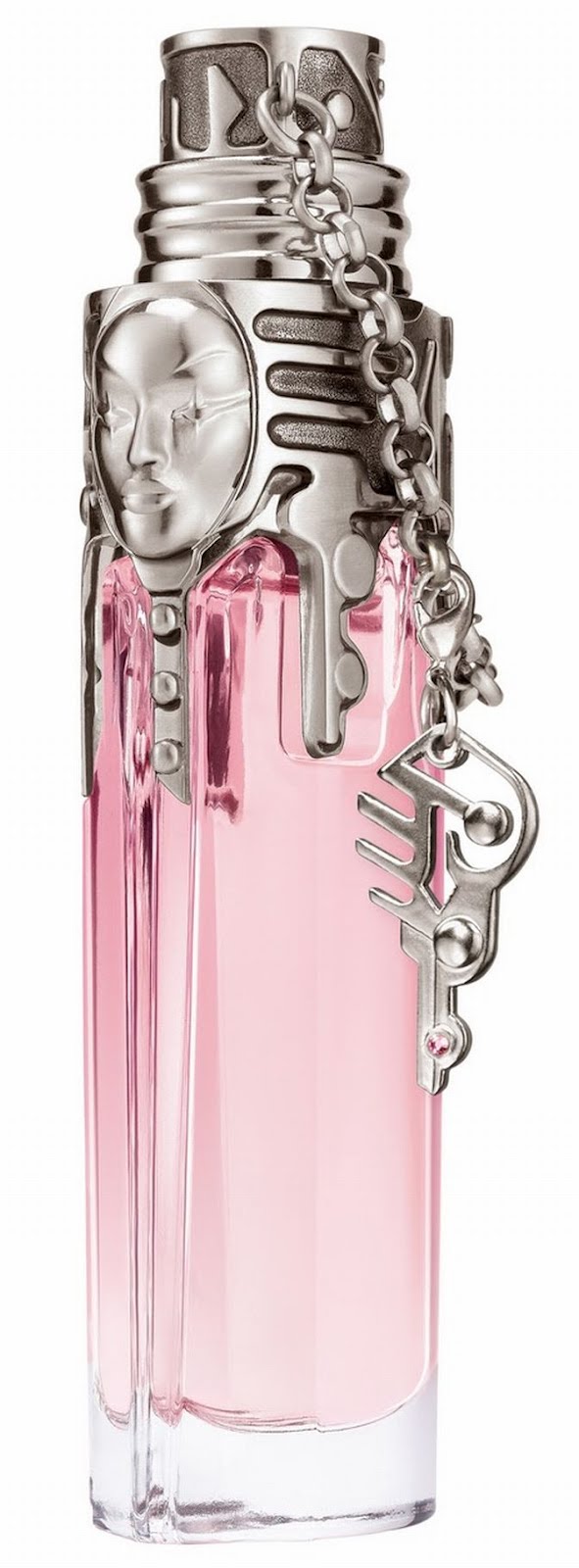
Womanity (Thierry Mugler)


Womanity, like Azzaro Chrome and One Man Show, is one of those weird conceptual fragrances that throws tact to the wind. If it were a classically composed fragrance with little or no concept behind it, I would dismiss Womanity as another fruity scent for young women and leave it at that. After all, it is called Womanity. What the hell am I supposed to do with a pink perfume in a godawful bottle with the godawful name Womanity? And how many times can I write the fake word Womanity in this review? (So far five.)

Womanity, as it turns out, isn't just another fruity scent. It opens with a spiced fig accord, very sweet, and grows saltier as it dries. The salty notes are dense and lend the fragrance an aquatic dimension that feels a bit unbalanced and out of place in the earlier stages of the drydown. As time passes, Mugler's concept becomes abundantly clear, and is a bit of a shock - this perfume is meant to resemble the musk of female genitalia. The fig creates a clean, showered, and soaped backdrop for the familiar salty, sometimes slightly fishy scent of a healthy woman. The milky sweetness of the base has a sweaty effect, with everything winding up very funky, salty, and soapy-musky in the end.

I must admit, this scent makes me a little uncomfortable. It smells unisex to me, but the effort put into executing this particular concept results in a very strange and erotic fragrance - for a man. And frankly, I don't see how it would register as usable beyond the short social tether of rave club and bedroom use. Any guy who wears it to work has a dirty and somewhat twisted perspective on things, if I may say so myself. It's definitely not a date scent, either. If you really know what you're smelling here, and you've smelled it enough, it's like contemplating hardcore pornography as a desktop wallpaper in the office - an obvious pass. And for the ladies . . . well, words elude me. I have no clue why a woman would want to smell literally like her, um, womanity parts.

Use Womanity at your own risk. I guess it works and smells pretty good, but it definitely stretches the boundaries of good taste. And the bottle is, beyond a doubt, the most hideous thing I've ever seen.

3/4/12

Clubman Special Reserve Aftershave-Cologne (Pinaud)


Chiaroscuro is an interesting artistic term referring to the study of contrast between light and dark, a practice that originated from a Renaissance style of drawing on colored paper which built lighter tones up from the base color. Paintings in chiaroscuro often have a burnt look to them, with a preponderance of umber and charcoal grey. Subject matter usually involves people, sometimes posed in scenes, or for a portrait. At the time of its popularity, it was a means for conveying a minimally-colored scene with maximal dramatic effect. 

Perception of space is achieved by contrast alone, with human physicality and the nuances of facial expression reliant upon the darkest darks and the lightest lights. Today, images in chiaroscuro are associated with antiquity, a time when oil paint glistened on crusty palettes and candlelight illuminated nocturnal events. It's the incarnation of history's illustration. There is nothing modern about it.

Years ago I often wondered what the olfactory equivalent of chiaroscuro could be, given the difficulty in rendering scent using equivalencies of light and dark contrasts. I wondered if it was even possible to develop a smell that could come close to this sort of visual dynamic. The problem with the parallel? Scent is not about color, but density. 

We consider smells based on their sheerness, or their opacity, with heavier scents eliciting considerations of complexity (the high number of interacting elements), and lighter scents raising questions about minimalism and reductionism (the low number of interacting elements). Grey Flannel invites its wearer to consider a complex blending of citruses, spices, mosses, and woods, with multitudinous elements weaving a broad tapestry. Arden's Green Tea is about airy citrus and cassis notes playing off a basic white musk frame, with only two components obvious to the nose. In either scent, associations of "dark" or "light" are limited to one, or the other. Neither of them involve the interplay of both, as this is impossible - a fragrance can not be light and heavy at the same time, and so considerations of hue are handicapped.

Despite this problem, my initial experience with Clubman Special Reserve made me think twice about it all. I remember receiving it in the mail, opening the box, unscrewing the cap, and taking a first sniff from the bottle. My nose wrinkled, my eyes screwed up, my tongue pressed itself into the back of my throat, and I immediately thought "wow, this stuff smells awfully thin and sweet." It seemed at odds with its bottle's rustic color scheme, and its proud name. Feeling doubtful about this reserve's "specialness," I dabbed some on my wrist, gave it a minute, and inhaled deeply.

What a surprise! The patchouli, which seemed comically unbalanced from the plastic spout, became smooth and refined on skin, blending beautifully with oakmoss, treemoss, lavender, rose, cinnamon, and leather. The result was a drydown akin to the smell of a freshly-oiled baseball glove, a crisp, dry leather with just a hint of sweetness. Of course, this smell in itself is very deep, dark, with very little contrast in an unusually congruent leather cologne. I personally don't believe in the concept of "leather" fragrances because I've found that many things labeled as "leather" scents are really just dark, woodsy, herbal compositions with little in the way of sweetness or luminosity - scents like Polo or Quorum. I can count on one hand, using one finger, the number of scents that have ever actually smelled like cured animal hide, and its name is Clubman Special Reserve. Truly, this cologne smells like chapped leather.

Special Reserve spurs imaginings of dark, smoky 17th century bordellos, with mustachioed men in feathered hats sloshing their steins of ale across the bare chests of mustachioed women in filthy apron corsets. At the same time, it generates an image of a teenage boy's baseball mitt, all spit-stained and creased at the thumb, ready for a neighborhood game. Could this disparity in associations be attributed to a form of olfactory chiaroscuro? 

One seems rather dark; the other is devoid of shadow altogether. But no, the true expression in Special Reserve is one of conceptual perfumery, a successful endeavor to emulate the simple smell of treated leather. The bordello and baseball glove associations are merely projections on my part, and in no way reflect what is actually going on in the scent itself, but rather what my experiences with this type of scent have been, either in theory or in practice. There's nothing unique about this; similar associations can be made sniffing a tray of freshly baked sugar cookies.

The blatant literalism of Special Reserve's leather is what makes it a no-go for me - I much prefer the more classical composition of the original Clubman aftershave-lotion to Special Reserve's one-note structure. However, I can understand and appreciate the concept behind it, and wholly endorse it as a worthy addition to the Pinaud gentleman's lineup. Anyone who likens Special Reserve to the original is looking for something that isn't there, as the two are very different scents. If you're a lover of riding tack leathers, you may find much to love in this scent's directness. 

If you're like me, someone who needs more nuance and abstraction, you'll find Special Reserve a bit dull, and probably not something you reach for very often. I ended up getting rid of my bottle, as I never wore it, and was hard-pressed to find an appropriate occasion for it. Still, like it or not, it's definitely worth more than the $9 price for a 6 ounce bottle.